
Why does a lender look at a business with a $500,000 price tag and see only half that value in “bankable” security? It’s a common frustration for Australian business owners who find their hard-earned reputation met with a heavy “haircut” from conservative bank valuers. You’ve built a brand with loyal customers and a strong team, yet when you ask how is goodwill calculated for a business loan, the answer often feels like a moving target that threatens to kill your acquisition plans. We understand the anxiety of these high-stakes decisions and the feeling that a deal might slip away due to rigid lending criteria.
We’re here to help you bridge that gap. This guide provides the exact formulas and “bank-lens” metrics used by Australian lenders in 2026 to value goodwill. You’ll learn how to normalise EBITDA effectively, understand the critical difference between Net Tangible Assets and goodwill, and develop a bank-ready strategy to maximise your borrowing power. Our goal is to move you from a state of uncertainty toward a feeling of streamlined confidence, ensuring you have the inside access needed to secure the funding your business deserves.
Key Takeaways
- Understand the vital distinction between accounting goodwill and the more conservative “lender haircut” that banks apply to protect their security.
- Discover how is goodwill calculated for a business loan using the latest 2026 triangulation methods that combine earnings multiples with data-led performance metrics.
- Identify “Valuation Killers” such as Key Person Risk that can slash your business’s perceived value and learn how to mitigate them before your application.
- Prepare a bank-ready dossier that leverages Open Banking and real-time financial monitoring to provide the transparency modern Australian lenders demand.
- Leverage proprietary AI technology and expert corporate advisory to pre-assess your goodwill and bridge the gap between market value and bankable funding.
Table of Contents
- Accounting Goodwill vs Lending Goodwill: The Australian Reality
- The 3 Primary Methods for Calculating Goodwill in 2026
- Factors That Inflate or Deflate Your Goodwill Value
- Documentation Checklist for a Successful Valuation
- How Broker.com.au Optimises Your Business Loan Valuation
Accounting Goodwill vs Lending Goodwill: The Australian Reality
In the Australian market, there is a sharp divide between what an accountant puts on a balance sheet and what a bank credit officer will actually fund. When you explore how is goodwill calculated for a business loan, you quickly realise that lenders don’t view your brand’s “vibe” with the same optimism you do. They distinguish between market price and bankable security, often leading to a significant funding gap that catches many buyers off guard.
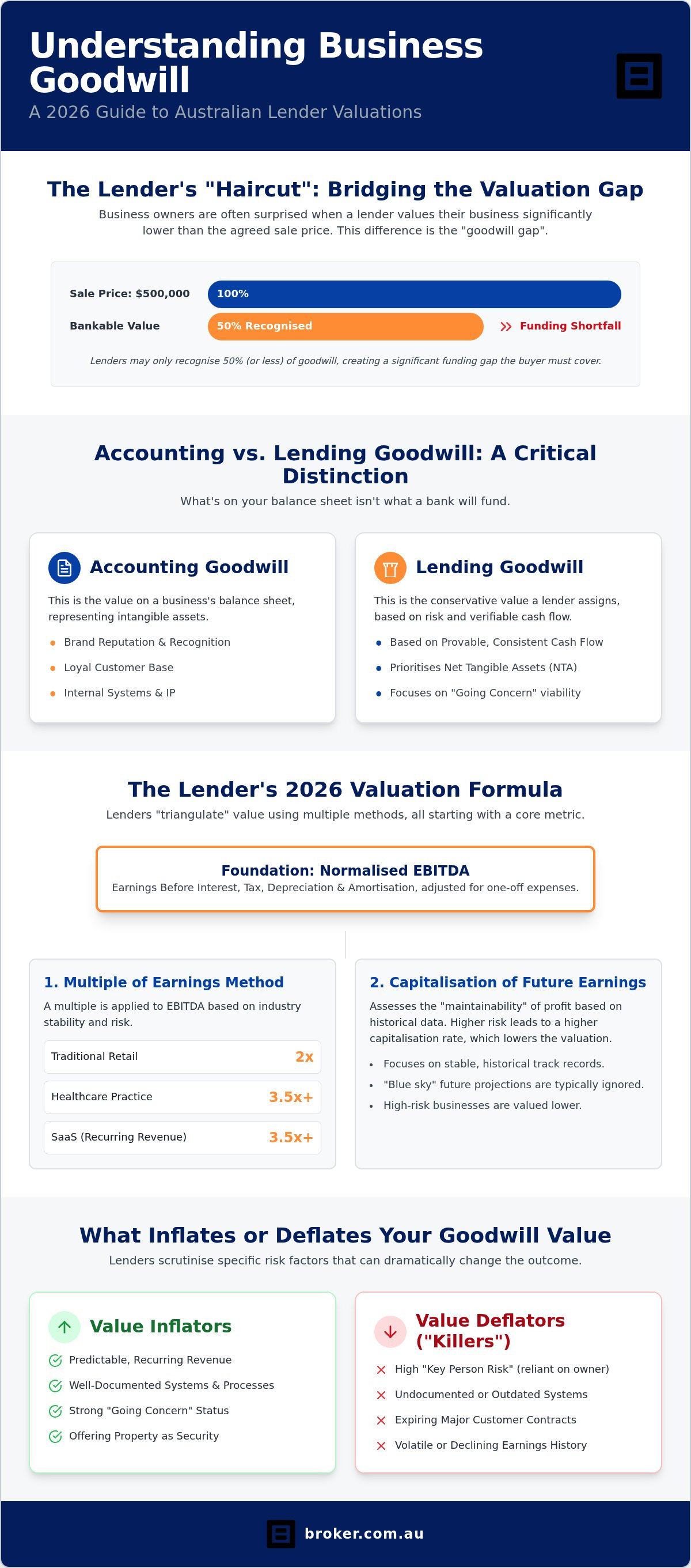
At its core, Goodwill (accounting) represents the intangible value of a business, including its reputation, customer loyalty, and internal systems. While these elements drive profit, they’re notoriously difficult to liquidate in a crisis. This is why Australian banks prioritise Net Tangible Assets (NTA), such as equipment, stock, and vehicles, as the baseline for any loan. If your NTA is low, the lender applies a “haircut” to the goodwill, sometimes recognising only 50% or less of the price you’ve agreed to pay. This creates a stressful emotional gap between a buyer’s vision and a lender’s cold risk assessment.
The “Going Concern” Framework
Lenders will only recognise goodwill if they’re confident the business is a “going concern.” This means your historical profitability must prove that the intangible assets actually generate consistent cash flow that will survive a change in ownership. A going concern is a business that has the resources to continue operating indefinitely. If the business relies on a single contract that’s about to expire, or if the systems aren’t documented, that “going concern” status is at risk, and your goodwill valuation will likely plummet.
Why Banks Are Conservative with Intangibles
The primary fear for a bank is that goodwill can evaporate overnight. If a business relies too heavily on the outgoing owner, known as “Key Person Risk,” the value isn’t truly transferable to you. In the volatile economic climate of 2026, Australian lenders have tightened their grip on intangible-heavy loans. They’re looking for businesses where the value is baked into the systems, not just the people. Interestingly, offering property security can often soften these rigid calculations. When a loan is backed by Australian real estate, lenders are often more flexible regarding how is goodwill calculated for a business loan because the physical asset provides a safety net that a brand name simply cannot match.
The 3 Primary Methods for Calculating Goodwill in 2026
When asking how is goodwill calculated for a business loan, you’ll find that Australian lenders rarely rely on a single figure. Instead, they “triangulate” value by using multiple methods to minimise their risk. In the 2026 market, this process has become increasingly data-led. Lenders now integrate real-time financial feeds to verify that the numbers on a spreadsheet match the reality of the bank account. Central to all these methods is the concept of “normalised earnings,” which adjusts profit to remove one-off expenses and owner-related perks, providing a clearer picture of the business’s true earning capacity.
The Multiple of Earnings Method (EBITDA)
EBITDA, or Earnings Before Interest, Taxes, Depreciation, and Amortisation, remains the foundation for most business valuations in Australia. Lenders apply a “multiple” to this figure based on industry risk and stability. For example, a traditional retail shop might only attract a 2x multiple, whereas a healthcare practice or a SaaS company with high recurring revenue could see multiples of 3.5x or higher. If you’re unsure which multiple applies to your industry, you can discover more about tailored finance solutions that match your specific acquisition profile. Lenders favour businesses where revenue is predictable and contractually backed, as this reduces the chance of the goodwill value vanishing after the sale.
The Capitalisation of Future Earnings
This method focuses on the “maintainability” of your profit. Lenders assess historical data to predict how much cash the business will likely generate in the coming years. They apply a capitalisation rate, which is essentially the inverse of a multiple, to account for perceived risks. While you might be excited about “blue sky” projections and future growth, credit departments almost always ignore these. They want to see a stable track record. If the business risk is high, the capitalisation rate increases, which effectively lowers the bank’s valuation of your goodwill.
The Residual Method (Purchase Price minus NTA)
The residual method is often the starting point for Australian acquisition funding. It uses a simple formula: the total purchase price minus the Net Tangible Assets (NTA). NTA includes physical items like equipment, stock, and property, minus any liabilities. Lenders prefer this because it clearly identifies the “intangible” portion of the loan. To maximise your borrowing power, it’s vital to identify “hidden” tangible assets, such as specialised fit-outs or proprietary hardware, that can be moved from the goodwill column into the asset column. This reduces the lender’s perceived risk and can lead to more favourable loan terms.
Factors That Inflate or Deflate Your Goodwill Value
Lenders don’t just look at the final number on a valuation report. They look at what happens to that number the day after you take over the keys. When considering how is goodwill calculated for a business loan, Australian banks apply a specific risk weight to your operations. If your revenue is tied to a single, fragile thread, they’ll deflate your valuation significantly. They’re looking for stability, not just potential.
Customer concentration is a prime example of a “valuation killer.” If a single client accounts for more than 20% of your total turnover, lenders see a red flag. They worry that if that one client leaves, your ability to service the loan vanishes. To secure the best terms, you need to show a diversified client base and robust “moats” around your revenue. High customer churn is another factor that will cause a lender to slash your goodwill estimate, as it suggests the brand loyalty isn’t as strong as the balance sheet claims.
The Owner-Dependency Trap
The biggest risk in the Australian SME sector is the founder who does everything. Banks call this Key Person Risk. If the business cannot function without the current owner’s personal relationships or specific technical skills, the goodwill isn’t truly transferable. It’s essentially worthless to a lender. They want to know the business is a system, not a personality.
To fix this, you must prove continuity of management. Show the bank that key staff members have signed long-term employment contracts and are staying on after the sale. Provide documented Standard Operating Procedures (SOPs) that allow a new owner to step in without a drop in quality. When systems are automated and roles are clearly defined, the bank feels much more comfortable funding the intangible value. It moves the risk from “unpredictable human” to “predictable process.”
Market Position and Brand Equity
In 2026, your brand’s digital footprint is a core part of its value. Lenders now look at SEO rankings, social proof, and customer retention rates to quantify brand equity. A business with a high market share and a loyal, recurring customer base attracts a much higher multiple than one that relies on expensive, one-off advertising. This digital “social proof” acts as a modern form of security.
Exclusive supplier contracts also play a massive role in stability. If you hold the sole rights to distribute a popular product in Australia, you’ve created a barrier to entry that lenders love. This stability directly impacts how is goodwill calculated for a business loan by reducing the perceived risk of future earnings evaporating under new management. By focusing on these defensible assets, you move from being a risky prospect to a bankable investment.
Documentation Checklist for a Successful Valuation
Securing a loan against intangible value requires more than just a good story; it requires a bulletproof dossier of evidence. In the 2026 Australian lending market, the “how is goodwill calculated for a business loan” question is answered through digital transparency. Banks have moved away from static, once-a-year reviews. They now utilise Open Banking protocols to monitor real-time financial health, meaning your documentation must be precise, current, and verifiable at the click of a button.
The goal is to provide a “Bank-Ready” package that leaves no room for conservative guesswork. When a credit officer sees gaps in your data, they fill those gaps with risk margins. By providing a complete picture of both your financial performance and your legal protections, you reduce the perceived risk and help the lender justify a higher valuation for your goodwill. If you are ready to present your business in the best possible light, you can get started with a bank-ready valuation through our specialist team.
Financials and Tax Compliance
Lenders typically require three full years of Profit and Loss statements and Balance Sheets to establish a trend of maintainable earnings. This history proves that your profit isn’t a “one-hit wonder” but a consistent result of your business systems. You will also need up-to-date Business Activity Statements (BAS) and access to your ATO Integrated Client Account portals to prove tax compliance. A critical part of this financial pack is the “add-back” schedule. Add-backs are discretionary expenses that a new owner would not necessarily incur, thereby increasing the real profit. Common examples include one-off legal fees, personal vehicle expenses, or non-market salaries paid to family members. Properly identifying these can significantly inflate the bankable earnings used in your goodwill calculation.
Operational and Legal Proof
Your legal documents provide the “moat” that protects your goodwill. Without a secure lease or protected brand, your intangible value is at risk. Lenders look for fully executed lease agreements that include “options to renew,” ensuring the business can remain in its location long enough to repay the debt. Stability is also proven through employment contracts for key staff, which mitigate the risk of talent walking out after the sale. Finally, ensure all Intellectual Property, such as trademarks or patents, is formally registered through IP Australia. These registrations transform “brand vibe” into a recognised legal asset, making it much easier for a lender to see how is goodwill calculated for a business loan when the value is backed by law.
How Broker.com.au Optimises Your Business Loan Valuation
Applying directly to a bank for a business loan is often a “one-shot” game. If their internal valuer returns a conservative figure, you’re usually stuck with a non-negotiable result that can quickly derail an acquisition. We act as the vital bridge between your business vision and the bank’s rigid lending criteria. By understanding exactly how is goodwill calculated for a business loan across a diverse panel of over 80 lenders, we ensure your application is directed to the specific institution most likely to recognise your intangible value.
Our role is to function as your high-level fixer, navigating the “bank lens” to present your business in the best possible light. We don’t just pass on your papers; we provide corporate advisory to help structure complex acquisitions. This includes highlighting the strength of your systems and the sustainability of your normalised earnings, moving the lender’s focus from perceived risk to proven predictability. This professional intervention often makes the difference between a rejected application and a successful funding round.
The AI Advantage in 2026
Our proprietary AI technology provides an exclusive advantage that the average consumer cannot obtain on their own. In the 2026 market, we use this tech to pre-assess your goodwill against real-time industry data and risk profiles before any bank sees your file. This proactive approach allows us to predict valuation outcomes with high accuracy, helping you avoid “valuation shopping” blackmarks that can damage your credit history. Whether you are seeking Business Acquisition Funding or looking to refinance existing debt, our AI identifies the path of least resistance to secure your capital.
Stress-Free Funding from Expert Guides
We believe the path to business growth should be efficient and professional, not filled with anxiety. Our “I’m interested” approach starts a low-pressure conversation about your specific goals and financial needs. We offer tailored finance solutions for both secured and unsecured needs, ensuring you’re always in good hands with a seasoned partner who understands the Australian landscape. If you’re ready to move from uncertainty toward a feeling of streamlined confidence, get a professional assessment of your business value today and let our expert guides unlock the doors to the best possible rates.
Securing Your Funding with a Bank-Ready Valuation
Navigating the gap between market price and bankable security doesn’t have to be a source of anxiety. By focusing on normalised earnings and documenting your internal systems, you transform intangible brand value into a predictable asset that lenders can trust. Understanding exactly how is goodwill calculated for a business loan allows you to present a defensible case to credit departments, ensuring you don’t fall victim to the standard industry “haircut.”
As an award-winning Australian business loan brokerage, Broker.com.au provides the expert corporate advisory needed for complex acquisitions. We use proprietary AI-driven loan matching technology to connect your specific industry profile with the right lender from our diverse panel. You’re in good hands with a team that knows how to bridge the gap between a conservative valuer and your business goals, providing the inside access you need to succeed.
If you’re ready to move forward with confidence and secure the capital your business deserves, I’m interested in a business loan assessment. Let’s work together to unlock the funding you need for your next chapter.
Frequently Asked Questions
Does the bank value goodwill when I apply for an unsecured business loan?
Banks generally don’t value goodwill as security for unsecured loans; they focus on cash flow serviceability instead. Unsecured lending is based on your trading history and BAS data rather than a formal asset valuation. Because there’s no collateral, the lender isn’t securing against the goodwill itself but rather the business’s ability to repay from monthly revenue. This is a common path for businesses with high intangible value but limited physical assets.
What is the standard EBITDA multiple for a small business in Australia?
Multiples in Australia generally fluctuate between 2x and 5x, with most small businesses landing in the 2.5x to 3.5x range. This figure acts as a baseline for the bank’s risk assessment. While high-margin sectors like medical practices command higher multiples, more volatile industries like retail often face lower caps. Lenders use these figures to determine how is goodwill calculated for a business loan, ensuring the debt remains manageable relative to your actual net profit.
How much does a professional bank-appointed valuation cost?
Professional valuation fees depend on the size of the business and the depth of the audit required by the lender. These reports are conducted by independent experts who assess everything from market trends to financial accuracy. While these costs are a standard part of the acquisition process, they ensure both you and the bank have a realistic view of the business’s value. We recommend discussing typical fee structures with your advisory team during the application phase.
Can I include my personal brand as part of the business goodwill?
Lenders usually exclude personal goodwill because it isn’t transferable to a new owner. If the business’s success relies solely on your name or personal relationships, the bank sees this as a high-risk dependency. To make your brand bankable, you must demonstrate that the value resides in the business’s systems, trademarks, and team rather than your individual personality. Documented processes help prove the brand can thrive without your daily presence.
What happens if the bank valuation is lower than the purchase price?
This creates a “funding gap” that you must usually cover with your own cash or additional security. Lenders only fund up to a certain percentage of their assessed value, not necessarily the price you’ve negotiated with the vendor. If the bank’s view of how is goodwill calculated for a business loan is more conservative than yours, you might need to renegotiate the price or seek a secondary loan facility to bridge the difference.
Does the ATO have different goodwill rules than my lender?
Yes, the ATO focuses on Capital Gains Tax (CGT) implications and accounting standards rather than lending risk. While the ATO treats goodwill as a CGT asset that isn’t depreciable, a lender views it through the lens of debt serviceability and security. A business might have significant “accounting goodwill” on a tax return that a bank refuses to recognise for a loan if the cash flow doesn’t support the repayment schedule.
How does industry risk-weighting affect my goodwill calculation?
Lenders assign specific risk scores to different industries based on historical default data and economic stability. In 2026, sectors with high recurring revenue, like childcare or professional services, receive more favourable weighting. If you’re in a high-risk industry, the bank will apply a steeper discount to your intangible assets. This weighting is a hidden factor that can significantly alter your final valuation, regardless of how strong your individual business performance appears on paper.
Can I use a “Business Overdraft” to fund a goodwill gap?
Business overdrafts are typically designed for short-term cash flow fluctuations rather than bridging a long-term goodwill funding gap. Using an overdraft for a permanent capital shortfall can be expensive and risky for your operational liquidity. A more sustainable approach involves using a structured Line of Credit or Working Capital Finance. These solutions allow you to manage the gap while keeping your day-to-day trading funds separate and secure.