
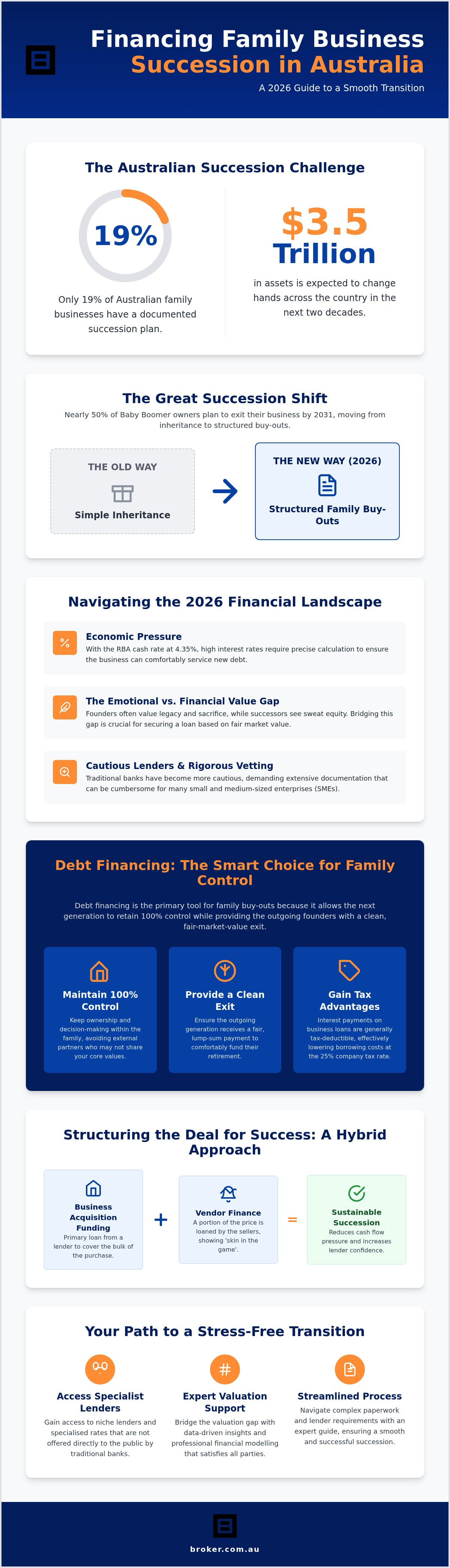
Did you know that only 19% of Australian family businesses have a documented succession plan? It’s a staggering figure when you consider that an estimated $3.5 trillion in assets is expected to change hands across the country over the next two decades. For many founders, the prospect of financing a family business succession feels like a high-stakes puzzle. You want the next generation to lead, but you’re likely feeling the weight of high interest rates and the fear that valuation disputes might fracture family bonds.
It’s completely normal to feel this way. You’ve spent years building your legacy, and you deserve a transition that’s both fair and financially sustainable. This guide will show you how to structure and secure the right funding to pass the torch without compromising your cash flow or your personal relationships. We’ll explore the 2026 lending environment, compare secured and unsecured options, and outline how to create a manageable debt structure that supports everyone involved. You’re in good hands, and the path to a stress-free transition starts with the right information.
Key Takeaways
- Understand why 2026 is a pivotal year for transitioning from traditional inheritance models to structured family buy-outs.
- Learn why debt financing is the most effective way to maintain family control while securing a fair market value for outgoing owners.
- Discover how lenders calculate “lendable value” to ensure that financing a family business succession remains sustainable for the next generation.
- Compare the strategic benefits of secured and unsecured business loans to find a funding mix that protects your cash flow.
- Gain inside access to niche lenders and specialised rates that traditional banks typically don’t offer directly to the public.
Table of Contents
- The Landscape of Family Business Succession in Australia
- Debt vs Equity: Structuring the Buy-Out
- Lending Options for Family Business Acquisition
- Assessing Borrowing Power and Business Valuation
- The Broker Advantage: Streamlining the Succession
The Landscape of Family Business Succession in Australia
Australia is currently facing what many economists call the “Silver Tsunami.” Almost half of Baby Boomer business owners plan to exit their companies by 2031, yet the traditional model of simple inheritance is fading. In 2026, Succession planning has evolved into a sophisticated financial transaction. Many families now prefer “family buy-outs” where the next generation formally purchases the entity. This shift ensures the outgoing generation can fund a comfortable retirement while the incoming owners take full responsibility for the company’s future growth.
Successfully financing a family business succession requires more than just a handshake over Sunday dinner. It demands a clear strategy to overcome common hurdles like valuation gaps and liquidity constraints. Without a structured finance plan, families risk significant fallout that can destroy both the enterprise and personal relationships. You’re essentially balancing a commercial acquisition with the delicate nuances of family dynamics.
Why 2026 Requires a New Approach to Funding
The financial environment in 2026 is distinct from previous decades. With the RBA cash rate sitting at 4.35% as of June, debt servicing requires precise calculation. Traditional banks have become more cautious, often demanding rigorous documentation that many SMEs find cumbersome. Additionally, tax changes like the Division 296 tax on superannuation balances over $3 million are pushing founders to reconsider their exit strategies. Professional corporate advisory has moved from a luxury to a necessity. It helps families navigate these hurdles with tailored financial modelling that satisfies both the ATO and commercial lenders.
The Emotional vs Financial Value Gap
One of the biggest hurdles is defining “Fair Market Value” in a family context. Founders often see the decades of sacrifice and legacy, while successors might point to the “sweat equity” they’ve already contributed as a reason for a lower price. This creates a valuation gap that can stall loan approvals. When financing a family business succession, the loan amount must be high enough to meet the parents’ retirement needs but low enough to keep the business’s cash flow healthy. It’s a delicate act. You’ll need to demonstrate to lenders that the business can service the debt while still retaining enough capital to invest in modern digital infrastructure. Professional brokers act as the “Expert Guide” here, helping to bridge this gap with data-driven insights that traditional banks might overlook.
Debt vs Equity: Structuring the Buy-Out
Choosing how to fund your transition is more than a balance sheet exercise; it’s a decision about the future of your family’s legacy. While equity financing involves bringing in external partners or private equity, most Australian families prefer to keep things in-house. Debt financing remains the primary tool for financing a family business succession because it allows the next generation to retain 100% control while providing the outgoing founders with a clean exit. It moves the entire family from a state of uncertainty toward a feeling of streamlined confidence.
A “one-size-fits-all” loan rarely works for complex transfers. We often see a hybrid model where Business Acquisition Funding is paired with vendor finance. This structure reduces the immediate pressure on the business’s cash flow. It also signals to external lenders that the outgoing generation has skin in the game. This often leads to better terms on the remaining debt because the risk is shared between the family and the financial institution, making the whole process feel much more professional and secure.
For Australian SMEs, the tax treatment of debt is a major drawcard. Interest payments on business loans are generally tax-deductible, which effectively lowers the cost of borrowing. With the company tax rate at 25% for base rate entities in the 2026-27 financial year, these deductions provide a meaningful buffer for the incoming owner’s bottom line. It’s a sophisticated way to manage the transition while keeping more capital inside the business for future growth and innovation.
The Advantages of Debt Financing for Successors
Successors often fear that bringing in outside investors will lead to the “too many cooks” problem. Debt avoids this entirely. You keep the decision-making power and the long-term upside of the business’s growth. It’s about maintaining that boutique feel while having the capital of a high-level operation. Using debt means you aren’t answering to a board of strangers who might not share your family’s core values. You remain the master of your own destiny while ensuring the business stays in good hands.
Vendor Finance: The Australian Family Staple
Vendor finance is essentially when the parents act as the “bank” for a portion of the purchase price. It’s incredibly flexible. You can structure repayments to align with seasonal cash flow or tie them to specific performance milestones. However, it’s not without risk. If the business hits a rough patch, the parents’ retirement income is directly at stake. Balancing this with an external loan helps spread the risk. It ensures the founders receive a guaranteed lump sum upfront, providing them with immediate relief and the financial security they’ve worked decades to achieve.
Lending Options for Family Business Acquisition
Selecting the right financial vehicle is the engine room of a successful transition. In the 2026 lending environment, the choice between different loan products can significantly affect your business’s agility and the family’s overall security. While traditional banks remain an option, 31% of Australian SMEs now prefer non-bank lenders due to their faster approval times and more flexible documentation requirements. This shift is particularly relevant when financing a family business succession, as it allows for more tailored solutions that a standard “big four” bank might not provide.
The core of most successions involves a mix of Secured Business Loans and Unsecured Business Loans. As of June 2026, secured rates typically range between 6.8% and 9.5% p.a., providing a cost-effective way to fund a buy-out if you have property or significant assets to pledge. Conversely, unsecured options offer rapid access to capital without requiring collateral, with rates starting from approximately 8.14% for businesses with strong cash flow. For many successors, Business Acquisition Funding is the most critical tool, as it specifically accounts for “goodwill”—the intangible value and reputation built by the family over decades.
Leadership changes are also an ideal time to modernise. Using Equipment Finance or Vehicle Finance to upgrade the company fleet or digital infrastructure can be bundled into the broader succession strategy. This ensures the incoming generation isn’t just taking over a legacy, but is equipped with the modern tools needed to drive future growth.
Secured Loans: Maximising Borrowing Power
Leveraging Commercial Property Loans or existing business assets is the most reliable way to secure a high loan-to-value ratio. While using the family home as collateral can lower interest rates, it often introduces emotional stress for the outgoing generation. We generally recommend using commercial premises where possible to keep business and personal risks separate. It’s also vital to manage cross-collateralisation carefully. You don’t want the parents’ primary residence tied to the business’s performance if the new owners decide to pivot the company’s direction. A clean break in security often leads to more harmonious family holidays.
Working Capital and Lines of Credit
Liquidity is the lifeblood of a business during a change in command. A Line of Credit or Working Capital Finance provides a vital safety net for “day-one” operations after the buy-out is finalised. New owners often find that a transition period causes temporary disruptions to standard cycles. Using Invoice Finance can bridge these gaps by unlocking the value of outstanding invoices immediately. This ensures that while you’re focused on the high-level strategy of financing a family business succession, the daily bills and payroll are always covered. Having these facilities in place before the handover provides a sense of streamlined confidence for everyone involved.
Assessing Borrowing Power and Business Valuation
Lenders look at family businesses through a different lens than independent SMEs. While a standard acquisition focuses purely on the numbers, financing a family business succession requires an understanding of the relationship between the balance sheet and the family’s personal assets. To a bank, “Lendable Value” is the amount they are willing to provide based on a combination of business performance and available security. It’s often lower than the emotional value you’ve placed on the company. Using proprietary AI technology, we can now provide an instant snapshot of your borrowing capacity, moving you from a state of uncertainty toward a clear, actionable path.
Successors often find that the business’s reported profit doesn’t tell the whole story. Family-run firms frequently have “discretionary” expenses that wouldn’t exist in a corporate environment. To secure the best rates, you need to present a professional, transparent view of the company’s true earning potential. This is where high-level financial modelling becomes essential. It allows you to demonstrate to lenders that the business is a robust, standalone entity capable of servicing debt under its new leadership.
Step 1: Financial Health Check and Modelling
The first step is “normalising” the accounts. You must remove family perks like non-commercial vehicle leases, travel, or salaries for family members not active in the business from the profit and loss statement. Lenders generally require three years of audited financial statements to establish a consistent track record. EBITDA stands for Earnings Before Interest, Taxes, Depreciation, and Amortisation, and it serves as the primary metric Australian lenders use to measure a business’s core operational profitability and debt-servicing capacity. By presenting a clean EBITDA, you highlight the business’s strength and improve your chances of a seamless approval.
Step 2: Choosing the Right Security Structure
Your security structure determines your interest rates and total borrowing power. For Commercial Property Loans, lenders typically look for a Loan-to-Value Ratio (LVR) of 65% to 75%. If the business owns its premises, this provides a powerful foundation for the buy-out. However, many successions involve director guarantees from the incoming owners. This is a high-stakes decision that requires careful thought. You’re effectively putting your personal assets on the line to back the business’s future. Our team acts as an Expert Guide during these discussions, ensuring you understand every implication before you sign. If you want to see where your business stands, you can Get Started with a preliminary assessment today.
The Broker Advantage: Streamlining the Succession
Going direct to your local “big four” bank might seem like the simplest path, but it often limits your options to a single set of rigid lending criteria. When financing a family business succession, you need a partner who understands that your business is more than just a set of numbers on a spreadsheet. Banks often struggle with the nuances of family buy-outs, particularly when it comes to valuing goodwill or accepting flexible repayment structures. By working with an award-winning broker, you gain inside access to niche lenders and specialised rates that aren’t available to the general public. We act as an influential intermediary, unlocking doors that traditional institutions often keep closed.
At Broker.com.au, we use proprietary AI technology to facilitate fast, accurate applications. This system matches your specific business profile with the ideal lender from our extensive panel, ensuring you don’t waste time on potential rejections. Our role is to act as your Expert Guide, managing the entire application process so you can focus on the handover. We move the conversation from a state of complexity toward a feeling of streamlined confidence. You’re in good hands with specialists like Matt, Kylie, and Flavio, who bring human-led advisory to every digital interaction.
Corporate Advisory Meets Mortgage Brokerage
A successful succession requires more than just a loan; it requires a sophisticated debt structure that ensures long-term sustainability. This is where corporate advisory expertise meets traditional brokerage. We act as a “High-Level Fixer” for complex restructures, ensuring that the debt doesn’t starve the business of growth capital. For example, by structuring a tailored finance package that combines a secured business loan with a flexible line of credit, we help families ensure that founders exit with their full value while successors maintain enough working capital to modernise. This proactive approach ensures situations that fall outside of the norm are handled with professional precision.
Taking the First Step: The “I’m Interested” Approach
We understand that family discussions about money and legacy can be sensitive. That’s why we’ve designed our entry point to be low-pressure and supportive. Unlike the aggressive “Apply Now” buttons found elsewhere, our “I’m interested” approach is simply the start of a conversation. It allows you to explore your options and get a quick quote without any immediate impact on your credit score. This “can-do attitude” ensures that you feel informed rather than rushed during such a pivotal time for your business. Ready to secure your family legacy? I’m interested in succession funding.
Securing Your Family’s Legacy Today
Transitioning your business to the next generation is one of the most significant milestones you’ll ever face. It requires a sophisticated balance of fair market valuation, sustainable debt structuring, and deep respect for family dynamics. By understanding your borrowing power and exploring tailored lending options, you can ensure the outgoing generation enjoys a well-earned retirement while the incoming owners have the capital they need to thrive. Success is about moving from a state of uncertainty toward a feeling of streamlined confidence.
As an award-winning Australian business loan broker, we specialise in financing a family business succession with professional precision. We provide inside access to over 50 leading Australian lenders and use proprietary AI to ensure your application is both fast and accurate. Our team acts as your Expert Guide, ensuring your transition is handled with the boutique attention it deserves. You don’t have to manage this high-stakes financial puzzle alone.
Ready to take the first step toward a stress-free handover? I’m interested in financing my family business succession. We’re here to help you protect what you’ve built and ensure your business remains in good hands for decades to come.
Frequently Asked Questions
How is a family business succession loan different from a standard business loan?
A succession loan is specifically structured to fund the transfer of ownership rather than just purchasing assets or equipment. Unlike a standard commercial loan, it often accounts for the “goodwill” of the family brand and the transition of leadership. Lenders evaluate the incoming owner’s experience and the historical stability of the firm. This specialised approach ensures the business remains viable while providing the outgoing generation with a fair and secure exit.
Can I use the equity in my family home to finance the business buy-out?
You can certainly use the equity in your family home to fund a buy-out, often through a home loan or a line of credit. This can lead to lower interest rates compared to unsecured business debt. However, it’s vital to consider the risk of cross-collateralisation. If the business faces challenges, your primary residence could be at stake. Many families prefer keeping business and personal assets separate to protect the family’s long-term security and peace of mind.
What is vendor finance, and is it common in Australian successions?
Vendor finance occurs when the outgoing owners, usually the parents, agree to accept a portion of the purchase price over time. It’s incredibly common in Australia, as it bridges the gap when bank funding doesn’t cover the full valuation. This arrangement shows external lenders that the founders have confidence in the successor. It allows for flexible repayment terms that align with the company’s seasonal cash flow, making the transition much more manageable for the next generation.
Do I need a formal business valuation before applying for financing?
Yes, a formal, independent business valuation is almost always required when financing a family business succession. Lenders need an objective assessment of the “Lendable Value” to determine the loan-to-value ratio. This process removes the emotional bias often found in family deals. Having a professional valuation ready also speeds up the application process and helps avoid disputes between family members regarding the fair market price of the enterprise during the handover.
How long does the financing process typically take for a business acquisition?
The timeline for securing financing typically ranges from four to eight weeks, depending on the complexity of the deal. Simple unsecured loans can be approved in as little as 24 to 48 hours with our proprietary AI technology. However, complex restructures involving secured property or multiple lenders take longer. Starting the conversation early ensures that all financial modelling and documentation are in place before the intended handover date, reducing last-minute stress for everyone involved.
Will high interest rates in 2026 make succession financing too risky?
While the RBA cash rate sitting at 4.35% in 2026 adds to the cost of borrowing, it doesn’t necessarily make succession too risky. The key is in the debt structure. By using a mix of secured loans and working capital finance, you can manage repayments without stifling growth. Interest on these loans is generally tax-deductible for Australian businesses, which provides a significant buffer. Professional guidance helps you lock in competitive rates that traditional banks might not offer.
Can a successor with limited personal assets still qualify for a business loan?
A successor with limited personal assets can still qualify for financing a family business succession by leveraging the company’s existing assets or cash flow. Unsecured business loans focus on the strength of the business’s revenue rather than personal collateral. Lenders also look at the historical performance of the firm and the successor’s involvement in operations. This allows talented next-generation leaders to take over the reins without needing a massive personal property portfolio to get started.
How does Broker.com.au help with the corporate advisory side of succession?
We act as an Expert Guide, going beyond just finding a loan. Our team provides corporate advisory insights to help structure your debt for long-term sustainability. We use proprietary AI to match your business with the best-fit lenders from a panel of over 50 institutions. This proactive approach manages the inherent anxiety of high-stakes decisions. We ensure your application is professional and transparent, giving you the best chance of a seamless, stress-free transition.