
The belief that a crushing debt cycle is an unavoidable part of doing business is a dangerous misconception that could cost you your family home. When monthly repayments outpace your revenue and the ATO issues aggressive warnings, it’s vital to act before your business loan default options australia become limited. You aren’t alone in feeling that the weight of cross-collateralised loans is becoming unmanageable, especially with the current RBA cash rate sitting at 4.35 per cent.
This 2026 guide is designed to move you from a state of financial uncertainty to one of streamlined confidence. You’ll master the strategic pathways to consolidate your liabilities, manage complex tax debt, and protect your business’s long-term viability. We provide a clear roadmap using expert brokerage insights to lower your debt service costs and navigate the Small Business Restructuring (SBR) framework. From eligibility requirements to securing specialised working capital, you’re about to discover how to restore your cash flow and keep your business trading without the constant fear of asset repossession.
Key Takeaways
- Learn how to reorganise your existing liabilities to improve solvency and alleviate the cash flow pressures currently impacting Australian SMEs in 2026.
- Discover how the Small Business Restructuring (SBR) framework allows directors to remain in control of daily operations while managing debts under the A$1 million threshold.
- Identify the most effective business loan default options australia provides by using strategic refinancing to replace expensive, short-term debt with sustainable secured business loans.
- Follow a proven five-step process, from comprehensive financial audits to predictive modelling, to ensure your new repayment plan is grounded in realistic data.
- Gain inside access to a national network of specialised non-bank lenders through AI-driven matching that identifies the best-in-class finance for your specific turnaround strategy.
Table of Contents
- Understanding Business Debt Restructuring in the 2026 Australian Market
- Formal Pathways: Small Business Restructuring (SBR) and Safe Harbour
- Strategic Refinancing: The Power of Informal Debt Consolidation
- The 5-Step Process for a Successful Debt Restructure
- Navigating the Complexities with an Expert Commercial Broker
Understanding Business Debt Restructuring in the 2026 Australian Market
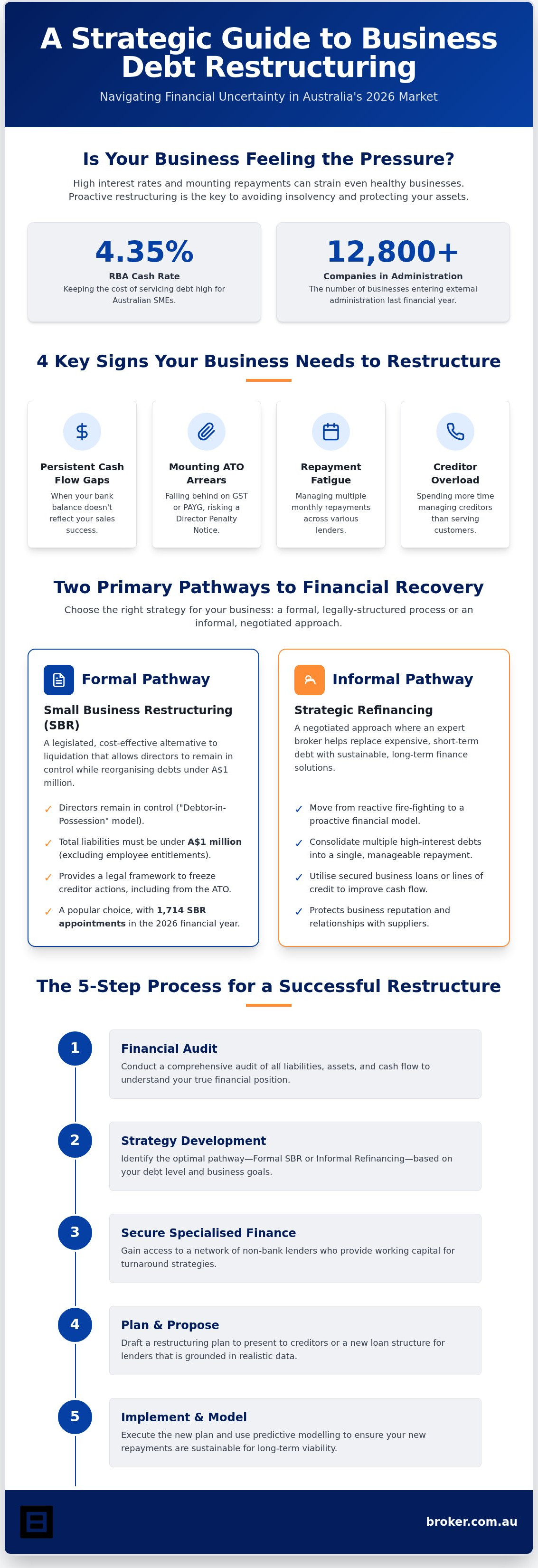
Debt restructuring is the strategic reorganising of your company’s liabilities to improve liquidity and ensure long term solvency. It isn’t just a survival tactic; it’s about engineering a sustainable capital structure that allows your business to breathe. In the current 2026 market, many Australian SMEs are facing intense cash flow pressure. With the RBA cash rate holding at 4.35 per cent, the cost of servicing debt has remained high, leading to over 12,800 companies entering external administration in the last financial year. Understanding your business loan default options australia is the first step toward avoiding a similar fate.
The process generally falls into two categories: formal and informal. Formal restructuring involves legislated pathways, such as the Small Business Restructuring (SBR) framework, which operates under the broader umbrella of Australian insolvency law. Informal restructuring is a negotiated approach where you work with an expert broker to refinance existing debt into more manageable products, like a secured business loan or a line of credit. The primary objective is to move from high stress, reactive fire fighting to a professional, proactive financial model that supports long term viability.
Signs Your Business Needs to Organise a Restructure
Even businesses with healthy top line revenue can find themselves in trouble. You might notice persistent cash flow gaps where your bank balance doesn’t reflect your sales success. Mounting ATO arrears are a critical red flag. If you’re falling behind on GST or PAYG, the risk of receiving a Director Penalty Notice (DPN) becomes a reality. Managing multiple monthly repayments across various lenders often leads to “repayment fatigue,” making it difficult to track your true financial position. When you spend more time managing creditors than you do serving customers, it’s time to evaluate your business loan default options australia.
The Benefits of Proactive Debt Management
Acting early creates vital breathing space. Proactive management helps protect your personal assets from the fallout of business related defaults, especially if you’ve signed personal guarantees or have cross collateralised loans. It also preserves your hard won reputation with key suppliers and customers. Instead of being consumed by aggressive debt collection actions, you can focus on operational growth. By using tailored finance solutions, you can consolidate high interest debts into a single, efficient repayment plan that restores your confidence and ensures your business remains a going concern.
Formal Pathways: Small Business Restructuring (SBR) and Safe Harbour
For many Australian SMEs, the most powerful tool in the toolkit is the Small Business Restructuring (SBR) process. Introduced to provide a more efficient, cost effective alternative to liquidation, it allows companies with liabilities under A$1 million to reorganise their debts while the directors remain in control. This “Debtor-in-Possession” model is a significant advantage; unlike voluntary administration, you don’t hand over the keys to an external party. Instead, you continue running the daily operations while a Small Business Restructuring Practitioner (SBRP) helps you draft a plan to present to your creditors. In the 2026 financial year, there were 1,714 SBR appointments, proving it remains a popular choice for those exploring business loan default options australia.
Parallel to SBR are Safe Harbour protections. These provisions in the Corporations Act 2001 shield directors from personal liability for insolvent trading, provided they are actively pursuing a course of action likely to lead to a better outcome for the company. Reviewing ASIC’s guide to insolvency for directors is essential for understanding these specific duties. When considering business loan default options australia, formal pathways like SBR provide the legal framework to freeze collection actions, including those from the ATO, and buy the time needed to implement a turnaround strategy.
Eligibility and Requirements for SBR
To access this pathway, your company must meet strict criteria. The A$1 million liability threshold is the primary gatekeeper. This figure includes secured and unsecured debt but excludes employee entitlements. Crucially, all tax lodgements must be up to date, even if the debt hasn’t been paid. Finally, for the plan to succeed, more than 50 per cent of creditors by dollar value must vote in favour. If you are unsure if your current debt profile fits these requirements, you can explore tailored finance solutions to help bridge the gap before entering a formal process.
Negotiating with the ATO as a Primary Creditor
In the current 2026 landscape, the ATO is often the majority creditor in Australian restructures. They’ve moved away from the broad leniency seen in previous years, now requiring clear evidence of future viability before approving a proposal. However, an SBR proposal often allows for a “haircut” on interest and penalties. The ATO evaluates these plans based on whether the proposed return is better than what they would receive in a liquidation scenario. By presenting a professional, data backed proposal through an SBRP, businesses can often settle tax debts for a fraction of the total amount, significantly lowering monthly service costs.
Strategic Refinancing: The Power of Informal Debt Consolidation
While formal pathways like SBR provide essential legal protection, they also leave a permanent mark on the public record. For many directors, an informal restructure via strategic refinancing is the preferred path. This involves using new, more efficient finance to pay out old, high interest debt. By moving your debt away from your current bank, you can often find better rates and more flexible terms than what is offered through standard “assistance” programs. It’s a proactive way to manage business loan default options australia without the administrative burden or public disclosure of a practitioner led process.
Secured business loans are the cornerstone of this strategy. By providing collateral, such as commercial property, you can access significantly lower interest rates compared to the 15.01 per cent p.a. often seen in short term products. Conversely, unsecured business loans offer a rapid injection of working capital. These are ideal for bridging the gap during a restructure, allowing you to settle urgent liabilities while you wait for larger refinancing to settle. It’s about finding the right balance between speed and cost to ensure your business remains a going concern.
Using Asset and Invoice Finance to Unlock Capital
Don’t let your balance sheet sit idle while you struggle with repayments. Asset finance allows you to leverage the equity in your existing machinery or vehicles to clear high interest debts. Similarly, invoice finance turns your accounts receivable into immediate cash. Instead of waiting 30 or 60 days for a customer to pay, you get those funds now to settle pressing debts. Fit out finance can even be used to refinance existing improvements, effectively freeing up the capital you’ve already invested in your premises to support your turnaround plan.
Consolidating Multiple Loans into a Single Facility
Managing five different repayments on five different dates is a recipe for financial disaster. Consolidating these into a single facility simplifies your balance sheet and reduces the risk of an accidental default. This move often has a positive impact on your business credit score over time, as it demonstrates a controlled and professional approach to debt management. A line of credit can then serve as a flexible safety net, providing inside access to funds whenever a cash flow dip occurs during your transition period. This streamlined approach allows you to focus on growth rather than managing a complex web of creditors.
The 5-Step Process for a Successful Debt Restructure
A successful restructure requires a clinical approach to your company’s balance sheet. It’s about moving beyond the emotional stress of debt and into a structured, data driven recovery. By following a proven five step framework, you can evaluate your business loan default options australia with clarity and precision. This logical progression ensures that every decision you make is backed by evidence rather than desperation.
- Step 1: Complete Financial Audit. You must understand exactly what is owed and to whom. This includes secured loans, unsecured lines of credit, and ATO arrears. Don’t overlook smaller supplier debts or personal guarantees.
- Step 2: Financial Modelling. Use current performance data to project future cash flow. This determines your actual repayment capacity without compromising daily operations. It’s the “reality check” phase of the process.
- Step 3: Choosing the Pathway. Based on your audit, decide if a formal SBR or an informal refinancing strategy is the most efficient route. Your liability level and tax compliance status will dictate this choice.
- Step 4: Stakeholder Negotiation. Present your proposal to lenders and the ATO. Having a seasoned intermediary handle these high stakes conversations often leads to more favourable terms and reduced interest rates.
- Step 5: Execution and Monitoring. Implementation is just the beginning. You must strictly adhere to the new repayment schedule to restore lender trust and ensure the long term viability of your business.
Preparing Your Documentation for Lenders and Practitioners
Transparency is your greatest asset during a restructure. Lenders require a comprehensive view of your position, typically including your latest Profit and Loss statements, balance sheets, and current ATO integrated client account records. If your traditional records are slightly behind due to recent stress, “Low Doc” finance options may provide a viable alternative. These products allow you to use bank statements or accountant declarations to prove your income. Regardless of the product, a robust business plan that demonstrates future viability is essential for securing a successful turnaround. You can get started with a tailored finance assessment to see which documentation pathway fits your business best.
Avoiding Common Pitfalls in the Restructuring Process
One of the most dangerous mistakes is “robbing Peter to pay Paul.” Taking out high interest, short term loans to cover existing repayments without a long term strategy only accelerates a collapse. Hiding debt from your broker or advisor is equally fatal; it prevents them from designing a solution that actually works. Always prioritise employee entitlements, such as superannuation and wages. Failing to meet these obligations can lead to severe legal complications and personal liability for directors, regardless of any other business loan default options australia you might pursue. A proactive, honest approach is always the most efficient path to relief.
Navigating the Complexities with an Expert Commercial Broker
The Australian lending landscape in 2026 is intricate. It’s no longer just about walking into a local branch and asking for help. Broker.com.au acts as your “Expert Guide,” using proprietary AI technology to scan the market and match your unique debt profile with the right lenders. This isn’t just about finding a loan; it’s about identifying the most viable business loan default options australia has to offer. Our technology accelerates the assessment process, ensuring you aren’t left waiting while your cash flow continues to tighten.
This approach provides “inside access” to a national network of specialised non-bank lenders. These institutions often specialise in turnarounds and are more comfortable with complex restructuring scenarios than traditional big banks. By leveraging our local insights, you gain a partner who handles the heavy lifting with creditors, allowing you to move from a state of high stakes anxiety toward streamlined confidence. We don’t just facilitate a transaction; we provide corporate advisory services to ensure your capital structure remains efficient long after the initial restructure is complete.
Why a Broker is More Effective Than a Direct Bank Approach
Banks operate on rigid “appetite” rules. If your business doesn’t fit their narrow criteria, you’ll likely face a fast rejection that could damage your credit profile. A broker provides a much wider market view, managing the entire application process to maximise your chance of approval. We understand how to present your financial modelling to highlight future viability, which is critical when negotiating “haircuts” on existing debt. This professional representation ensures you don’t miss out on terms that could significantly lower your monthly service costs.
Taking the First Step Toward Financial Relief
We believe the path to recovery should be stress free. That’s why we use an “I’m interested” philosophy. It isn’t a high pressure sales tactic; it’s the start of a supportive conversation with specialists like Matt or Kylie. In your first consultation, we’ll review your financial audit and discuss which business loan default options australia provides, whether through a formal SBR or informal refinancing. It’s about moving from uncertainty to a feeling of relief. If you’re ready to protect your business’s future, I’m interested in restructuring my business debt.
Securing Your Business’s Future Through Strategic Restructuring
Navigating the complexities of the 2026 Australian economy requires a shift from reactive fire-fighting to proactive financial management. By understanding the full range of business loan default options australia provides, you can protect your personal assets and ensure your company continues to trade successfully. Whether you choose the legislative protection of a Small Business Restructure or the privacy of an informal consolidation through a secured business loan, the goal remains the same: a sustainable capital structure that supports growth.
As an award-winning Australian business loan broker, we provide the expert guide approach needed to remove the stress from these high-stakes decisions. Our team offers inside access to over 50 specialised lenders and uses AI-driven financial modelling to deliver quick, accurate results tailored to your specific needs. You don’t have to face aggressive creditors or ATO collection actions alone. If you’re ready to restore your cash flow and gain streamlined confidence in your business’s viability, I’m interested in a tailored debt restructure plan. The path to financial relief starts with a single, low-pressure conversation.
Frequently Asked Questions
What is the difference between debt restructuring and liquidation?
Debt restructuring is a proactive strategy designed to keep your business trading by reorganising liabilities into a manageable framework. It focuses on future viability and maintaining operations. In contrast, liquidation involves the formal closure of the business, where assets are sold to pay creditors in a final distribution. While liquidation marks the end of a company, restructuring provides a pathway to restore solvency and protect the business’s long-term value.
Can I restructure my business debt if I owe money to the ATO?
Yes, you can restructure debt even if the ATO is your primary creditor. The ATO often prefers a restructuring proposal that offers a higher return than what they would receive in a liquidation scenario. To be eligible for formal pathways, you must ensure all tax lodgements are up to date. This is a critical component when evaluating your business loan default options australia to avoid aggressive collection actions or Director Penalty Notices.
How long does a formal Small Business Restructuring process take?
A formal Small Business Restructuring (SBR) process is designed for speed, typically concluding within 35 to 40 business days. This timeframe includes a 20-business-day period for the practitioner to develop the restructuring plan and a further 15 business days for creditors to cast their votes. This accelerated schedule is significantly faster than traditional voluntary administration, allowing you to resolve financial distress quickly while maintaining control of your daily business operations.
Will restructuring my debt affect my personal credit score?
The impact depends on the pathway you choose. An informal restructure, such as refinancing via a commercial broker, may have minimal impact if handled before defaults occur. However, a formal SBR is a public record and will likely appear on your credit report. If you have provided personal guarantees for your business loans, any compromise of those debts could directly affect your personal credit standing and your future borrowing capacity.
Do I need to be a company (Pty Ltd) to restructure my business debt?
Formal Small Business Restructuring under the Corporations Act is only available to incorporated companies. Sole traders and partnerships cannot access the SBR framework. However, these business structures can still pursue informal restructuring through strategic refinancing. By using an expert broker, non-incorporated businesses can consolidate high-interest debt into more sustainable products, like a secured business loan, to achieve similar cash flow relief without the need for a formal practitioner.
What is a “haircut” in the context of debt negotiation?
A “haircut” refers to a negotiated reduction in the total amount of debt owed to a creditor. For instance, if a lender agrees to accept A$70,000 as full settlement for a A$100,000 debt, the business has successfully negotiated a 30 per cent haircut. This is a common outcome in successful restructuring plans, as creditors often prefer receiving a guaranteed partial payment over the uncertainty and lower returns typical of a full liquidation.
How much does it cost to engage a restructuring practitioner in Australia?
Engaging a Small Business Restructuring Practitioner involves fixed fees for both the proposal and implementation phases. According to 2026 industry data, the typical cost for an SBR plan ranges between A$15,000 and A$30,000. These costs cover the practitioner’s professional fees and administrative expenses. While this requires an upfront investment, it is often far more cost-effective than the alternative of liquidation or continuing to service unmanageable high-interest debt without a clear plan.
Can I still get a business loan after restructuring my debt?
Yes, obtaining finance after a restructure is possible through specialised non-bank lenders. While major banks may have rigid rules regarding past financial distress, many lenders in the secondary market specialise in turnaround situations. These lenders focus on your current cash flow and future projections rather than just your credit history. Working with a broker provides inside access to these specialised business loan default options australia, helping you secure the capital needed for growth.