
What if your business’s largest monthly overhead was actually your most powerful wealth-creation tool? For many Australian business owners, the cycle of rising commercial rents and the lack of control over their physical premises is a constant source of anxiety. It often feels like you’re working to pay off someone else’s mortgage while your own retirement savings sit idle. We understand that the rules around superannuation can feel like a complex maze, particularly with the 2026 regulatory shifts affecting borrowing arrangements.
Mastering how to use smsf to buy commercial property is the definitive way to break this cycle and reclaim your independence. This guide is designed to move you from a state of uncertainty to streamlined confidence. You’ll learn how to pay rent to yourself, benefit from a concessional 15% tax rate on rental income, and ensure your business real estate is protected for the long term. We provide a clear roadmap through the latest compliance requirements and borrowing structures, ensuring you have the inside access needed to turn your business premises into your fund’s most valuable asset.
Key Takeaways
- Discover how to transform a major business overhead into a long-term retirement asset by paying rent directly to your own superannuation fund.
- Gain clear insights into how to use smsf to buy commercial property by meeting the strict “Business Real Property” criteria and the Sole Purpose Test.
- Explore five strategic acquisition paths tailored to your fund’s liquidity and learn how current LVR limits impact your borrowing potential in 2026.
- Learn how to navigate the modern application landscape using AI-powered tools that provide instant feedback on your fund’s serviceability and compliance.
- Identify and manage specific investment risks, from maintaining fund liquidity for ongoing costs to balancing single-asset concentration.
Table of Contents
- The Strategic Case for SMSF Commercial Property in 2026
- Understanding the Rules: Business Real Property and LRBAs
- Five Paths to SMSF Property Acquisition
- The 2026 SMSF Loan Application Process
- Navigating Risks and Ensuring Long-Term Success
The Strategic Case for SMSF Commercial Property in 2026
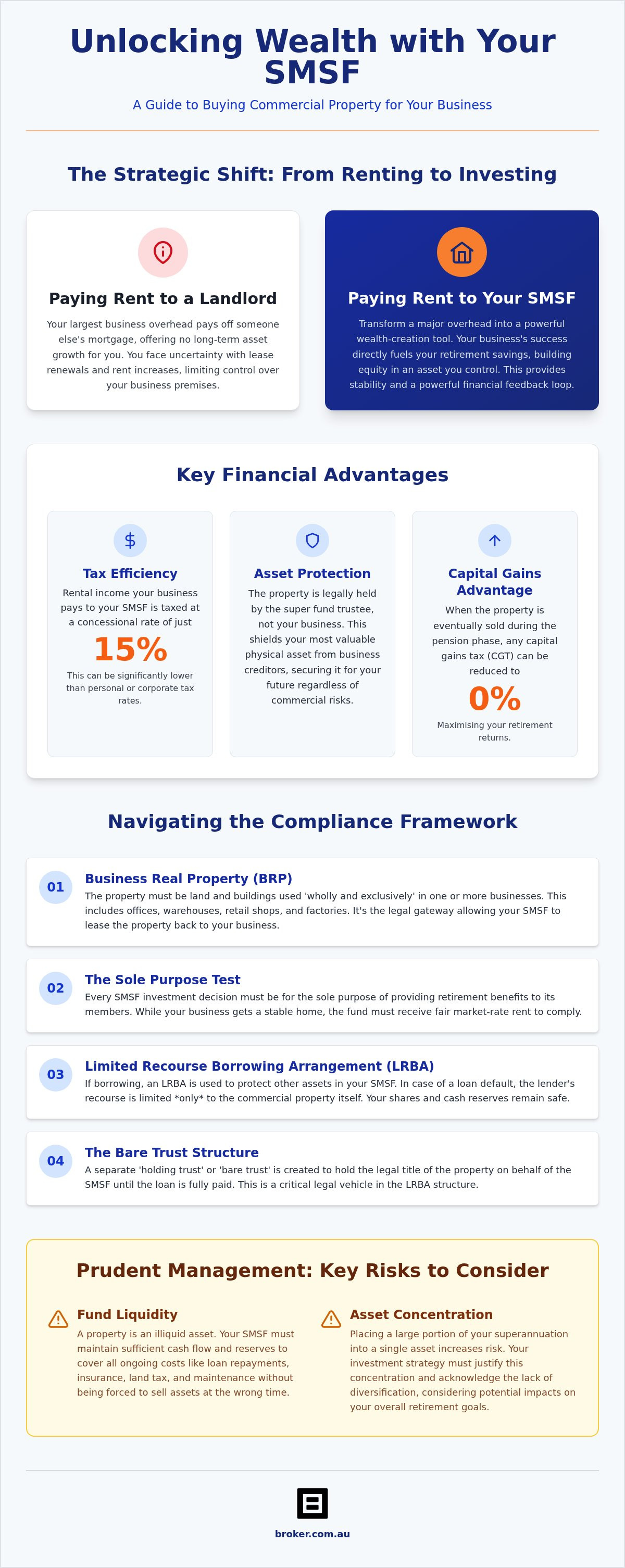
Australian business owners are increasingly moving away from traditional leasing. In the shifting 2026 RBA landscape, where interest rate margins remain a key consideration for SMEs, owning your premises provides a necessary volatility hedge. By understanding how to use smsf to buy commercial property, you transform a recurring cost into a growing asset. It isn’t just about the numbers. It’s about the psychological peace of mind that comes with long-term tenure. You no longer have to worry about a landlord refusing a lease renewal or spiking the rent just as your business hits its stride. This stability allows you to invest in fit-outs and infrastructure with total confidence.
The “Rent vs. Invest” debate has a clear winner when the Superannuation in Australia framework is applied. Instead of your hard-earned cash disappearing into a third party’s bank account, those lease payments flow directly into your fund. Learning how to use smsf to buy commercial property allows you to create a powerful feedback loop where your business’s success directly fuels your retirement wealth. This isn’t a generic strategy; it’s a tailored approach that aligns your daily operations with your future financial freedom.
Tax Efficiency and Wealth Acceleration
Inside the fund, the tax environment is designed to reward long-term investment. Rental income paid by your business to your fund is generally taxed at a concessional rate of just 15%. This is often significantly lower than the personal or corporate tax rates you might face outside the super environment. When you eventually transition the property into the pension phase, the Capital Gains Tax (CGT) advantages become even more compelling, potentially reducing your tax liability on the sale to zero. Additionally, your fund can use concessional contributions to help service the loan, which effectively accelerates your equity growth while reducing your taxable income.
Asset Protection for Business Owners
Maintaining a clear line between your business operations and your real estate assets is vital for risk management. Holding your warehouse, office, or retail space within an SMSF provides a robust layer of protection. Because the property is held by the super fund trustee, it is generally shielded from business creditors if your company faces financial difficulty. This structure ensures that your most valuable physical asset remains secure, regardless of the day-to-day risks of running a company. It’s a high-level fix that prioritises your family’s future while you focus on scaling your business today. By separating the roof over your head from the risks of your trade, you build a fortress for your wealth.
Understanding the Rules: Business Real Property and LRBAs
The regulatory framework is the foundation of any successful investment. To master how to use smsf to buy commercial property, you must first understand the concept of “Business Real Property” (BRP). This isn’t just a tax office term; it’s the specific legal gateway that allows an SMSF to purchase property from, or lease it to, a fund member or their business. Generally, BRP refers to land and buildings used wholly and exclusively in one or more businesses. This includes typical offices, retail shops, and industrial warehouses.
Every decision you make must satisfy the Sole Purpose Test. This means the investment’s primary objective is to provide retirement benefits for members. While your business gains a stable home, the fund must receive market-rate benefits. For a deeper dive into these responsibilities, the Moneysmart guide to SMSFs provides an excellent starting point for new trustees.
Most trustees utilise a Limited Recourse Borrowing Arrangement (LRBA). This structure is vital for risk mitigation. If the fund defaults on the loan, the lender’s rights are limited to the property itself. Your other fund assets, like your share portfolio or cash reserves, remain protected. It’s a critical safety net that ensures one bad investment doesn’t sink your entire retirement strategy.
The Mechanics of the Bare Trust
The Bare Trust, or holding trust, is the legal vehicle that holds the property title on behalf of the SMSF until the loan is repaid. The SMSF trustee manages the property and receives the rent, but the Bare Trust is the entity on the deed. Getting this setup right is crucial. A common mistake is using the wrong name on the purchase contract, which can trigger double stamp duty or significant settlement delays. We often act as a “High-Level Fixer” to ensure these structures are seamless from day one. If you’re feeling overwhelmed by the paperwork, exploring our Commercial Property Loans can help clarify the requirements.
Leasing to Your Own Business
The “Arms Length” rule is the gold standard for self-leasing. You must treat your business as if it were any other tenant. This means setting the rent at the current market rate, supported by an independent valuation. You also need a formal, written lease agreement that mirrors a standard commercial contract. This document should outline the term, rent reviews, and maintenance responsibilities. Learning how to use smsf to buy commercial property requires a firm grasp of these principles to avoid ATO penalties. Don’t forget the administrative side; the SMSF must be registered for GST if rental income exceeds A$75,000 per annum, requiring regular Business Activity Statements (BAS) to stay compliant.
Five Paths to SMSF Property Acquisition
Choosing the right path depends on your fund’s current liquidity and your long-term business goals. In 2026, the lending environment for SMSFs remains robust, but LVR (Loan to Value Ratio) limits have tightened compared to previous years. Most specialist lenders now look for an LVR between 65% and 75% for commercial assets, meaning your fund needs a solid deposit and a clear strategy for the remaining capital. Understanding how to use smsf to buy commercial property involves evaluating whether you want to own the asset outright or use leverage to secure a more strategic location that offers better growth potential.
For time-poor business owners, the complexity of these paths can be a hurdle. Each method has different documentation requirements and compliance hurdles that can delay your plans if not managed correctly. We act as your expert guide, providing inside access to the structures that best fit your specific business stage.
Direct Purchase vs. LRBA
An outright cash purchase is the most straightforward route. It maximises your immediate cash flow because every cent of the rent stays in the fund without being diverted to interest payments. This is often the preferred choice for high-liquidity funds looking for a stable, low-risk income stream. However, for many growing SMEs, a leveraged purchase via an LRBA is more practical. This allows you to acquire a higher-value asset, such as a larger warehouse or a premium office suite, by using debt to bridge the gap. In 2026, calculating your break-even point is essential; you must weigh the cost of borrowing and annual administration against the potential for capital growth and the tax-sheltered rental income. It’s a calculation where precision and professional financial modelling are non-negotiable.
In-Specie Transfers and Unit Trusts
If you already own your business premises in your personal name, an in-specie transfer is a powerful strategic move. Because the property meets the Business Real Property criteria, you can contribute the asset directly to your SMSF. This can instantly boost your fund’s value while moving the property into a more tax-efficient environment. For those with joint business partners, a related non-geared unit trust or a “Tenants in Common” structure allows for fractional ownership. These paths are more complex and require a high-level fixer to ensure the trust deeds and lease agreements are perfectly aligned.
- Direct Cash Purchase: Best for high-liquidity funds seeking simplicity.
- Leveraged Purchase (LRBA): Ideal for acquiring premium assets with a smaller deposit.
- In-Specie Transfer: A strategic way to move personally owned business real estate into super.
- Unit Trusts: Perfect for joint ventures and fractional ownership between partners.
- Tenants in Common: Offers flexibility for multiple fund members to hold specific shares.
Each of these options requires a tailored approach to ensure you don’t fall foul of the strict ATO regulations. Getting the structure right from the start is the only way to guarantee the long-term security of your business’s new home.
The 2026 SMSF Loan Application Process
The path to securing finance within a super fund has historically been bogged down by manual paperwork and lengthy wait times. In 2026, the application process has evolved into a streamlined, tech-driven journey that prioritises speed without sacrificing compliance. If you’re wondering how to use smsf to buy commercial property efficiently, the process now follows five distinct stages designed to get you from interest to ownership without the usual stress.
- Step 1: The AI-Powered Health Check – Our proprietary technology analyses your fund’s serviceability instantly, replacing the old method of waiting weeks for a bank’s initial assessment.
- Step 2: Documentation and Compliance – We help you organise essential documents, including Bare Trust deeds and detailed financial modelling, to ensure your fund meets strict lender standards.
- Step 3: Lender Matching – Since many major banks have reduced their SMSF involvement, we provide inside access to specialist non-bank lenders who understand complex business structures.
- Step 4: Valuation and Formal Approval – A formal valuation is conducted by an approved professional to secure the final “Expert Guide” tick of approval from the lender.
- Step 5: Settlement – Our team coordinates the final steps between solicitors, trustees, and the lender to ensure a seamless transition of the property title.
Preparing Your Fund for Approval
Before you start the application, your fund must be “finance ready.” Your SMSF Investment Strategy must explicitly allow for property investment and borrowing to satisfy compliance auditors. Lenders will also require up-to-date tax returns and audit certificates to verify the fund’s standing. For self-employed owners, “Low Doc” SMSF options are gaining significant traction in 2026. These products allow for more flexible income verification, which is ideal if your recent business financials don’t perfectly align with traditional banking templates.
Leveraging Technology for Speed
We use proprietary AI to identify the lenders most likely to approve your specific fund structure. This technology significantly reduces “application fatigue” by only targeting institutions with a proven appetite for your specific asset class. Our digital document portals allow you to upload and sign paperwork securely, keeping the momentum high. While the technology does the heavy lifting, our team provides human oversight for complex multi-member funds. This combination ensures your application is both technically perfect and personally managed. If you’re ready to see which lenders are currently active in the market, you can get started with an SMSF loan health check today.
Navigating Risks and Ensuring Long-Term Success
Success in property investment requires more than just securing the initial loan. While learning how to use smsf to buy commercial property opens significant doors, you must manage the ongoing risks associated with high-value assets. Liquidity is your primary safeguard. Your fund must maintain enough cash to cover council rates, insurance premiums, and unexpected repairs without relying solely on the next rent payment. If your fund is too asset rich and cash poor, you may struggle to meet these mandatory obligations during a business downturn. We help you model these scenarios early so you can move forward with a clear financial safety net.
Single asset concentration is another factor to consider. If the property represents nearly all of your fund’s value, your retirement is tied to the performance of one specific market. Balancing your portfolio with other investments can mitigate this risk. You also need a contingency plan for your business. If your company faces a period where it can’t pay the rent, the SMSF trustee must take action to protect the fund’s interests. This might involve finding a new tenant or adjusting lease terms within strict arm’s-length boundaries. Proactive planning ensures that your retirement isn’t jeopardised by the temporary struggles of your operational business.
Compliance and Auditing
Ongoing compliance is the bedrock of your fund’s security. Every SMSF holding property must undergo an annual independent audit to ensure all transactions remain at arm’s length and satisfy the sole purpose test. One common pitfall is illegal early access during renovations. You cannot use fund money to improve a property if that improvement provides a present-day benefit to you or your business rather than purely increasing the fund’s value for retirement. Professional corporate advisory is essential here. It ensures you stay on the right side of the ATO while maximising your investment’s potential. We act as your high-level fixer, ensuring your structure remains robust year after year.
Taking the Next Step
The transition from leasing to owning is a major milestone for any Australian SME. Planning for the exit is just as important as the purchase. Whether you intend to sell the property in the pension phase to take advantage of CGT exemptions or keep it to provide a steady income stream, your strategy needs to be clear from the start. A brief 15-minute discovery call can clarify your borrowing power and help you understand the specific paths available to your fund. Our promise is to provide a seamless, stress-free path to ownership, giving you inside access to the best structures in the market.
I’m interested in an SMSF loan for commercial property
Taking Control of Your Commercial Legacy
Transitioning from a tenant to a landlord within your own super fund is a transformative move for any Australian SME. By mastering how to use smsf to buy commercial property, you’ve discovered how to shield your business from rental volatility while building a tax-sheltered asset for retirement. We’ve explored the strict compliance of Business Real Property, the safety of Limited Recourse Borrowing, and the necessity of maintaining fund liquidity for long-term success. It’s a strategic shift that turns a recurring overhead into a pillar of your personal wealth.
As award-winning Australian finance specialists, we use proprietary AI technology to provide faster approvals and inside access to over 40 leading lenders. This ensures your path to ownership is efficient and perfectly tailored to your fund’s unique structure. Don’t let the complexity of 2026 regulations or shifting interest rates hold your business back. If you’re ready to move from uncertainty to streamlined confidence, I’m interested in an SMSF property loan and would love to start the conversation. Your business premises shouldn’t just be an expense; it’s the foundation of your future, and we’re here to help you secure it.
Frequently Asked Questions
Can I use my SMSF to buy an office and lease it back to my own company?
Yes, you can lease an office back to your own business if the property qualifies as Business Real Property. This is one of the most common reasons why business owners research how to use smsf to buy commercial property. You must ensure the lease is at a market rate and backed by a formal, written agreement. This arrangement must satisfy the “arm’s length” rule to remain compliant with ATO regulations and protect your fund’s status.
What is the minimum deposit required for an SMSF commercial property loan in 2026?
Most specialist lenders in 2026 require a minimum deposit of 25% to 35% of the property’s value. This corresponds to a Loan to Value Ratio (LVR) of 65% to 75%. Beyond the deposit, your fund must also demonstrate sufficient liquidity to cover purchase costs like stamp duty, legal fees, and a “cash buffer” for ongoing expenses. Having a solid deposit is the first step in showing your fund’s serviceability during the application process.
Do I need a separate Bare Trust to buy commercial property with my super?
You definitely need a separate Bare Trust if you are using a Limited Recourse Borrowing Arrangement (LRBA) to fund the purchase. The Bare Trust legally holds the property title on behalf of your SMSF until the loan is fully repaid. This structure is essential because it limits the lender’s recourse to that specific asset. It ensures your other retirement savings, such as shares or cash, are protected if the property investment faces financial trouble.
Can my SMSF borrow money to renovate a commercial property?
No, you cannot use borrowed funds from an LRBA to renovate or improve a property. Borrowed money can only be used for maintenance and repairs that restore the asset to its original condition. If you want to add value through renovations, your SMSF must pay for those works using its own available cash reserves. Navigating these rules is vital to avoid breaching the strict borrowing laws that govern superannuation investments in Australia.
What are the typical interest rates for SMSF commercial loans in Australia?
In August 2026, typical variable interest rates for SMSF commercial property loans range from 6.6% to 7.5% per annum for qualified borrowers. Depending on your LVR and the specific lender, some rates may start from 6.94% while others reach up to 8.14% or more. These rates are generally higher than standard commercial loans due to the limited recourse nature of the debt. We provide inside access to non-bank lenders who specialise in these competitive margins.
How long does the SMSF property purchase process usually take?
The entire process from initial health check to settlement usually takes between 6 and 12 weeks. This timeline includes time for documentation, lender matching, property valuation, and legal review of the trust deeds. Using digital portals and AI-powered matching can speed up the early stages, but the coordination between solicitors and trustees often dictates the final pace. Starting early ensures you have a stress-free experience and don’t miss out on a strategic property opportunity.
Can I buy a commercial property with other people using an SMSF?
Yes, your fund can partner with other individuals or entities to purchase a commercial asset. This is often done through a “Tenants in Common” arrangement or by investing in a non-geared unit trust. It’s a great way to acquire a larger property that might be out of reach for a single fund. Understanding how to use smsf to buy commercial property with partners requires careful legal structuring to ensure all transactions remain at arm’s length.
What happens to the property when I retire and move into the pension phase?
When you move into the pension phase, the property can remain in the fund to provide you with a steady retirement income. The best part is that the tax rate on rental income typically drops from 15% to 0%. If you decide to sell the property while in the pension phase, you may also be exempt from Capital Gains Tax. This makes commercial property a highly efficient asset for long-term wealth preservation and income generation.