Did you know that 61% of Australian SMEs walked away from bank loan applications in 2026 simply because the documentation felt like a mountain they couldn’t climb? It’s a frustrating reality when you’re already juggling rising costs and an RBA cash rate of 4.35%. You’ve likely felt the sting of high monthly outgoings limiting your ability to hire or innovate. Finding effective strategies to lower business loan repayments isn’t just about survival; it’s about giving your enterprise the breathing room it deserves to thrive.
You’re in good hands. We’ve designed this guide to help you move from financial uncertainty toward a state of streamlined confidence and relief. You’ll discover how to reduce your monthly debt burden through tailored refinancing, structural optimisations, and the latest AI-driven insights. We will walk you through five specific methods to re-engineer your debt, ensuring your finance structure aligns perfectly with your unique cash flow rhythm rather than working against it.
Key Takeaways
- Understand how high monthly outgoings create a “cash flow trap” and learn to calculate the true opportunity cost of restricted liquidity for your enterprise.
- Master five proven strategies to lower business loan repayments, including strategic debt consolidation and term extensions that spread principal costs more effectively.
- Discover the criteria for choosing between a simple lender renegotiation and a full refinance to capture more competitive “New Customer” rates.
- Learn how to align your repayment frequency and timing with your business’s natural revenue cycles to eliminate seasonal cash flow stress.
- Explore how proprietary AI technology and expert advisory provide inside access to tailored solutions that fall outside the rigid criteria of traditional banks.
Table of Contents
- Understanding the Burden: Why High Repayments Stifle Business Growth
- Strategic Debt Restructuring: Beyond Just a Lower Interest Rate
- Refinancing vs. Renegotiating: Choosing the Right Path for Your Cash Flow
- Optimising Your Repayment Schedule: Alignment with Revenue Cycles
- How Broker.com.au Uses AI and Expert Insights to Lower Your Debt Burden
Understanding the Burden: Why High Repayments Stifle Business Growth
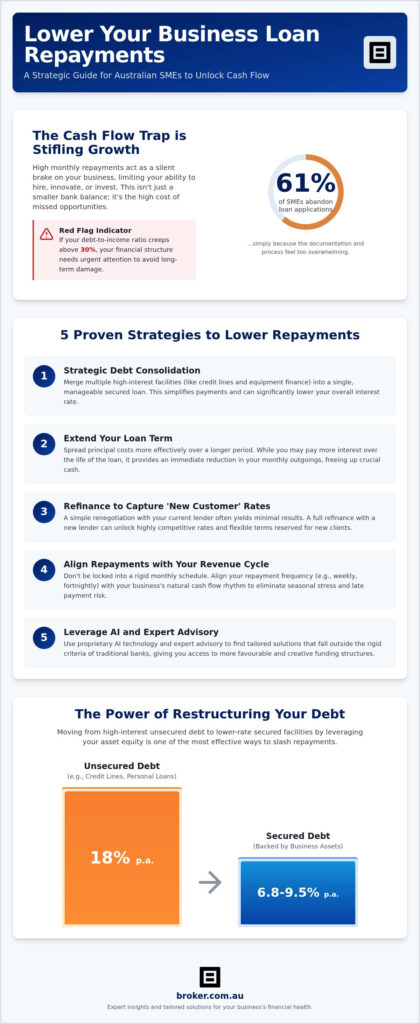
High monthly repayments act as a silent brake on your business momentum. When a significant portion of your revenue is diverted to servicing debt, you’re caught in the “Cash Flow Trap.” This isn’t just about a smaller bank balance at the end of the month; it’s about the missed opportunities to hire new talent, upgrade equipment, or invest in marketing. In an economic climate where the RBA cash rate sits at 4.35%, every dollar tied up in inefficient interest is a dollar that isn’t working for your future. Cash is oxygen for an enterprise. Without it, growth suffocates.
Think about the opportunity cost. If you could free up an extra 15% in monthly liquidity by implementing strategies to lower business loan repayments, what would that look like for your bottom line? For many Australian SMEs, that 15% represents the difference between stagnation and scaling. Debt stress also takes a heavy psychological toll on owners. It clouds decision-making and leads to defensive, risk-averse strategies rather than the bold moves that define market leaders. If your debt-to-income ratio is creeping above 30%, it’s a clear red flag that your current structure needs urgent attention.
The Real Cost of High-Interest Business Debt
Legacy loans often carry rates and terms that no longer reflect the current market or your improved business profile. Over time, compounding interest on older facilities can quietly drain your reserves. Tight cash flow can also put your credit rating at risk if you’re constantly scrambling to meet deadlines. To maintain a healthy enterprise, you must keep a close eye on your Debt Service Coverage Ratio (DSCR), which is a key metric that compares your operating income to your total debt obligations. Understanding Repayment Plans and how they impact your DSCR is essential for long-term stability. If your ratio is low, lenders see you as high-risk, which makes future funding more expensive and harder to access.
Debt as a Tool vs. Debt as a Hindrance
There’s a fundamental difference between “good debt” that fuels a high return on investment and “stagnant debt” that simply drains resources. Good debt allows you to acquire an asset or fund a project that generates more income than the cost of the loan. Stagnant debt, however, often stems from poorly structured working capital or outdated equipment finance that no longer serves your 2026 business goals. You should regularly assess if your current loan facilities still align with your operational needs. A professional health check with an award-winning broker can reveal if your debt is still a useful tool or if it has become a hindrance. Our role as a high-level fixer is to ensure your finance structure supports your dreams, providing the tailored insight needed to move from uncertainty to relief.
Strategic Debt Restructuring: Beyond Just a Lower Interest Rate
Restructuring isn’t just a buzzword; it’s a fundamental re-engineering of your balance sheet. While many owners focus solely on the headline interest rate, the most effective strategies to lower business loan repayments often involve deep structural changes. For instance, leveraging asset equity allows you to move from unsecured debt, which can carry rates as high as 18% p.a., toward secured facilities. These secured options typically offer much lower rates, often ranging between 6.8% and 9.5% p.a. as of August 2026. This shift immediately reduces the monthly burden while providing a more stable foundation for future growth.
More advanced tactics include debt recycling, where you convert non-deductible debt into deductible debt to improve your overall tax position. Additionally, negotiating interest-only periods can provide vital relief during short-term expansion or recovery phases. By only paying the interest component for a set time, you preserve working capital for immediate operational needs. These Strategies for improving your business’s finances ensure your capital remains fluid and productive rather than being locked away in principal repayments during a lean spell.
Consolidation: Cleaning Up Your Balance Sheet
Managing multiple high-interest facilities, such as unsecured lines of credit and separate equipment finance, is often a recipe for administrative and financial stress. Consolidation merges these into a single, manageable secured loan. The primary advantage is the significantly lower interest rate and a single monthly outgoing. However, you must weigh this against the risk of putting business assets on the line. The biggest mistake Australian business owners make is the “set and forget” approach. Markets evolve, and your loan portfolio should too. If you’re feeling overwhelmed by multiple debt facilities, I’m interested in helping you streamline your commitments into a more efficient structure.
Balloon Payments and Term Extensions
Spreading your principal across a longer period is a classic way to lower monthly outgoings. While this increases the total interest paid over the life of the loan, the immediate cash flow relief can be transformative. Another option is a balloon payment, also known as a residual. By deferring a portion of the principal until the end of the term, your monthly obligations drop sharply. This is particularly effective for equipment or vehicle finance where the asset retains value. The goal is to structure these extensions carefully to avoid triggering a full loan reassessment, keeping your transition as seamless and efficient as possible.
Refinancing vs. Renegotiating: Choosing the Right Path for Your Cash Flow
Deciding whether to stay with your current lender or move to a new one is a pivotal moment for any business owner. Renegotiation is often the path of least resistance. It involves staying with your existing bank but demanding better terms based on your track record. Refinancing, on the other hand, is the process of moving your debt to a different institution to capture competitive “New Customer” rates. It’s a frustrating reality in the Australian banking landscape that long-term clients often pay a “Loyalty Tax.” Banks frequently offer their best rates to attract new business, while existing customers are left on higher legacy rates. Reviewing your position is one of the most effective strategies to lower business loan repayments and reclaim that lost liquidity.
Before making a move, you must calculate your break-even point. Refinancing isn’t free; it involves application fees, valuation costs, and sometimes exit fees from your current lender. In 2026, establishment fees can range from 3% to 6% of the loan amount. If the monthly savings from a lower interest rate don’t outweigh these upfront costs within a reasonable period, staying put might be the wiser financial move. However, if the gap between your current rate and the market average is wide, the long-term savings usually justify the initial investment.
When to Pressure Your Current Bank
You have more leverage than you might think, especially if your business performance has improved since you first signed your loan. Higher turnover, consistent cash flow, or additional collateral like commercial property are powerful bargaining chips. Our role as an expert guide is to manage these tough conversations for you. We help you organise the necessary documentation, such as up-to-date financial modelling and tax portals, to prove you’re a lower-risk prospect. Often, the mere threat of moving your business elsewhere is enough to make a bank manager reconsider your current interest margin.
The Refinancing Process in 2026
The lending landscape has shifted dramatically. In 2026, 31% of SMEs now prefer non-bank lenders over traditional institutions because they offer more flexible terms and faster approvals. Modern digital lending platforms have shortened the refinancing turnaround time from weeks to just a few days. By using proprietary AI to scan the market, we provide inside access to the best rates across a panel of over 80 lenders. This streamlined approach removes the inherent anxiety of high-stakes decisions, ensuring you’re in good hands throughout the transition. Whether it’s a secured business loan or specialised equipment finance, the goal is to move you from a state of complexity toward streamlined confidence.
Optimising Your Repayment Schedule: Alignment with Revenue Cycles
Timing is everything in business. One of the most overlooked strategies to lower business loan repayments involves synchronising your outgoings with your actual income. Most traditional lenders default to a rigid monthly structure, but this often ignores the natural pulse of your industry. If your revenue is lumpy, a fixed monthly bill can create unnecessary stress during lean periods. By re-engineering your schedule to match your revenue cycles, you can preserve liquidity without increasing your total debt. This is about working smarter, not harder, with the capital you already have.
Consider the “Buffer Strategy.” By using a Line of Credit alongside your primary loan, you can manage repayments during quieter months and pay the facility down when cash flow peaks. We recently helped a retail enterprise that was struggling with the disconnect between their weekend-heavy sales and a mid-week loan debit. By shifting their payment date to Tuesday, allowing weekend takings to clear first, and moving to a more frequent schedule, they saved approximately $2,000 a month in interest costs and avoided expensive overdraft fees. Small tweaks to the “when” can be just as powerful as changes to the “how much.”
Matching Repayments to Industry Rhythms
Agricultural, tourism, and retail businesses rarely see a flat income line across the year. If you’re running a ski lodge or a harvest-dependent farm, you shouldn’t be saddled with the same heavy repayment in your off-season as you carry in your peak. We specialise in negotiating “payment holidays” or flexible seasonal structures into loan agreements. This allows you to prioritise higher principal reductions when the till is full and switch to interest-only or reduced payments when things quieten down. If your current bank isn’t this flexible, I’m interested in showing you how non-bank lenders provide the operational agility you actually need.
Frequency and Timing Hacks
The math behind repayment frequency is simple but effective. Switching from monthly to fortnightly payments can significantly reduce the total interest you pay over the life of the loan. Because there are 26 fortnights in a year, you effectively make an extra month’s worth of repayments annually without feeling the pinch in your daily budget. Additionally, using an offset account for your Working Capital Finance or Secured Business Loan ensures that every spare dollar in your account is working to lower your interest component. Aligning these dates with your BAS or GST cycles can also simplify your bookkeeping, moving you from a state of constant administrative catch-up to streamlined financial confidence.
How Broker.com.au Uses AI and Expert Insights to Lower Your Debt Burden
Executing the right financial move requires more than just a search engine; it requires a high-level fixer who understands the nuances of the Australian lending landscape. At Broker.com.au, we don’t just look at a spreadsheet. We look at your enterprise’s entire trajectory. Our award-winning approach combines cutting-edge digital tools with high-level corporate advisory to deliver effective strategies to lower business loan repayments for enterprises of all sizes. We move you from a state of uncertainty toward a feeling of streamlined confidence, ensuring your debt works for you rather than against you.
The 2026 economic climate demands agility. With traditional banks becoming increasingly stringent, many business owners feel trapped by rigid criteria. We act as your expert guide, providing inside access to a panel of over 80 lenders, including boutique non-bank specialists that the average consumer simply cannot access on their own. Whether you need a Secured Business Loan restructure or Business Acquisition Funding, we handle the heavy lifting of negotiations and paperwork so you can focus on running your business.
The AI Advantage in Commercial Lending
Our proprietary AI technology is a game-changer for time-poor directors. Instead of spending weeks manually comparing terms, our system scans the entire Australian market in minutes to identify the lowest repayments and most favourable structures. This technology identifies “hidden” lenders and niche products that traditional banks won’t mention. We match your specific industry risk profile to the right lender with surgical precision. This speed is vital; it allows you to move from “I’m interested” to “Approved” faster than ever, capturing competitive rates before the market shifts. It’s a seamless, efficient process designed to alleviate the inherent anxiety of high-stakes financial decisions.
A Human Touch in a Digital World
While our technology provides the speed, our people provide the insight. Having a dedicated broker like Matt or Kylie makes a significant difference, especially during complex restructures or M&A activity. We specialise in situations that fall outside the norm, providing tailored advice that considers your long-term dreams and immediate cash flow needs. Our corporate advisory team goes beyond traditional brokerage, helping you with sophisticated financial modelling to ensure your large-scale debt is structured for sustainable growth. We stay with you long after the loan is settled, acting as a proactive partner in your success. If you’re ready to see how a bespoke structure can transform your bottom line, I’m interested in lowering my business loan repayments and reclaiming my business’s momentum.
Reclaim Your Financial Momentum Today
Lowering your debt burden in 2026 requires more than just a lower interest rate; it demands a strategic re-engineering of your entire finance structure. By consolidating high-interest facilities and aligning your repayment frequency with your natural revenue cycles, you transform debt from a hindrance into a powerful growth tool. Implementing these strategies to lower business loan repayments ensures that your working capital remains fluid, allowing you to reinvest in staff and equipment when it matters most.
You don’t have to navigate these complex decisions alone. As an award-winning broker, we provide the inside access and local insights needed to unlock the best market rates. Our proprietary AI technology for 2026 lending markets identifies tailored solutions that traditional banks often ignore, a fact reflected in our five-star client testimonials. We handle the heavy lifting and the tough bank negotiations so you can focus on your enterprise’s future. If you’re ready to move toward streamlined confidence and relief, I’m interested in lowering my repayments. You’ve worked hard to build your business; it’s time your finance structure worked just as hard for you.
Frequently Asked Questions
Can I lower my business loan repayments without refinancing?
Yes, you can often negotiate better terms with your current lender without moving your debt elsewhere. This might involve switching to an interest-only period for six to twelve months or extending your loan term to spread the principal. These are valid strategies to lower business loan repayments when you want to avoid the administrative burden of a full refinance. However, success depends on your recent trading history and current Debt Service Coverage Ratio.
Will extending my loan term cost me more in the long run?
Extending your loan term will increase the total interest paid over the life of the facility, even if your monthly outgoings drop. While it provides immediate cash flow relief, the compounding interest over the additional years adds up. You must weigh the benefit of having extra liquidity today against the long-term cost. It’s an effective tool for short-term survival or expansion, but it should be used strategically rather than as a permanent solution.
Does a balloon payment make sense for my business vehicle loan?
A balloon payment makes sense if your priority is minimising monthly overheads for Vehicle Finance or equipment. By deferring a large portion of the principal until the end of the term, you free up working capital for daily operations. This structure is ideal if you intend to sell the asset or refinance the residual amount before the final payment is due. It ensures your monthly cash flow remains predictable and manageable during the term.
How much does it cost to refinance a business loan in Australia?
Refinancing costs vary depending on the complexity of your debt, but you should typically budget for establishment fees between 3% and 6% of the loan amount. Other expenses include property valuations for Commercial Property Loans and potential exit fees from your existing lender. While these upfront costs can be significant, the long-term interest savings from a more efficient structure often result in a break-even point within the first year of the new facility.
Can I consolidate my unsecured business loan with my commercial property loan?
Consolidating an Unsecured Business Loan into a Commercial Property Loan is a powerful way to reduce your interest margin. Unsecured rates in 2026 can reach 18% p.a., whereas secured facilities are often significantly lower. By using the equity in your commercial premises as collateral, you can merge multiple high-interest debts into one manageable monthly payment. This strategy simplifies your bookkeeping and immediately lowers the cost of servicing your business debt.
How often should I review my business loan structure?
You should review your loan structure at least once a year or whenever your business undergoes a major change, such as an acquisition. The Australian lending market is dynamic, and banks often reserve their best rates for new customers, leaving long-term clients with a “Loyalty Tax.” Regular reviews ensure you aren’t paying more than necessary and that your current facilities still align with your operational goals and revenue cycles.
What documents do I need to prepare for a loan restructure?
To prepare for a restructure, you’ll need up-to-date financial records including your profit and loss statements, balance sheets, and recent Business Activity Statements (BAS). Lenders will also want to see your tax portal balance and six months of bank statements to verify consistent cash flow. Having these documents organised allows our proprietary AI to quickly match you with the right lender, moving you from uncertainty to streamlined confidence and relief.
Can a broker help if I have already been knocked back by my big bank?
Absolutely, as we specialise in finding solutions for situations that fall outside the rigid criteria of major banks. In 2026, 31% of SMEs now prefer non-bank lenders who offer more flexible terms and faster approvals. If you’ve been knocked back, our “High-Level Fixer” approach provides inside access to alternative funding sources. We look at your business’s true potential, not just a standard bank spreadsheet, to secure the support you need.