
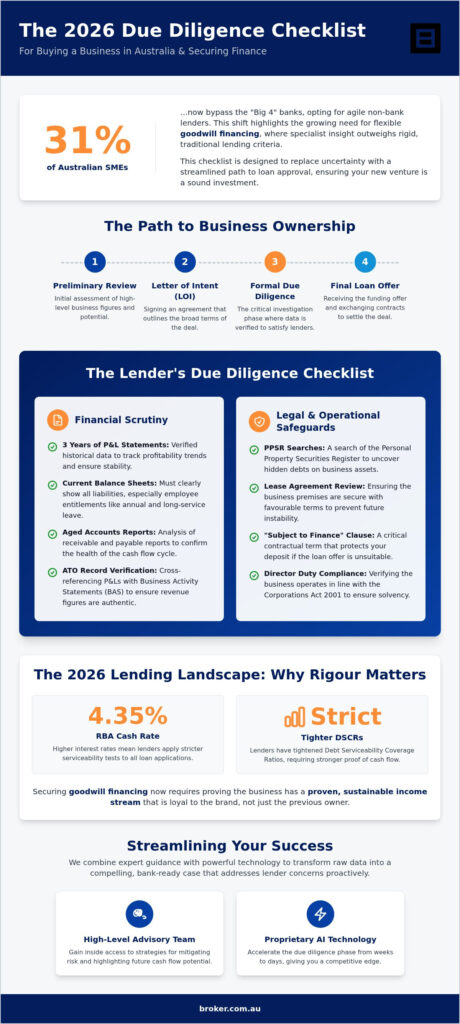
Did you know that 31% of Australian small and medium enterprises now bypass the “Big 4” banks in favour of agile non-bank lenders when acquiring a business? This shift is often driven by the need for more flexible goodwill financing australia wide, where specialist insight and inside access frequently outweigh the rigid, traditional criteria used by larger institutions.
Buying a business is one of the most significant financial leaps you’ll ever take. It’s completely natural to feel a knot in your stomach over potential hidden debts or whether the ASIC records and PPSR searches are truly clean. You want to be certain that the asking price reflects reality, not just a seller’s optimism. We’ve designed this 2026 due diligence checklist to replace that uncertainty with a streamlined path to loan approval. You’ll learn how to satisfy strict lending requirements while ensuring your new venture is a sound investment. From verifying the latest 2026 ASIC fee structures to navigating upcoming CGT adjustments, this guide provides the clarity you need for a confident, stress-free transition into ownership.
Key Takeaways
- Understand why Australian lenders demand a comprehensive due diligence report before approving business acquisition funding.
- Identify the critical financial records required for scrutiny, including three years of verified P&L statements and current employee entitlement liabilities.
- Master the legal safeguards, such as PPSR searches and lease reviews, that ensure you aren’t inheriting hidden debts or unstable premises.
- Gain inside access to strategies for securing goodwill financing australia wide by focusing on future cash flow and risk mitigation.
- Learn how to assemble a high-level advisory team and use proprietary AI technology to make the application process seamless and stress-free.
Table of Contents
- Understanding Due Diligence in the Context of Acquisition Finance
- The Financial Due Diligence Checklist: What Lenders Scrutinise
- Legal and Operational Safeguards for Loan Security
- Assembling Your Advisory Team and Managing Deal Red Flags
- How Broker.com.au Streamlines Your Business Purchase Funding
Understanding Due Diligence in the Context of Acquisition Finance
Due diligence isn’t just a hurdle; it’s a systematic investigation into the financial and operational health of a target business before you sign a binding commitment. In the Australian market, this due diligence process serves as the bedrock for any successful acquisition. While you, as the buyer, are hunting for value and growth potential, your lender is looking for something else entirely: risk mitigation. They need to see a clear, data-backed reason to believe the business will thrive under your leadership.
Lenders require a comprehensive due diligence report because they’re essentially partnering with you on the debt. They need to know that the cash flow is robust enough to cover interest and principal without fail. Our role as your expert guide is to take the mountain of raw data, including tax portals, bank statements, and staff contracts, and transform it into a bank-ready case. We organise this information to present a professional narrative that addresses lender concerns before they even ask.
Why 2026 Lending Standards Require More Rigour
With the RBA cash rate sitting at 4.35% as of mid-2026, lenders have tightened their Debt Serviceability Coverage Ratios (DSCR). They’re no longer satisfied with “near enough” figures. In this economic landscape, securing goodwill financing australia wide requires a shift in perspective; you’re not just buying a name, you’re buying a proven, sustainable income stream. Lenders want to see that customers are loyal to the brand, not just the outgoing owner. Under the Corporations Act 2001, incoming directors have a strict legal duty to exercise their powers with care and diligence to ensure the company remains solvent.
The Timeline of a Standard Australian Acquisition
Most deals follow a predictable rhythm that begins with a preliminary review, followed by a Letter of Intent (LOI) that outlines the broad terms. Once the LOI is signed, you enter the formal due diligence period. It’s vital to include a “subject to finance” clause in your sales contract to protect your deposit if the final funding offer doesn’t meet your needs. While this phase used to take weeks of manual labour, our proprietary AI technology now allows us to verify data in days. This speed gives you a competitive edge, ensuring you can move from “I’m interested” to a settled deal with streamlined confidence. This efficient approach is particularly effective when arranging goodwill financing australia wide for fast-moving sectors like logistics or manufacturing.
- Phase 1: Preliminary review of high-level figures.
- Phase 2: Signing the Letter of Intent (LOI).
- Phase 3: Formal due diligence and data verification.
- Phase 4: Final loan offer and contract exchange.
The Financial Due Diligence Checklist: What Lenders Scrutinise
Lenders don’t just look at the potential of a business; they look at the hard evidence of its performance. To secure a competitive offer, you must provide verified Profit and Loss (P&L) statements for the last three financial years. This historical data allows credit officers to track trends and ensure that the profitability isn’t just a recent spike. They want to see a track record of stability that justifies the investment.
Balance sheets are equally critical during this phase. They must clearly show all current liabilities, particularly employee entitlements such as accrued annual leave and long-service leave. In the Australian market, these obligations stay with the business. If they aren’t properly accounted for in the purchase price or the loan structure, they can create an immediate cash flow strain. Lenders also require Aged Accounts Receivable and Payable reports. These documents reveal the true health of the cash flow cycle, showing whether customers pay on time and if the business is keeping up with its own vendor commitments.
A vital step in the Australian context is verifying reported turnover against Australian Taxation Office (ATO) records. Lenders will cross-reference your P&L statements with Business Activity Statements (BAS). This ensures the revenue figures are authentic and have been consistently reported for tax purposes. If you are seeking goodwill financing australia wide, this level of transparency is non-negotiable for high-level loan approval.
Analysing Cash Flow and Profitability
Lenders focus on the “true” profitability of a business, often referred to as EBITDA. We help you identify “Add-backs”, which are one-off or personal expenses the current owner runs through the business that won’t continue under your ownership. These might include personal vehicle leases or non-recurring legal fees. Removing these reveals the actual owner benefit. Be aware that “lumpy” revenue patterns, where income fluctuates wildly between months, can make conservative lenders nervous. They want to see that the business can comfortably cover new loan repayments plus a safety buffer of at least 20% to 25% to account for market shifts.
Tax and Compliance Verification
Compliance is a major factor in risk assessment. You must verify that all Superannuation Guarantee contributions for employees are up to date. Lenders are increasingly wary of businesses with unpaid super or existing ATO debt payment arrangements. Obtaining a Tax Clearance Certificate is a vital part of the acquisition process; it confirms the seller has met their tax obligations, ensuring you don’t inherit a surprise bill from the revenue office. If you’re unsure how your target’s figures will look to a credit officer, our team can help you get started with a preliminary assessment of your funding capacity.
Legal and Operational Safeguards for Loan Security
Lenders need more than just healthy profit figures; they need to know the business is legally bulletproof. While the financial due diligence we covered previously proves the business can afford the debt, legal due diligence ensures the business actually owns what it claims to sell. One of the first steps in any Australian acquisition is conducting PPSR searches via the Personal Property Securities Register. This check ensures that the plant, equipment, or vehicles you’re buying aren’t already pledged as security to another lender or supplier. An unreleased charge can derail a loan application instantly, as no bank wants to sit in second place behind an unknown creditor.
The commercial lease is the next critical anchor. Lenders generally require the lease term, including options to renew, to match or exceed the duration of the business loan. We pay close attention to demolition clauses, which are common in Australian retail and industrial hubs. These clauses allow a landlord to terminate a lease for redevelopment, potentially destroying the business’s value overnight. When you’re arranging goodwill financing australia wide, the strength of your tenure is often as important as your turnover.
Intangible assets often hold the most value in modern acquisitions. We verify that all Intellectual Property (IP), including trademarks, domain names, and proprietary software, is legally owned by the entity you’re purchasing. Simultaneously, we scrutinise employment contracts to identify “key person dependencies”. If the business’s success relies entirely on a single manager who isn’t staying post-settlement, the lender will view the deal as high-risk. Securing goodwill financing australia wide depends on proving that the brand and systems can survive the transition of ownership.
Asset and Equipment Verification
Never rely solely on a spreadsheet. A physical inspection of plant and equipment is essential to confirm that the assets are in the condition described. We recommend checking maintenance logs for heavy machinery or vehicle fleets to ensure there isn’t a massive repair bill looming just after settlement. Keep in mind that existing Asset Finance on the books will impact your overall borrowing power. If the equipment is already under a lease or chattel mortgage, that debt must be factored into your total serviceability calculations.
Contractual and Supplier Review
Supplier relationships are the lifeblood of many SMEs. We look for “Change of Control” clauses in major supplier agreements that could allow a vendor to cancel the contract once you take over. Similarly, customer contracts should be reviewed for tenure and termination rights to ensure your revenue won’t vanish on day one. Finally, we verify that all essential business licences, such as liquor, council, or industry-specific permits, are transferable to the new owner. Without these, the business cannot legally operate, regardless of how much funding you’ve secured.
Assembling Your Advisory Team and Managing Deal Red Flags
Success in a high-stakes acquisition depends on the quality of the experts you have in your corner. Navigating the 2026 lending environment requires more than just a good credit score; it demands a “High-Level Fixer” mentality. You need a team that can translate complex data into a narrative that lenders find irresistible. This collaborative approach ensures that every financial, legal, and operational stone is turned over before you commit your capital.
- Step 1: Engage a Specialist Business Broker. A broker provides the “inside access” needed to reach non-bank and private lending pools. Since 31% of SMEs now prefer non-bank lenders, having a partner who understands these alternative appetites is essential for securing goodwill financing australia wide.
- Step 2: Appoint a Commercial Lawyer. Your solicitor must review the Sale of Business Agreement (SOBA) with a focus on warranties and indemnities. They ensure that the “subject to finance” clauses we discussed earlier are robust enough to protect your interests.
- Step 3: Work with a CPA or Chartered Accountant. While you look at growth, your accountant performs forensic financial analysis. They verify the “Add-backs” and EBITDA figures to ensure the business’s profitability isn’t just a clever accounting trick.
- Step 4: Identify Deal Breakers Early. Walking away from a bad deal is a victory. Identifying unfixable issues in the preliminary stage saves you thousands in wasted legal and accounting fees.
Common Red Flags That Stop Loans in Their Tracks
Lenders are trained to spot inconsistencies that suggest hidden instability. Declining revenue trends are a major concern; if the top line is shrinking, you must provide a documented, credible explanation to satisfy credit officers. High customer concentration is another significant hurdle. If a single client represents more than 40% of the total revenue, the lender will view the business as too vulnerable to a single point of failure. Finally, any active legal proceedings or unresolved disputes with former employees can lead to an immediate loan rejection, as the potential liability is often impossible to quantify accurately.
The Role of Commercial Advisory in 2026
Modern advisory goes beyond simple document collection. Specialists now use AI-driven financial modelling to project how the business will perform under your specific management style, which provides lenders with a clear roadmap for debt serviceability. Your advisors also help structure the debt effectively, balancing secured and unsecured portions to maximise tax efficiency. Securing inside access to the best rates through a specialist intermediary can save an SME thousands of dollars in interest over the life of the loan. If you are ready to build your acquisition squad, you can speak with an expert today to begin your journey with confidence.
How Broker.com.au Streamlines Your Business Purchase Funding
Securing the capital for a major acquisition shouldn’t feel like an uphill battle against bureaucracy. We understand that the transition from a prospective buyer to a confident business owner is paved with complex paperwork and high-stakes decisions. Our proprietary AI technology simplifies the often-daunting document collection phase by accurately categorising your financial data in record time. This allows our team to focus on what matters most: acting as your expert guide to navigate the nuances of the Australian lending market.
While many traditional lenders shy away from intangible assets, we embrace the challenge. We specialise in structuring comprehensive finance packages that integrate goodwill financing australia wide with essential equipment loans and initial working capital. By leveraging our technology, we cut through the noise of traditional bank applications, ensuring your data is verified and presented in a format that credit officers actually want to see. This proactive approach transforms a high-pressure situation into a seamless, professional experience.
Our philosophy is built on accessibility and transparency. We’ve replaced the aggressive “Apply Now” culture with a low-pressure “I’m interested” consultation process. This allows you to start a conversation with a seasoned partner who prioritises your specific needs over a generic transaction. Whether you are looking for secured funding or exploring the possibilities of an unsecured business loan, we provide the inside access required to unlock the best possible terms for your unique situation.
Tailored Finance Solutions for Every SME
No two business purchases are identical, which is why we maintain an extensive panel of lenders ranging from the major banks to boutique acquisition funders. If you are targeting a high-cash-flow service business, we can explore unsecured business loan options that focus on your future revenue rather than physical bricks and mortar. For those looking to integrate their retirement strategy into their business purchase, we offer specialised expertise in SMSF property acquisitions. This breadth of choice ensures that your goodwill financing australia requirements are met with a solution that fits your long-term goals perfectly.
Get Started with Confidence
Our award-winning team is the preferred partner for Australian business owners because we handle the heavy lifting. From the moment you express interest, we manage the intricate dialogue with lenders, allowing you to focus on the operational handover and staff management. We promise a stress-free path to settlement, backed by local insights and a can-do attitude that goes above and beyond the norm. When you are ready to take the next step toward ownership, we are here to ensure you do so with streamlined confidence. I’m interested in business acquisition funding
Secure Your Acquisition with Confidence
Success in the Australian market requires more than just a vision; it demands a rigorous approach to risk management. By following this 2026 due diligence checklist, you’ve moved from uncertainty toward a state of streamlined confidence. You now understand how to verify cash flow through BAS records and protect your tenure with a robust lease review. This preparation is the foundation for securing goodwill financing australia wide, allowing you to focus on the growth of your new enterprise rather than hidden liabilities.
As an award-winning Australian brokerage, we specialise in the complexities of business acquisitions. Our proprietary AI technology provides faster approvals by simplifying the document phase, ensuring you’re always in good hands. We act as your expert guide, providing inside access to the best rates and a stress-free path to settlement. When you’re ready to turn your goals into reality, our team is standing by to handle the heavy lifting for you.
I’m interested in a business purchase loan
Your transition into ownership should be an exciting milestone. With the right data and a dedicated advisory team, you can step into your new role with absolute certainty.
Frequently Asked Questions
How long does due diligence usually take for an Australian business loan?
A thorough due diligence period usually spans four to eight weeks, depending on the complexity of the entity and the industry sector. While our proprietary AI technology can verify financial data in just a few days, the legal and administrative components often require more time. You should allow enough room in your contract to satisfy both your own value checks and the lender’s risk assessment before settlement.
Can I get a business purchase loan if the business has a lot of goodwill?
You certainly can, provided the business demonstrates strong, sustainable cash flow to service the debt. Securing goodwill financing australia wide often involves looking beyond the “Big 4” banks to specialist lenders who have a higher appetite for intangible assets. These lenders prioritise future earnings potential and your industry experience over physical collateral, making them ideal for service-based acquisitions.
What is the most common financial red flag lenders look for?
The most frequent red flag is declining revenue trends that lack a documented, credible explanation. Lenders also scrutinise customer concentration; if more than 40% of your turnover relies on a single client, it creates a “single point of failure” risk. Clear, transparent records and a proactive explanation are the best ways to alleviate these concerns during the application process.
Do I need to provide a personal guarantee for a business purchase loan?
Yes, most Australian lenders require a personal guarantee from the directors for an SME business purchase loan. This remains true even for secured loans, as it aligns your personal interests with the success of the business. It’s a standard requirement designed to provide the lender with an additional layer of security and commitment throughout the life of the loan.
What documents do I need for a low-doc business loan in 2026?
For a low-doc application in 2026, you generally need your most recent Business Activity Statements (BAS) and six to twelve months of trading bank statements. Some lenders may also request an accountant’s declaration to confirm your income levels. These products are ideal for fast-moving acquisitions where full financial statements aren’t yet finalised for the current financial period.
Is a ‘subject to finance’ clause enough to protect me during due diligence?
While a “subject to finance” clause is essential, it isn’t a total safety net unless the wording is precise. You should ensure the clause specifies that the finance must be on terms “satisfactory to the purchaser.” This prevents you from being legally forced into a high-interest loan that doesn’t fit your long-term financial modelling or acquisition strategy.
How does the PPSR affect my ability to get equipment finance?
The PPSR is critical because any existing “security interest” registered against an asset will prevent you from using it as collateral for new finance. If a supplier has an unreleased charge on a piece of machinery, a new lender won’t provide equipment finance until that interest is discharged. Always conduct a thorough PPSR search early in the due diligence phase to avoid delays.
What is the difference between secured and unsecured acquisition funding?
Secured funding is backed by a physical asset, such as commercial property, which often results in lower interest rates. Unsecured acquisition funding relies on the strength of the business’s cash flow and is a common path for goodwill financing australia for service-based industries. Choosing the right structure depends on your available equity and the specific asset mix of the business you’re purchasing.