
What if the most valuable asset in your company is the one your bank refuses to acknowledge? It’s a frustrating reality for many Australian business owners. You’ve spent years building a reputation and a loyal client base, yet when you apply for finance, the “blue sky” value of your goodwill often gets dismissed in favour of tangible assets. With the RBA cash rate at 4.10% as of mid-2026, lenders are scrutinising serviceability more than ever. Securing an accurate goodwill valuation for business loan australia applications is now the critical bridge between a rejected file and a successful approval.
We know the anxiety that comes with complex financial jargon like EBITDA and the fear of being undervalued by a traditional lender. You deserve a clear path to the capital you need without the stress of asset-backing uncertainty. This article explains exactly how Australian lenders calculate your business value and goodwill to secure funding for growth or acquisition. You’ll discover the specific valuation multiples currently used in the 2026 market and how to present your financial position to unlock your true borrowing power.
Key Takeaways
- Understand why banks value your business more conservatively than the open market, prioritising historical debt serviceability over future growth potential.
- Master the specific formulas lenders use, such as EBITDA multiples and the Asset-Based Approach, to determine your true borrowing capacity.
- Learn how to professionally prepare your financial statements to secure a successful goodwill valuation for business loan australia applications.
- Identify the critical impact your ABN history, GST compliance, and existing finance facilities have on your risk profile.
- Discover how to leverage proprietary AI technology to match your unique valuation with the ideal lender from a panel of over 50 Australian providers.
Table of Contents
- Why Valuing a Business for a Loan Differs from a Sale
- Common Business Valuation Methods Lenders Use in Australia
- The Lender’s Lens: Assessing Risk and Financial Health
- Preparing Your Business for a Professional Loan Valuation
- Navigating Acquisition and Growth Funding with Broker.com.au
Why Valuing a Business for a Loan Differs from a Sale
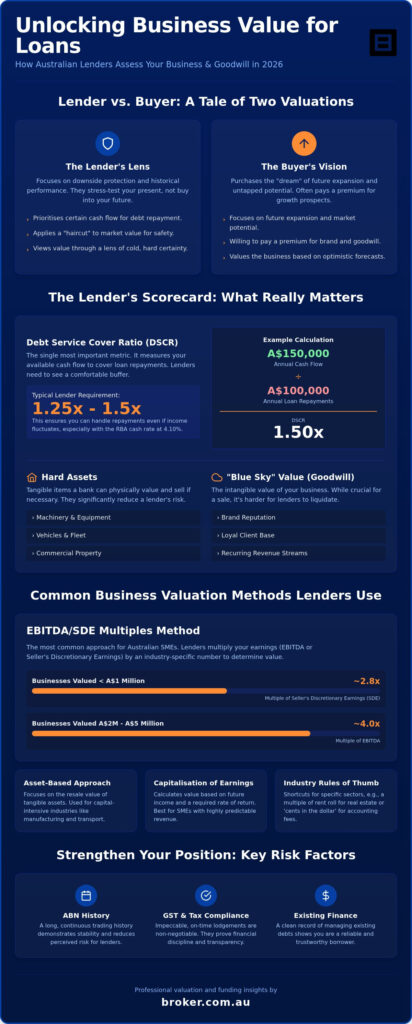
Most business owners assume a professional valuation prepared for a sale is the same as one prepared for a bank. It isn’t. When a buyer looks at your company, they’re often purchasing the “dream” of future expansion and untapped markets. A lender, however, views your business through a lens of cold, hard certainty. They aren’t buying your future; they’re stress-testing your present. This fundamental gap is why a goodwill valuation for business loan australia often comes in lower than a market appraisal. While a buyer might pay a premium for your brand’s potential, a credit officer focuses on downside protection. They apply what the industry calls a “haircut” to market values. This ensures that even if market conditions shift, the bank’s exposure remains covered. Navigating this gap requires a Business Acquisition Funding specialist who understands how to translate your business’s value into a language banks trust.
The Concept of Debt Serviceability
In a loan assessment, your net profit is often a secondary concern. Lenders prioritise operating cash flow. They want to know exactly how much “free” cash is available after all expenses are paid to cover new debt. This is measured through the Debt Service Cover Ratio (DSCR). If your business generates A$150,000 in annual cash flow and your loan repayments are A$100,000, your DSCR is 1.5x. Most Australian lenders in 2026 look for a ratio of at least 1.25x to 1.5x to account for the current RBA cash rate of 4.10%. They need to see you can comfortably pay back both the principal and interest without suffocating your daily operations.
Blue Sky vs. Hard Assets
Lenders distinguish sharply between “hard assets” and “Blue Sky” value. Hard assets are things a bank can touch and sell if things go wrong, such as machinery, vehicles, or property. Blue Sky refers to the intangible value of your reputation and client relationships, technically known as goodwill in accounting. While goodwill is a legitimate asset, it’s difficult to liquidate in a hurry. This is why Secured Business Loans typically offer significantly more competitive interest rates. By providing tangible security, you reduce the lender’s risk, which often unlocks higher borrowing power than relying on goodwill alone. If you have significant equipment or vehicles, leveraging Asset Finance can also be a strategic way to improve your overall loan structure.
Common Business Valuation Methods Lenders Use in Australia
Lenders don’t just pick a number out of the air. They use rigorous frameworks to find a “floor” value that protects their capital. While the Australian government outlines several business valuation methods, banks usually narrow their focus to the ones that prove immediate repayment capacity. This ensures they aren’t over-leveraging themselves in a market where the RBA cash rate sits at 4.10%. The most common approach for Australian SMEs is the Earnings Multiple Method. Lenders take your EBITDA and apply a multiplier based on your industry, risk profile, and market position. Current 2026 data shows that privately held Australian businesses with a value under A$1 million are typically selling for approximately 2.8 times seller’s discretionary earnings (SDE). Larger enterprises valued between A$2 million and A$5 million often reach multiples of around 4.0 times EBITDA. For capital-intensive industries like manufacturing or transport, an Asset-Based Approach is used. This focuses on the “bones” of the business, specifically the resale value of machinery, vehicles, and inventory. Alternatively, for established SMEs with highly predictable revenue, lenders might use the Capitalisation of Future Earnings method. This calculates value based on the expected rate of return an investor requires. Some sectors follow specific “rules of thumb” that act as a shortcut for valuers. Real estate agencies are often valued on a multiple of their rent roll commission, while accounting firms might be valued on a “cents in the dollar” basis of their recurring fees. If you’re unsure where your business sits on this spectrum, our specialists in Business Acquisition Funding can help clarify your position.
EBITDA Multiples Explained
EBITDA represents a company’s core operating profitability by excluding non-operating expenses like interest, taxes, depreciation, and amortisation, providing a clear view of cash flow available for debt servicing in 2026. This metric is the baseline because it ignores how a business is financed, showing the bank the raw power of the operations. Lenders use it to compare your business against industry peers to see if your performance is sustainable or an outlier.
How Lenders Treat Goodwill
A successful goodwill valuation for business loan australia depends on distinguishing between personal and business goodwill. Personal goodwill, where the revenue relies on the current owner’s personal relationships, is a major red flag for lenders. They prefer business goodwill, which is tied to systems, brands, and recurring contracts that survive an ownership change. Lenders are rarely willing to fund 100% of a goodwill-heavy acquisition without some form of tangible security. You can strengthen your intangible value by formalising client contracts and documenting internal processes before the valuer arrives.
The Lender’s Lens: Assessing Risk and Financial Health
Lenders don’t just look at what you make; they look at how you make it. Your ABN history and GST compliance are the first indicators of a well-run operation. A business that has changed ABNs frequently or has a spotty record with the ATO will struggle to secure a high goodwill valuation for business loan australia. Lenders want a clean Business Activity Statement (BAS) history because it’s the ultimate proof of transparency and financial discipline. Your existing commitments also play a massive role in the final credit decision. If you have significant Asset Finance facilities for vehicles or equipment, these are deducted from your total borrowing power. Lenders call this “serviceability headroom.” They also scrutinise the “Quality of Earnings.” A business relying on one-off projects is viewed as high-risk compared to one with recurring, contract-based revenue streams. The more predictable your income, the more comfortable a lender feels financing the intangible value of your business.
Risk Weighting and Industry Sentiment
Lenders apply different risk weights based on your sector. In 2026, medical practices often receive more favourable terms than hospitality businesses due to their defensive nature in high-interest environments. Concentration risk is another potential deal-breaker. If more than 20% of your revenue comes from a single client, a lender will likely devalue your goodwill. They fear that the loss of that one relationship would collapse your ability to service the loan. Current economic factors, like the 4.10% RBA cash rate, mean lenders are prioritising stability over rapid, unproven growth.
Financial Modelling and Projections
Banks live in the past but lend for the future. While they require at least two years of historical performance, they also need to see where you’re going. A credible 3-year financial model is essential. This shouldn’t just be a spreadsheet of “best-case” scenarios. It needs to account for 2026 realities, such as the “Payday Super” regulations starting July 1, 2026, which impact short-term cash flow. Using AI-driven insights helps validate these assumptions. It shows the lender your projections are based on data, not just optimism. This level of preparation moves you from being a risky applicant to a strategic partner in the eyes of the credit team.
Preparing Your Business for a Professional Loan Valuation
Preparing for a goodwill valuation for business loan australia isn’t about hiding flaws; it’s about presenting your data so a lender can’t ignore your value. While some older government guides suggest preparing five years of financials, modern Australian lenders in 2026 typically focus on the last two financial years. They want to see consistent, high-quality data that proves your business is resilient. Start by organising your Profit & Loss statements and Balance Sheets. You should also conduct an internal audit of your equipment and physical asset register. Ensure all intellectual property (IP) and commercial leases are legally secured and up to date. A lender won’t value goodwill if the lease on your primary premises is about to expire. One of the most powerful tools in your preparation is the ‘Add-Back’ strategy. This involves identifying one-off expenses that artificially lower your net profit. Common add-backs include:
- One-time legal or professional fees.
- Personal expenses run through the business, like a family vehicle.
- Non-recurring repairs or maintenance.
- Owner salaries that are above or below market rates.
By adding these back, you standardise your earnings, which directly increases the EBITDA multiple used to calculate your loan amount.
The Role of Professional Appraisers
You might wonder if a preliminary estimate from a broker is enough. For small, unsecured facilities, it often is. However, for significant Business Acquisition Funding, lenders usually require a formal valuation from a recognised firm. Specialised corporate advisory valuations come with a cost, but they provide the “stamp of approval” that major Australian banks require. To find a valuer that lenders will accept, look for those with a RICS or API qualification who specialise in your specific industry.
Cleaning Up the Balance Sheet
Lenders view Director Loans as a major red flag, so aim to reduce or clear these before applying. Your Line of Credit should be structured to show healthy liquidity rather than being constantly maxed out. Regarding accounts receivable, you should write off any invoices that are more than 90 days overdue and unlikely to be collected; this shows the lender you have a realistic and honest view of your cash flow. If you’re ready to see how your current financials stack up against lender requirements, I’m interested in helping you find the right match.
Navigating Acquisition and Growth Funding with Broker.com.au
Securing a fair goodwill valuation for business loan australia applications in 2026 requires more than just a tidy set of books. It requires a strategic partner who can bridge the gap between your hard work and the bank’s rigid criteria. At Broker.com.au, we act as your expert guide, using proprietary AI technology to match your specific business profile with the ideal lender from our panel of over 50 Australian providers. This technology doesn’t just look at interest rates; it identifies which credit teams currently have an appetite for your specific industry and goodwill structure. Working with an award-winning broker gives you “inside access” to rates and terms that aren’t advertised to the general public. Banks often have “boutique” tiers for high-quality acquisitions that are only accessible through professional intermediaries. We help you move from a state of uncertainty to streamlined confidence by handling the complex negotiations and loan restructures on your behalf. Whether you’re looking for Business Acquisition Funding or a way to refinance existing debt to unlock equity, our team ensures your business is positioned for success.
Our Process: From Valuation to Settlement
We don’t just submit your documents; we translate your business value into a compelling narrative for credit departments. A spreadsheet shows numbers, but our team explains the strength of your recurring revenue and the stability of your market position. This “stress-free” approach means we manage the conversations with dozens of potential lenders simultaneously, ensuring you don’t have to repeat your story fifty times. Starting with us is simple. Our “I’m interested” approach is designed to be a low-pressure conversation where we first understand your goals before diving into the technicalities of a goodwill valuation for business loan australia.
Specialised Solutions for Business Owners
Your business doesn’t exist in a vacuum, and neither should your finance. We take a holistic view of your wealth, often combining Home Loans with business finance to create a strategy that protects your personal assets while funding your commercial dreams. To preserve your precious working capital, we also provide specialised fit-out and vehicle finance. This ensures you aren’t draining your cash reserves on equipment when those funds could be better used for growth. Ready to see what your business is worth to a lender? I’m interested.
Secure the Capital Your Business Deserves
Mastering the nuances of a goodwill valuation for business loan australia is the difference between stagnation and your next major acquisition. You now understand that lenders prioritise historical serviceability over future hype and that a well-prepared balance sheet is your strongest negotiating tool. By identifying strategic add-backs and cleaning up director loans, you present a narrative of stability that credit departments find impossible to ignore.
You don’t have to navigate the complexities of the 2026 lending landscape alone. Broker.com.au provides award-winning finance solutions backed by proprietary AI-powered applications to ensure your application lands with the right lender. With access to a broad panel of over 50 Australian lenders, our expert team is ready to help you find the most competitive rates and terms tailored to your specific needs.
If you’re ready to transform your business’s intangible value into tangible growth, I’m interested is the best way to start a low-pressure conversation. We’re here to help you turn your commercial goals into a stress-free reality. Your next chapter of growth is well within reach.
Frequently Asked Questions
What is the most common method for valuing an Australian SME for a loan?
The Earnings Multiple Method is the industry standard for Australian small to medium enterprises. Lenders take your EBITDA and apply a multiplier that reflects your industry risk and market position. In the 2026 market, businesses valued under A$1 million typically see multiples around 2.8x, while larger SMEs between A$2 million and A$5 million often reach 4.0x. This method provides a clear, data-driven baseline for a goodwill valuation for business loan australia.
Can I get a business loan based on my future revenue projections in 2026?
Lenders primarily rely on your historical performance from the last two financial years rather than future projections. While a solid three-year model is essential to show your growth strategy, banks prioritise “proven” cash flow to ensure you can meet repayments. This is particularly true with the current RBA cash rate of 4.10%, which has made lenders much more conservative regarding serviceability requirements.
How does ‘Goodwill’ affect my ability to get a secured business loan in Australia?
Goodwill is an intangible asset that lenders view as higher risk because it can’t be easily liquidated if the business fails. By opting for a secured business loan with property or equipment as collateral, you provide the bank with a “safety net” that offsets this risk. This security often allows the lender to fund a higher portion of the goodwill value while offering you more competitive interest rates.
What is a ‘Debt Service Cover Ratio’ and why does it matter for my valuation?
The Debt Service Cover Ratio (DSCR) measures your business’s ability to cover its debt obligations using its operating cash flow. It’s calculated by dividing your annual net operating income by your total annual debt service. In 2026, most Australian lenders require a DSCR between 1.25x and 1.5x. If your ratio falls below this, the lender will likely devalue your goodwill to reduce their exposure.
Will a lender accept my own internal valuation or do I need a professional appraiser?
Major Australian lenders require a professional appraisal from an independent, qualified valuer before approving significant funding. While your internal valuation is a helpful starting point for an initial conversation with a broker, it lacks the legal weight required for a formal credit submission. Professional valuers provide the objective “stamp of authority” that banks need to justify lending against intangible assets.
How long does a formal business valuation take for a commercial property loan?
A formal business valuation typically takes between 10 and 14 business days to complete. This timeframe allows the appraiser to review your financial statements, conduct industry research, and analyse comparable market data. If the valuation is linked to a commercial property loan, the process might be slightly longer as the valuer needs to coordinate property inspections alongside the financial analysis.
What ‘Add-Backs’ can I use to increase my business valuation for a lender?
You can use “Add-Backs” to restore profits that were reduced by non-recurring or personal expenses. Common examples include one-off legal fees, personal vehicle costs run through the company, and owner salaries that exceed market rates. Correctly identifying these items increases your EBITDA, which directly boosts your goodwill valuation for business loan australia and increases your total borrowing capacity.
Does having an existing Line of Credit affect how my business is valued?
An existing Line of Credit affects your valuation by impacting your liquidity ratios and total serviceability headroom. Lenders often view the full limit of your facility as a potential debt, even if you haven’t fully drawn it. Having a properly structured facility that shows consistent repayment history is vital; otherwise, the bank may view it as a sign of cash flow stress and lower your valuation accordingly.