
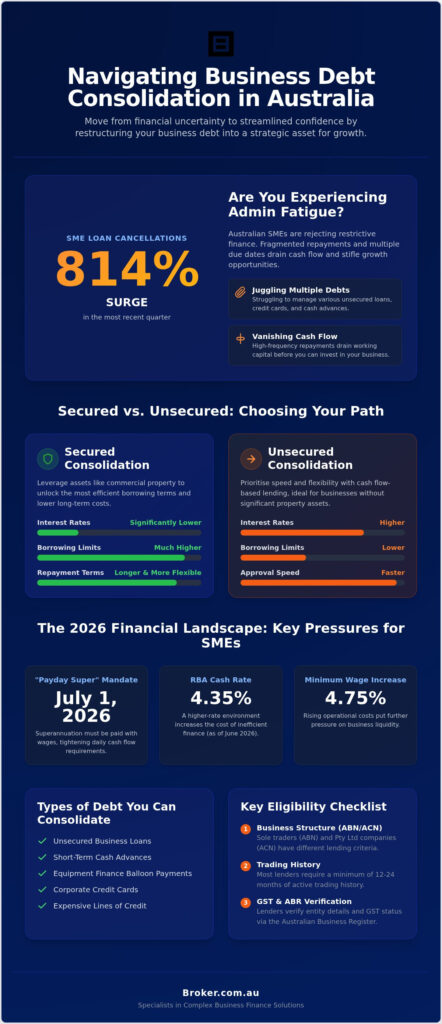
With borrower-initiated loan cancellations surging by 814% in the most recent quarter, it’s clear that Australian SMEs are no longer settling for restrictive finance that strangles their daily operations. Exploring the right business debt consolidation options australia has become a strategic necessity for directors who feel the weight of fragmented repayment dates and the pressure of the 2026 “Payday Super” mandate. You’ve likely felt the exhaustion of “admin fatigue” while juggling various unsecured loans, watching your cash flow vanish before you can even consider new hires or equipment upgrades.
We understand that managing high-stakes finance shouldn’t feel like a second job. This guide is designed to move you from a state of uncertainty toward streamlined confidence by showing you how to consolidate multiple debts into a single, manageable monthly repayment. We’ll explore how to lower your overall interest costs and navigate the current RBA climate to improve your borrowing power. You’ll discover how to unlock trapped working capital and transform your debt into a strategic tool for future expansion.
Key Takeaways
- Learn how to move from high-frequency, high-cost debt to a tailored, structured facility that stabilises your monthly cash flow.
- Compare the benefits of secured and unsecured paths to see how your current assets can unlock more efficient borrowing terms.
- Discover the “Total Cost of Debt” formula to identify hidden fees and calculate the true return on investment for your restructure.
- Access a 2026 checklist to organise your financial intelligence, ensuring your P&L and balance sheets are ready for a professional application.
- Gain “inside access” to the best business debt consolidation options australia by partnering with a specialist who understands complex, outside-the-norm scenarios.
Table of Contents
- Navigating Business Debt Consolidation Options in Australia
- Secured vs Unsecured Consolidation: Choosing the Right Path
- The Strategic Audit: Calculating the Real ROI of Consolidation
- How to Organise Your Business for a Successful Application
- Why Partnering with a Specialist Broker is Your Best Move
Navigating Business Debt Consolidation Options in Australia
Managing a growing business is demanding enough without the daily friction of fragmented repayments. In the current Australian commercial landscape, the concept of what is debt consolidation? refers to the strategic process of merging multiple liabilities into a single, more efficient facility. It’s not just about administrative ease. The core objective is to move away from high-frequency, high-cost debt toward structured, low-cost facilities that protect your daily cash flow and long-term viability.
2026 has emerged as a watershed year for SME balance sheets. With the “Payday Super” mandate now in full effect as of July 1, 2026, businesses must manage superannuation contributions on the same day as wages. This regulatory shift, combined with an RBA cash rate that sat at 4.35% as of June 2026, means there’s zero margin for inefficient finance. Organising your liabilities now is critical to maintaining the liquidity needed to handle rising operational costs, such as the 4.75% increase in the National Minimum Wage.
There’s a distinct difference between a simple refinance and a comprehensive debt restructure. While refinancing might involve moving a single loan to a better rate, a restructure involves a holistic “re-architecture” of your entire debt profile. This is where you evaluate all business debt consolidation options australia to ensure your capital structure actually supports your growth rather than hindering it. It’s a proactive move that signals to future lenders that you’re in control of your financial modelling.
The Types of Debt You Can Consolidate
Most Australian lenders allow you to roll several types of high-interest debt into a more manageable facility. This typically includes unsecured business loans and short-term cash advances that often carry aggressive daily or weekly repayment schedules. You can also consolidate equipment finance balloon payments that are nearing their due date, alongside corporate credit cards and lines of credit that have become too expensive to maintain under current market conditions.
ABN vs ACN: Who is Eligible for Consolidation?
Eligibility depends heavily on your business structure and trading history. Sole traders operating under an ABN generally face different criteria compared to Pty Ltd companies with an ACN. Most reputable lenders require a minimum of 12 to 24 months of active trading history to prove the business can service the new facility. Verification is handled through the Australian Business Register, where lenders confirm your GST status and entity details to ensure you meet their specific risk profiles.
Secured vs Unsecured Consolidation: Choosing the Right Path
Your asset position is the single most influential factor in determining which business debt consolidation options australia are available to your firm. While speed is often a priority for SMEs facing cash flow pressure, the choice between secured and unsecured facilities dictates your long-term interest costs and repayment flexibility. According to Australian Banking Association guidance, lenders have established frameworks to support businesses in restructuring debt, yet the terms offered shift significantly once physical security is introduced to the application.
Deciding between these paths requires a sophisticated “Expert Guide” approach. It isn’t just about finding the lowest headline rate. It’s about understanding how each facility impacts your borrowing power for future expansion. A well-structured consolidation should feel like a relief, moving you from a state of constant financial fire-fighting toward a streamlined, predictable monthly commitment.
Secured Consolidation: Leveraging Commercial Property
Using equity in commercial real estate is often the most efficient way to drive down interest rates. By securing your consolidated debt against property, you transition from the high-risk pricing of short-term loans to the more stable environment of commercial property finance. While some directors choose to use residential equity, this requires a balanced view of the risks and rewards. Secured loans remain the preferred choice for long-term restructuring because they offer longer repayment windows and significantly higher borrowing limits than their unsecured counterparts.
Unsecured Options: Prioritising Speed and Flexibility
Not every SME has a property portfolio to lean on, especially in high-growth service or tech sectors. Cash flow-based lending allows you to consolidate multiple liabilities without tying up specific physical assets. These facilities typically rely on Director Guarantees and a clear demonstration of your monthly revenue stability. If your goal is to maintain asset agility for future equipment finance or fit-out projects, an unsecured path provides the momentum you need without the complexity of property valuations.
Consolidating ATO Debt and Tax Obligations
A major strategic advantage in 2026 is the ability to move tax debt into a commercial loan. The ATO is not a bank; their repayment plans often carry high interest charges and strict compliance hurdles that can stifle a business. By using a commercial facility to clear tax obligations, you simplify your balance sheet and improve your standing with the tax office. Lenders generally view a settled tax account much more favourably than a lingering repayment plan. If you’re ready to clean up your balance sheet, you can explore our tailored finance solutions to find a structure that fits your specific asset position.
The Strategic Audit: Calculating the Real ROI of Consolidation
A successful debt restructure requires looking far beyond the headline interest rate. To truly understand your return on investment, you must apply a “Total Cost of Debt” formula. This calculation accounts for the interest expense alongside the often-overlooked friction costs that erode your bottom line. When evaluating business debt consolidation options australia, many directors realise that a slightly higher interest rate on a clean, structured facility is far more valuable than a low-rate loan buried under complex fee structures.
Identifying hidden fees is a critical step in your strategic audit. You need to scrutinise your existing contracts for aggressive exit penalties or “break costs” that trigger when you pay out a loan early. On the new facility, keep a sharp eye on establishment fees, valuation costs for secured assets, and ongoing service charges. These upfront expenses can significantly impact your initial liquidity, so they must be weighed against the long-term savings of the new structure. Our role is to provide the “inside access” needed to uncover these variables before you commit to a new path.
The most vital metric for any SME in 2026 is “Cash Flow Relief.” This isn’t just about the total interest you save over five years. It’s about the immediate monthly capital you’ve unlocked to handle the 4.75% increase in the National Minimum Wage or the new “Payday Super” requirements. If consolidation frees up $3,000 in monthly cash flow, that’s capital you can immediately reinvest into growth initiatives or the permanent $20,000 instant asset write-off. The administrative relief of moving from five repayment dates to one shouldn’t be underestimated either; it removes the “admin fatigue” that distracts you from high-level decision making.
Interest Rates vs Repayment Terms
It’s a common trap to prioritise the lowest monthly repayment without checking the term length. Extending a three-year debt into a seven-year facility will certainly improve your daily cash flow, but it may increase the total interest paid over the life of the loan. You must balance your immediate need for liquidity with your long-term goal of becoming debt-free. We often help clients use balloon payments strategically to lower monthly commitments while planning for a structured payout once their expansion goals are met.
Improving Your Borrowing Power for Future Growth
Consolidation does more than just simplify your life; it cleans up your credit file for future “Big Bank” applications. By replacing high-interest, short-term “churn” debt with a professional commercial facility, you improve your debt-to-income ratio and overall financial standing. This is particularly important if you plan on seeking business acquisition funding or commercial property loans later in 2026. Debt Service Cover Ratio (DSCR) is a financial metric used by lenders to determine if your business generates enough net operating income to cover its total debt repayments, a calculation that has become increasingly stringent throughout 2026.
How to Organise Your Business for a Successful Application
Preparation is the bridge between a rejected application and a successful restructure. In 2026, the Australian lending landscape is defined by increased scrutiny. Lenders are no longer just looking at your revenue; they are obsessing over your structure and cash flow consistency. When exploring business debt consolidation options australia, your document readiness determines your speed to market and the quality of the rates you’ll receive.
Gathering your financial intelligence is the first step. You’ll need a Profit and Loss statement and a Balance Sheet that are no more than three months old. These documents must reflect how your business has absorbed recent regulatory changes, such as the 4.75% National Minimum Wage increase and the new “Payday Super” mandate that commenced on July 1, 2026. Lenders want to see that your business remains resilient under these updated cost structures and that your internal systems are organised enough to handle daily superannuation contributions.
In the current AI-vetting era, your bank statement history is your most important testimonial. Automated systems now scan for “dishonours” or excessive “round-trip” transactions that might signal liquidity stress. Presenting a clean six-month history is essential. Beyond the numbers, you must build a compelling “Business Case.” Frame your consolidation as a strategic move to unlock growth capital, rather than a desperate attempt to stay afloat. This shift in narrative can be the difference between a standard offer and a premium, low-interest facility.
Low Doc vs Full Doc Consolidation
Depending on your urgency and the state of your bookkeeping, you can choose between Low Doc and Full Doc paths. Low Doc options often allow you to qualify using just your ABN and six months of bank statements, which is ideal for fast-moving SMEs. However, providing full tax returns through a Full Doc application usually unlocks the most competitive rates. We use proprietary AI technology to streamline this verification process, ensuring your data is presented to the right lenders in the most favourable light.
Protecting Your Credit Score During the Process
A common mistake is applying with multiple lenders simultaneously, which creates “hard hits” that damage your credit rating. An expert guide avoids this by using “soft quotes” to gauge eligibility without leaving a footprint on your file. If you have existing defaults or credit impairments, these must be managed and explained before the application hits a lender’s desk. Proactive communication ensures you remain in good hands throughout the process. If you want to see how your current financials align with the best market rates, you can get started with a tailored assessment today.
Why Partnering with a Specialist Broker is Your Best Move
Securing the most effective business debt consolidation options australia offers requires more than a simple internet search. It requires a partner with the “Inside Access” to identify rates and structures that aren’t visible to the general public. While many traditional lending institutions have tightened their appetite for SME risk in 2026, an expert broker functions as a high-level fixer. We navigate the complexities of the current lending landscape to ensure your business doesn’t get caught in the rigid, impersonal credit policies of the major traditional banks.
A commercial advisory service goes far beyond standard loan broking. While a basic broker might just facilitate an application, our approach focuses on financial modelling and strategic re-architecture. This level of insight is crucial for businesses facing outside-the-norm situations or complex trust structures. By positioning your firm for “Best in Class” finance solutions, we move you away from a state of uncertainty toward a feeling of streamlined confidence. You’re no longer just rate shopping; you’re building a foundation for sustainable growth.
The integration of technology and human insight has never been more important. Our award-winning methodology ensures your application is processed with both accuracy and speed, avoiding the delays common in traditional banking. This proactive stance allows us to manage even the most intricate deals with a boutique level of personal attention. You can feel certain that you are in good hands, with a team dedicated to prioritising your specific needs over mere administrative process.
The Broker.com.au Difference: AI + Human Expertise
Our proprietary AI technology is a game-changer for Australian SMEs. It quickly identifies the optimal lender for your specific industry, matching your unique profile with the best available terms. This speed is balanced by the human touch of our seasoned advisors, including Matt, Kylie, and Flavio. We transform the lending journey into a low-pressure conversation, moving you seamlessly from “I’m interested” to a funded facility without the typical stress of high-stakes finance.
Beyond Consolidation: A Long-Term Financial Partnership
We view a successful debt restructure as the beginning of a long-term partnership. Once your cash flow is stabilised, your consolidated position becomes a stepping stone toward business acquisition or asset expansion. We conduct annual reviews to ensure your debt structure remains competitive as market conditions evolve, always looking for ways to go above and beyond for our clients. I’m interested in exploring my consolidation options.
Securing Your Business Future Through Strategic Restructuring
The landscape for Australian SMEs is shifting rapidly. By evaluating your business debt consolidation options australia today, you’re doing more than just cleaning up your balance sheet; you’re actively protecting your firm’s liquidity against 2026’s regulatory pressures. Moving from fragmented, high-interest repayments to a single, structured facility restores your focus to high-level decision making and unlocks the capital needed for future expansion.
As an award-winning national brokerage, we provide inside access to over 70 lenders and use proprietary AI technology to ensure your application is fast and stress-free. We specialise in complex commercial restructures, including the strategic management of ATO debt, acting as your expert guide through every stage of the process. You’re in good hands with a team that prioritises your specific needs and handles the heavy lifting on your behalf.
I’m interested in a tailored debt consolidation strategy
Take the first step toward a more efficient financial structure. Your journey toward streamlined confidence starts with a simple conversation about what’s possible for your business. We’re here to help you turn your financial goals into a reality.
Frequently Asked Questions
Is business debt consolidation a good idea for Australian SMEs in 2026?
Consolidating your debt is a strategic move to manage the liquidity crunch caused by the 2026 Payday Super mandate and recent minimum wage hikes. By exploring business debt consolidation options australia, you can lower your monthly repayments and eliminate the admin fatigue of juggling multiple lenders. It’s an effective way to regain control over your cash flow and focus on scaling your operations rather than managing liabilities.
Can I consolidate my ATO tax debt into a business loan?
Yes, you can transition outstanding tax obligations into a professional commercial facility. This is often a smarter path than an ATO repayment plan because commercial lenders provide more predictable terms and help you avoid the high interest charges the tax office applies. Moving tax debt to a loan cleans up your balance sheet and improves your standing for future finance applications.
Will I need to provide my family home as security for a consolidation loan?
No, you don’t always need to use your family home to secure a restructure. While secured facilities often offer the lowest rates, unsecured business loans and cash flow-based lending allow you to consolidate without putting your personal residence on the line. We help you weigh the cost-benefit ratio of each path to ensure your personal assets remain protected while you streamline your business.
How does consolidating debt affect my business credit score?
Consolidating your debt can significantly improve your credit standing over the long term. While the initial application might cause a minor, temporary dip due to credit inquiries, your score typically rises as you replace high-interest “churn” debt with a structured facility. Consistent, single repayments demonstrate financial stability to credit reporting agencies and future big-bank lenders.
What is the difference between refinancing and debt consolidation?
Refinancing involves moving a single existing loan to a new lender to secure a better interest rate or improved terms. Debt consolidation is a more comprehensive restructure where you merge several different liabilities, such as credit cards, short-term cash advances, and equipment finance, into one single facility. It’s about simplifying your entire capital structure rather than just adjusting one loan.
Can I get a low-doc debt consolidation loan if my financials aren’t up to date?
Yes, Low-Doc products are specifically designed for businesses that don’t have current tax returns or full financial statements ready. These options typically rely on your ABN and six months of bank statements to verify your cash flow. While the interest rates might differ from Full-Doc loans, they provide a fast and efficient way to restructure when urgency is a priority.
How long does the business debt consolidation process typically take?
The timeline depends on the complexity of your deal and whether security is involved. Unsecured consolidations can often be approved and funded within 24 to 48 hours using our proprietary AI technology. Property-secured restructures usually take between two to four weeks because they require formal valuations and more detailed legal documentation to finalise the facility.