
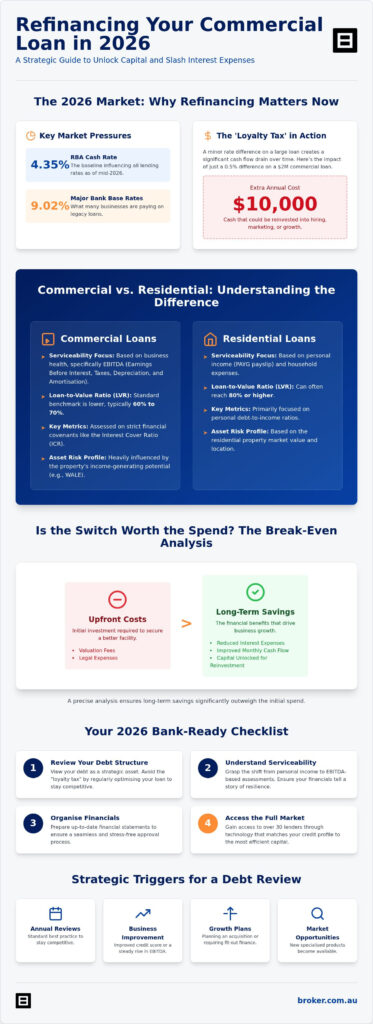
Your current business debt shouldn’t feel like a life sentence, even with the RBA cash rate sitting at 4.35 per cent as of mid-2026. While many directors feel trapped in rigid, expensive structures, refinancing a commercial loan for better rates is often the most effective lever to inject liquidity back into your operations. If your margins are being squeezed by base rates from the big banks that have climbed as high as 9.02 per cent, you aren’t alone in feeling the pressure of a tightening market.
It’s exhausting to deal with a lack of transparency while your hard-earned equity sits idle. You deserve a debt structure that works as hard as you do. This guide shows you how to restructure your liabilities to slash interest expenses and unlock capital without the typical banking headache. We’ll explore the latest market shifts, comparing traditional offers with the competitive non-bank sector to help you secure a tailored solution that simplifies your repayments and fuels your next phase of growth.
Key Takeaways
- Avoid the “loyalty tax” by viewing your debt as a strategic asset that requires regular optimisation to stay competitive in the 2026 market.
- Understand the technical shift from personal income to EBITDA-based serviceability to ensure your business structure meets modern lending criteria.
- Learn how to conduct a precise break-even analysis to ensure the long-term savings of refinancing a commercial loans for better rates outweigh upfront valuation and legal costs.
- Discover the essential “bank-ready” checklist for 2026 to organise your financial statements and ensure a seamless, stress-free approval process.
- Gain “inside access” to over 30 lenders through proprietary AI technology that matches your specific credit profile with the most efficient capital providers.
Table of Contents
- The Real Cost of Complacency: Why Business Loan Refinancing Matters in 2026
- Commercial vs Residential Refinancing: Navigating the Technical Nuances
- The Break-Even Analysis: Calculating if the Switch is Worth the Spend
- Preparing Your Business for a Seamless Refinance: A 2026 Checklist
- Unlocking ‘Inside Access’ to Australia’s Best Commercial Rates
The Real Cost of Complacency: Why Business Loan Refinancing Matters in 2026
Refinancing isn’t just a paperwork exercise; it’s a high-level capital optimisation strategy. For many Australian business owners, debt is often treated as a “set and forget” arrangement. However, staying with a legacy loan often leads to a “loyalty tax” that quietly erodes your profit margins. Understanding what refinancing is in a commercial context allows you to pivot your financial structure to match your current business maturity. By treating your debt as a flexible tool, you can ensure your capital is always working at its highest potential.
The 2026 lending environment has shifted significantly in favour of the borrower. Non-bank lenders and specialist firms are now providing “inside access” to rates that challenge the traditional big four banks. This increased competition means more flexibility for businesses with complex needs, such as those looking for SMSF loans or development finance. At Broker.com.au, we act as your expert guide, helping you move from a state of uncertainty toward a feeling of streamlined confidence and relief. We believe you’re in good hands when you have the right data and the right partners to unlock the best possible terms.
The “Loyalty Tax” and the Australian SME
Major banks frequently reserve their most competitive pricing for new acquisitions to hit aggressive growth targets. Existing clients are often left on “back book” rates that don’t reflect the current competitive market. With the RBA cash rate holding at 4.35 per cent in 2026, even a minor discrepancy in your margin can be incredibly costly. Consider a $2 million commercial loan as an example. A difference of just 0.5 per cent in your interest rate equates to $10,000 in additional interest costs every year. That is cash flow that could be better spent on new hires, marketing, or digital transformation.
Strategic Triggers for a Debt Review
You don’t need to wait for a massive market shift to review your position. While annual reviews are standard practice, specific internal milestones should trigger a proactive look at refinancing a commercial loan for better rates. If your business has recently improved its credit score or seen a steady increase in EBITDA, you’re likely eligible for terms that weren’t available when you first signed. Similarly, if you’re planning a business acquisition or require Fit-out Finance, a total debt restructure can often lower your overall weighted average cost of capital.
Market-driven opportunities also play a role. When specialized lenders introduce new products for specific sectors, such as medical or professional services, they often offer “best in class” rates to attract high-quality borrowers. Staying informed about these shifts ensures you aren’t paying a premium for a loan structure that no longer suits your trajectory. Our role is to provide that local insight, ensuring you’re never locked into a deal that hampers your growth.
Commercial vs Residential Refinancing: Navigating the Technical Nuances
Many borrowers mistakenly apply residential logic to business debt. While home loans focus on your personal salary and lifestyle expenses, refinancing a commercial loan for better rates requires a deep dive into your business’s operational health. Lenders look at EBITDA (Earnings Before Interest, Taxes, Depreciation, and Amortisation) rather than just a PAYG payslip. This shift in serviceability modelling means your financial statements must tell a story of consistent profitability and cash flow resilience to secure the best terms in 2026.
The type of asset you hold also dictates your leverage. A modern industrial warehouse in a prime logistics hub is viewed as lower risk than a niche retail space with a short Weighted Average Lease Expiry (WALE). This commercial real estate loan guide highlights how risk profiles shift based on the property’s income-generating potential. Additionally, most commercial restructures still involve personal guarantees. This means your personal assets remain linked to the business’s performance, a technicality that requires careful financial navigation to manage effectively without causing unnecessary stress.
Understanding Covenants and Loan-to-Value Ratios (LVR)
Residential borrowers often expect LVRs of 80 per cent or higher. In the commercial sector, 60 to 70 per cent is the standard benchmark for 2026. Beyond the deposit, you must navigate strict financial covenants. Lenders use the Interest Cover Ratio (ICR) and Debt Service Cover Ratio (DSCR) to ensure your business can comfortably meet its obligations. If your current structure is too restrictive, our team can help you discover more tailored options that provide the breathing room your business needs to scale.
Specialised Refinancing: SMSF and Development Debt
Refinancing within a Self-Managed Super Fund (SMSF) carries a unique set of compliance hurdles. You aren’t just dealing with a bank; you’re dealing with the ATO’s strict regulations on Limited Recourse Borrowing Arrangements (LRBA). Similarly, developers often find themselves stuck in high-interest construction finance long after the project is complete. Transitioning to a “residual stock” loan at a lower rate is a common strategy to preserve capital while you wait for the final units to settle. These complex scenarios require an expert guide who understands the nuances of fit-out finance and equipment rollovers. We pride ourselves on being that partner, moving you from a state of complexity toward a feeling of streamlined confidence.
The Break-Even Analysis: Calculating if the Switch is Worth the Spend
Before you sign a new offer, you must determine your break-even point. This is the precise moment when your cumulative interest savings finally eclipse the total cost of switching lenders. In the Australian market, typical upfront costs for commercial refinancing often range between $10,000 and $20,000, depending on property valuations and stamp duty. While these figures might seem daunting, the long-term capital reallocation often justifies the initial spend within 24 to 36 months. We believe in transparency, and our role is to ensure you move forward only when the data supports a clear financial gain.
If you’re currently on a fixed-rate loan, you’ll need to account for break fees. These charges can amount to thousands of dollars, as they’re calculated based on the difference between your fixed rate and current market rates. However, if the market has shifted significantly since you first settled, refinancing a commercial loan for better rates can still be profitable even after paying these exit penalties. It’s about looking at the total cost of capital over the remaining life of the debt rather than just the immediate invoice.
Quantifying the Upfront Investment
Commercial valuations are significantly more complex than residential appraisals. A valuer doesn’t just look at comparable sales; they analyse lease agreements, tenant quality, and market yields. This expertise comes at a higher price, with fees typically starting from $200 to $600 for standard properties but scaling much higher for specialised assets. You should also account for lender legal fees. Most commercial providers require their own solicitors to draft and review documentation at your expense. Additionally, expect a discharge fee from your outgoing lender, usually between $200 and $1,000, along with government charges for title searches and mortgage registration.
The Long-Term ROI of a Lower Rate
The primary goal of refinancing a commercial loan for better rates is to improve your monthly cash flow and net profit. A lower rate doesn’t just save money; it allows for a “snowball effect” on your debt reduction. By maintaining your previous repayment level on a lower-rate loan, you can accelerate principal reduction and significantly shorten your loan term. This strategy mirrors the efficiency seen in international frameworks like the SBA 7(a) loan program, which emphasises using debt restructuring to stabilise small business operations and fuel growth.
Visualising these five-year savings is essential for making an informed decision. Using a commercial loan calculator can help you see the tangible impact on your bottom line, moving you from a state of uncertainty toward a feeling of streamlined confidence. We’re here to help you run these numbers and provide the local insights you need to ensure your refinance is a strategic win rather than a side-step into unnecessary fees.
Preparing Your Business for a Seamless Refinance: A 2026 Checklist
Getting your business ready for a credit assessment shouldn’t feel like an interrogation. In 2026, lenders have moved toward highly automated, data-centric models that reward clarity and precision. By organising your records early, you position your firm as a low-risk, high-quality borrower. This is essential when refinancing a commercial loan for better rates. A well-prepared application doesn’t just speed up the approval; it gives you the leverage to negotiate terms that a disorganised competitor simply won’t see. We’re here to act as your expert guide, moving you from a state of paperwork anxiety toward a feeling of streamlined confidence.
The Essential Document Pack for 2026
Lenders now expect real-time insights into your cash flow. Gone are the days of submitting year-old tax returns and hoping for the best. To ensure a professional and efficient application, you should have the following items ready:
- Two years of Profit & Loss statements and Balance Sheets.
- Your most recent Business Activity Statements (BAS) to prove current trading.
- A clean portal printout from your ATO Integrated Client Account (ICA) showing tax compliance.
- Current lease agreements and a detailed rent roll if you are a commercial property investor.
Optimising Your Business Profile
Before applying, look at your balance sheet through a lender’s eyes. High levels of director debt or messy inter-entity loans can raise red flags during the credit modelling process. Take the time to tidy up these entries and ensure your ABN and GST registrations are current and correct. If your financials aren’t fully up to date, don’t panic. There are “Low Doc” options available through our network of over 30 lenders that focus on alternative proof of income, such as bank statements or accountant letters. We can help you get started with a tailored assessment to see which path fits your current situation.
Don’t just provide numbers; provide a story. A “Business Growth Narrative” explains how the capital released or the interest saved will be reinvested into your company. Whether you’re funding a business acquisition or upgrading equipment, showing a clear path to increased revenue makes your application far more attractive to credit committees. Use digital tools like cloud accounting and AI-driven portals to eliminate the manual headache of document collection. These systems allow for a seamless transfer of data, ensuring your broker has everything they need to secure that “inside access” to the market’s best offers. You’re in good hands when the process is built on transparency and efficiency.
Unlocking ‘Inside Access’ to Australia’s Best Commercial Rates
You shouldn’t have to settle for the one-size-fits-all products offered by a single bank. When you are refinancing a commercial loan for better rates, having a partner who sees the whole field is your greatest advantage. We provide that “inside access” by connecting you with over 30 different lenders, including non-bank institutions and private capital funds that don’t advertise on the high street. This breadth of choice ensures your debt is placed where it’s most valued, not just where you happen to have a transaction account. It’s about moving you from a state of uncertainty toward a feeling of streamlined confidence.
Our approach as a “High-Level Fixer” means we handle the heavy lifting of the application process so you can stay focused on running your operations. We don’t just find a loan; we build a debt strategy. Whether you’re looking to release equity for growth or simplify your monthly repayments, we use our industry leadership to navigate the complexities of the 2026 market on your behalf. You’re in good hands when your finance is managed by experts who understand that every business dream is unique.
Why an Award-Winning Broker Beats a Direct Bank
Walking into a local branch limits your options to a single credit policy. If your business acquisition or development finance needs fall “outside of the norm”, you’ll likely face a rejection or an unnecessarily high margin. An award-winning broker provides a tailored alternative. We have access to unadvertised commercial rates and private capital that often provide more flexible covenants than the big four. Having a dedicated expert like Matt or Flavio in your corner means you get personalised attention and local insights that a cold, impersonal bank can’t replicate. We pride ourselves on being a seasoned partner who is deeply knowledgeable about the Australian lending landscape.
The AI-Powered Refinance Process
Efficiency is at the heart of what we do. We utilise proprietary AI technology to match your business profile with the right credit policy instantly. This tech-driven approach streamlines the assessment phase, allowing for a seamless transition from your old lender to a new, more efficient structure. We believe the process should be as stress-free as possible, which is why we avoid aggressive sales tactics. Our “I’m interested” philosophy starts a low-pressure conversation, ensuring you feel informed rather than rushed before you make a decision.
Our rhythm is logical and intentional, designed to lead you from initial curiosity to a successful settlement. By combining technical financial expertise with client-facing clarity, we’ve transformed the digital portal into a human-led advisory. If you’re ready to unlock the capital tied up in your current debt and secure a better deal for your business, Book a consultation with our commercial specialists today.
Take Control of Your Capital for a Stronger 2026
The Australian lending market moves quickly; what was a competitive deal two years ago might now be costing your business thousands in unnecessary interest. By moving beyond the “loyalty tax” of traditional banks and conducting a precise break-even analysis, you can transform your debt from a burden into a strategic asset. Success in refinancing a commercial loan for better rates depends on more than just a lower percentage point. It’s about finding a tailored structure that aligns with your specific growth trajectory and cash flow needs.
As an award-winning national brokerage, we provide the expert guidance you need to navigate these high-stakes decisions with confidence. Our proprietary AI technology streamlines the application process, while our network offers inside access to over 30 Australian lenders. You don’t have to manage this complexity alone. We’re here to ensure your transition is efficient, professional, and entirely stress-free. We believe you’re in good hands when your financial strategy is backed by local insight and specialized expertise.
I’m interested in better commercial rates
Your business deserves a financial foundation that supports your biggest dreams. Let’s get started on building it today.
Frequently Asked Questions
How much can I actually save by refinancing my commercial loan?
Your total savings depend on the margin reduction and the loan’s principal amount. With big bank rates reaching over 9 per cent in 2026, dropping your rate by even 0.5 per cent on a $2 million loan saves $10,000 annually. Over a five-year term, this adds $50,000 back into your cash flow, assuming you’ve passed the initial break-even point.
What are the typical exit fees for a commercial loan in Australia?
You’ll typically encounter discharge fees and, if you’re on a fixed term, substantial break costs. Discharge fees usually range from $200 to $1,000 per lender. However, break fees for fixed-rate commercial contracts are the primary concern; these are calculated based on current market interest rates and can cost thousands. It’s essential to have a broker calculate these before committing.
Can I refinance a commercial property loan into an SMSF loan?
Yes, it’s possible to refinance a commercial property into an SMSF loan structure through a Limited Recourse Borrowing Arrangement (LRBA). This is a complex technical manoeuvre that requires strict adherence to ATO regulations. The property must be purchased by the fund from the current owner at market value. This strategy is often used by directors to manage retirement assets while refinancing a commercial loan for better rates.
How long does the commercial refinancing process usually take?
The commercial refinancing process usually takes between four and eight weeks from application to settlement. While our proprietary AI technology can speed up the initial credit matching, the timeline is often dictated by property valuations and the outgoing bank’s discharge process. Ensuring your “bank-ready” document pack is complete before starting will significantly reduce delays.
Do I need a new valuation for my commercial property to refinance?
Almost every new lender will require a fresh valuation of your commercial asset. Lenders need a current market assessment to determine the Loan-to-Value Ratio (LVR), which usually sits between 60 and 70 per cent in 2026. These valuations look at lease terms and tenant quality rather than just physical structure. Fees typically range from $200 to $600 for standard properties.
Is it possible to consolidate business debt and a home loan?
You can consolidate debt by using residential equity to secure business funding, but the loans usually remain separate products. While you might use your home as additional security to lower your business interest rate, banks generally keep commercial and residential debt in different categories due to different regulations. This approach can help you access lower rates by improving the lender’s security position.
What is a “Low Doc” commercial refinance and do I qualify?
A “Low Doc” refinance allows you to secure funding without providing full sets of audited financial statements. You may qualify if you have clean bank statements, a strong BAS history, or an accountant’s declaration of income. These products are ideal for businesses with complex structures or those whose most recent tax returns don’t reflect their current growth. We can match you with specialist lenders who prioritise cash flow over traditional paperwork.
Will refinancing my business loan affect my credit score?
Refinancing will involve a hard credit enquiry, which may cause a minor, temporary dip in your credit score. This is a standard part of refinancing a commercial loan for better rates as the new lender assesses your reliability. However, the long-term benefit of improved serviceability and lower monthly repayments usually outweighs this short-term effect. Making consistent, lower repayments on your new loan will eventually strengthen your overall credit profile.