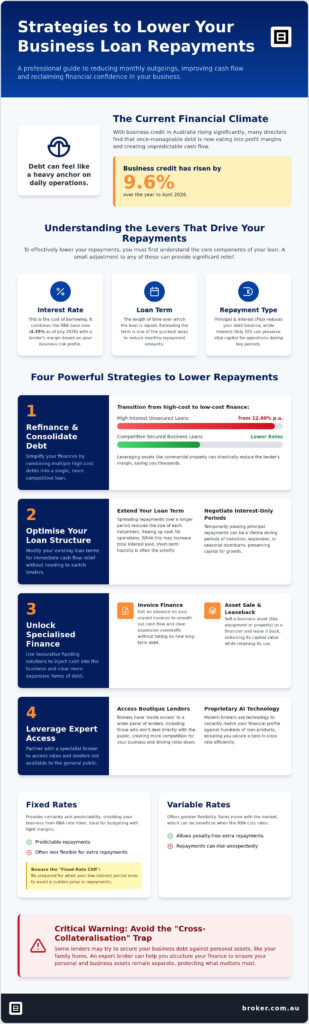
With business credit in Australia rising by 9.6% over the year to April 2026, many directors are finding that debt which once felt manageable has become a heavy anchor on their daily operations. It is incredibly stressful when high interest rates start eating into your profit margins, especially when complex loan structures make monthly cash flow feel volatile and unpredictable. You likely feel that your current finance setup should be working harder for you, rather than against you.
This guide shares professional strategies to lower business loan repayments, providing you with the expert insights needed to reduce your monthly outgoings and improve your firm’s liquidity. We will explore how to consolidate fragmented debt for easier management and how to use strategic refinancing to secure more competitive market rates. By the end of this article, you will understand how to re-align your debt portfolio with your current business lifecycle, moving from a state of financial uncertainty toward streamlined confidence and relief.
Key Takeaways
- Learn how adjusting loan terms and repayment frequency can provide immediate cash flow relief and help you better manage seasonal volatility.
- Discover professional strategies to lower business loan repayments by transitioning from high-cost unsecured debt to more competitive secured finance or commercial property equity.
- Explore how specialised tools like Invoice Finance and asset ‘Sale and Leaseback’ can inject cash into your firm to clear expensive overdrafts.
- Understand the value of negotiating interest-only periods and strategic balloon payments to preserve capital for growth and daily operations.
- Find out how to leverage proprietary AI technology and ‘inside access’ to boutique lenders to secure best-in-class rates that aren’t available to the general public.
Table of Contents
- Understanding the Levers: What Drives Your Business Loan Repayments?
- Optimising Loan Structures for Immediate Relief
- Specialised Finance Solutions to Replace High-Cost Debt
- Partnering with a Broker for ‘Inside Access’ and Best-in-Class Rates
- Streamline Your Debt and Reclaim Your Cash Flow
Understanding the Levers: What Drives Your Business Loan Repayments?
To effectively implement strategies to lower business loan repayments, you must first understand the specific mechanics that determine your monthly bill. A Business loan is not a static product; it is a combination of shifting variables. The three core components are your interest rate, the loan term, and the frequency of your repayments. While these might seem straightforward, they interact in complex ways that can either stifle your growth or provide the breathing room your firm needs to thrive.
Your business’s risk profile is the invisible hand behind your interest rate. Lenders start with a base rate, often tied to the Reserve Bank of Australia (RBA) cash rate, which sits at 4.35% as of July 2026. They then add a “margin” based on how they perceive your creditworthiness. If your business has matured, improved its trading history, or secured better assets since you first signed your contract, you may still be paying a legacy margin that is far too high for your current profile. A proactive review allows you to challenge these outdated assessments and move toward a more efficient debt structure.
You also need to weigh the difference between principal-and-interest (P&I) and interest-only (IO) obligations. P&I loans ensure you’re actually reducing your debt over time, but they demand a higher monthly commitment. Interest-only periods, while not reducing the debt balance, can be vital for preserving capital during lean periods or major transitions. In the current market, many owners are finding that their old agreements no longer align with their 2026 cash flow requirements, making a restructure necessary to protect profit margins.
Fixed vs Variable Rates in the Current Australian Market
Locking in a fixed rate provides a sense of streamlined confidence, shielding you from any sudden RBA hikes. It makes budgeting predictable, which is a massive relief for firms with tight margins. However, fixed rates often lack the flexibility of variable options, which might allow for extra repayments without penalty. Many Australian business owners are currently approaching a fixed-rate “cliff,” where their low-interest periods are ending. Identifying this date early is crucial so you aren’t caught off guard by a sudden repayment jump that could disrupt your operations.
The Impact of Loan Terms on Cash Flow
Extending your loan term is one of the most immediate strategies to lower business loan repayments because it changes the amortisation schedule. Amortisation is the process of spreading your debt repayments across a set timeframe so the loan is fully extinguished by the end of the term. A longer term means the principal is divided into smaller portions, significantly reducing your monthly outgoings. While this approach results in more interest paid over the life of the loan, the priority for many SMEs in 2026 is maintaining short-term liquidity to manage daily operational costs and meet new “Payday Super” obligations without stress.
Refinancing is one of the most powerful strategies to lower business loan repayments because it allows you to reset the clock on your debt using your current, likely stronger, financial position. Many SMEs start their journey with high-interest unsecured loans, which currently carry variable rates starting around 12.60% p.a. as of mid-2026. By moving this debt into a secured business loan, you leverage your assets to command a much lower margin from the lender. Beyond just switching providers, consolidation simplifies your daily operations. Managing multiple facilities from various lenders often leads to “fee creep” and a higher aggregate interest rate. Consolidating these into a single, streamlined facility not only reduces monthly outgoings but also provides a clearer view of your firm’s financial health. Before making the leap, you must calculate your break-even point. This involves weighing the cost of exit fees, which can still be significant for some legacy bank products, against the monthly interest savings. If you don’t recover those costs within 12 to 18 months, the move might not be strategically sound.
When to Switch Lenders for a Better Deal
Banks often suffer from “lender fatigue,” where they stop offering competitive rates to long-term clients while aggressively courting new ones with introductory offers. If your bank has become complacent, it is time to look elsewhere. To ensure a seamless transition, have your financial statements, tax portal records, and asset registers ready. Crucially, you must avoid the “cross-collateralisation” trap. Some lenders will try to secure your business debt against your family home; an expert guide will help you structure your finance so your personal assets remain protected.
Secured vs Unsecured: Finding the Sweet Spot
Optimising Loan Structures for Immediate Relief
While securing a lower interest rate is a high-impact move, optimising the actual architecture of your debt is often the fastest way to implement strategies to lower business loan repayments. Small adjustments to how a loan is serviced can provide significant relief without requiring a full change of lender. One effective method is utilising an offset account. This allows your trading cash to work against your debt balance, reducing the interest charged daily while keeping the capital fully accessible for operational needs. Similarly, matching your repayment cycles to your specific cash flow rhythm, such as switching from monthly to quarterly payments to align with BAS cycles or seasonal peaks, can alleviate the stress of regular outgoings.
Interest-Only Periods: A Tactical Breathing Space
Negotiating an interest-only period is a sophisticated tool for directors who need to preserve capital for growth rather than debt reduction. A principal holiday is a mechanism in Australian business lending where the borrower is permitted to pause the repayment of the loan’s core balance, only servicing the interest component for a set period. This can be particularly effective during a business acquisition transition, where 6 to 12 months of interest-only payments provide the necessary liquidity to integrate new operations. It is a tactical move that prioritises current cash flow, though it requires a plan to “catch up” later in the term when the principal repayments resume at a higher level.
Balloon Payments and Residual Values
In the world of vehicle and equipment finance, the strategic use of balloon payments is a frequently overlooked method for reducing monthly strain. By setting a residual value, you essentially defer a portion of the loan principal until the end of the term. For example, a 30% balloon payment can drop your monthly truck or machine lease significantly, as you are only amortising 70% of the asset’s value over the life of the agreement. This structure is an excellent fit for firms with high growth potential that currently face tight cash flow, allowing them to use the equipment to generate revenue now while deferring the heavy lifting of repayment.
Managing the end-of-term risk is the key to making this strategy work. When the balloon payment falls due, you have the option to refinance the residual amount, sell the asset to clear the debt, or pay it out from accumulated profits. This flexibility ensures you aren’t locked into a rigid repayment schedule that ignores the reality of your business’s evolving needs. By structuring your finance with these levers in mind, you move from a state of reactive payment to proactive capital management, ensuring your debt supports your “dream” rather than hindering it.
Specialised Finance Solutions to Replace High-Cost Debt
Implementing specialised strategies to lower business loan repayments often requires looking beyond traditional term loans. Many Australian firms find themselves trapped in a cycle of high-interest working capital debt, such as business credit cards or overdrafts with base rates that can exceed 10.72% p.a. as of July 2026. By replacing these reactive debts with structured specialised finance, you can significantly reduce your monthly interest expense and regain control over your cash flow.
One of the most effective “High-Level Fixer” moves is the Sale and Leaseback. If your business owns equipment, machinery, or vehicles outright, you can sell these assets to a lender and lease them back. This provides an immediate cash injection to clear expensive, high-interest debt, replacing it with a lower-rate Asset Finance facility. It is a seamless way to unlock the value already sitting on your balance sheet to fix a liquidity crunch.
Unlocking Cash with Invoice and Asset Finance
Invoice Finance allows you to turn your unpaid invoices into immediate liquidity. Instead of waiting 30, 60, or 90 days for debtors to pay, you receive a percentage of the invoice value upfront. This is a far more efficient tool for managing cash flow volatility than relying on an expensive overdraft. When you compare the interest rates of a tailored invoice facility against the double-digit rates of most business credit cards, the savings become obvious. It transforms your accounts receivable into a proactive tool for debt reduction.
The Flexibility of a Business Line of Credit
A Line of Credit offers a revolving advantage that traditional term loans cannot match. You only pay interest on the funds you actually use, rather than the full loan amount. This makes it a cheaper “safety net” for businesses that experience seasonal fluctuations. Setting up a standby facility before you need it ensures you aren’t forced into high-cost, emergency borrowing when a situation “outside of the norm” arises. Transitioning from a rigid repayment schedule to a flexible facility allows you to align your outgoings perfectly with your revenue cycles.
The structure you choose also has significant tax implications. A Chattel Mortgage typically allows for an immediate GST claim on the asset’s purchase price and provides depreciation benefits, which can be more tax-effective than a Hire Purchase agreement for many SMEs. Choosing the right structure is about more than just the interest rate; it is about ensuring your debt works in harmony with your tax obligations and long-term financial modelling. If you are looking to restructure your current debt portfolio, I’m interested in specialised finance and seeing how these tools can work for your firm.
Partnering with a Broker for ‘Inside Access’ and Best-in-Class Rates
Securing the right finance is rarely about finding a generic product on a bank’s website. It’s about finding a lender whose appetite for risk matches your specific business profile. While the strategies to lower business loan repayments we have discussed are powerful, they require precise execution to be effective. This is where partnering with an award-winning broker provides a distinct advantage. At Broker.com.au, we act as your ‘High-Level Fixer’, using proprietary AI technology to scan a national panel of major and boutique lenders to find the perfect fit for your firm instantly.
Our role goes beyond simple comparison. We provide inside access to non-bank and boutique lenders that don’t deal directly with the public. These institutions often have more flexible serviceability requirements and more competitive margins than the major banks. By having an expert guide negotiate on your behalf, you can often remove hidden establishment or ongoing account-keeping fees that quietly erode your profit margins. The result is a move from financial uncertainty toward a state of streamlined confidence and relief.
The AI Advantage in Modern Broking
Technology is the cornerstone of a quick and accurate application process. Our AI identifies rate-reduction opportunities far faster than any manual search could. This speed is vital for protecting your credit score. Instead of submitting multiple applications to different banks, which can leave damaging ‘hits’ on your file, we identify the right lender first. This proactive approach ensures you get the best-in-class rates you deserve without the stress of being rejected by traditional lenders who may have tightened their credit conditions in 2026. Real-time market monitoring also means we stay your long-term partner, alert to new opportunities as the RBA cash rate or market conditions shift.
Tailored Solutions for ‘Outside the Norm’ Situations
Many Australian business owners operate through complex structures like Trusts or SMSFs. Traditional banks often find these ‘outside of the norm’ situations difficult to process, leading to long delays or outright rejections. We specialise in these complexities, finding tailored solutions that respect the dream you’ve built. Whether you are looking for secured business loans or a flexible line of credit, our ‘can-do’ attitude ensures we explore every avenue to improve your cash flow. If you are ready to see how these strategies to lower business loan repayments can be applied to your specific situation, I’m interested — let’s have a low-pressure chat.
Streamline Your Debt and Reclaim Your Cash Flow
Managing business debt in 2026 doesn’t have to be a source of constant stress. By shifting from high-cost unsecured facilities to secured options and utilising structural levers like interest-only periods or balloon payments, you can significantly improve your firm’s liquidity. Implementing these strategies to lower business loan repayments ensures your finance setup aligns with your actual trading rhythm rather than working against it. It is about moving from a reactive state of survival to a proactive strategy of capital management.
At Broker.com.au, our award-winning expertise and proprietary AI technology provide you with inside access to over 50 Australian lenders, including boutique providers that don’t deal with the general public. We specialise in finding tailored solutions for complex situations, ensuring your application is both quick and accurate. If you are ready to see how a professional restructure can transform your bottom line, we are here to help you navigate the process with streamlined confidence.
I’m interested in lowering my repayments
You have built a business worth protecting. With the right expert guide by your side, you can alleviate financial anxiety and focus on what truly matters: growing your dream and securing your firm’s future.
Frequently Asked Questions
Can I renegotiate my business loan rate without switching banks?
Yes, you can often renegotiate your current rate by approaching your existing lender with a clear business case. Banks frequently have retention teams dedicated to keeping high-performing clients; especially when presented with more competitive offers from the market. Presenting your improved trading history or a stronger asset position can help you secure a better deal without the administrative burden of moving to a new institution.
What are the typical costs involved in refinancing a business loan in Australia?
Refinancing usually involves several upfront costs, including establishment fees, valuation fees for any property used as security, and discharge fees from your current lender. Some banks also charge legal fees to document the new facility. While these costs can be significant, the long-term savings from lower interest rates and reduced monthly outgoings often outweigh the initial expense. It is essential to calculate your break-even point to ensure the move is financially sound.
How does an interest-only period affect my total loan cost?
An interest-only period provides immediate cash flow relief but increases the total interest paid over the life of the loan. Because you aren’t reducing the principal balance during this time, interest is calculated on a higher amount for a longer duration. This is one of many strategies to lower business loan repayments in the short term, but it requires a plan to manage the higher principal repayments once the interest-only period ends.
Is it possible to consolidate personal debt into a business loan for lower rates?
Lenders generally require a clear distinction between personal and business debt for tax and regulatory reasons. You can usually only consolidate debt into a business facility if you can prove the funds were used for a genuine business purpose. Mixing the two can complicate your tax deductibility and BAS reporting, so it’s vital to speak with a specialist to ensure any consolidation stays compliant with Australian law.
What is the difference between a balloon payment and a residual value?
A balloon payment is a lump sum you agree to pay at the end of a loan term, typically associated with a Chattel Mortgage. A residual value is the estimated value of an asset at the end of a lease agreement, such as a Hire Purchase. Both mechanisms are effective strategies to lower business loan repayments by deferring a portion of the principal, though they carry different tax treatments and end-of-term obligations.
How long does the process of refinancing a business loan usually take?
The timeframe depends on the complexity of your business structure and the type of security involved. A simple unsecured refinance can be completed in a few business days; while property-backed commercial loans typically take between four and eight weeks. Using proprietary AI technology and a streamlined application process can significantly reduce these lead times, ensuring you access lower rates and improved cash flow as quickly as possible.
Will applying for a new loan to lower my repayments hurt my credit score?
A single credit inquiry for a refinance usually has a negligible impact on your credit score. However, submitting multiple applications to different lenders in a short period can signal financial distress and lower your rating. Partnering with a broker allows you to identify the right lender first, avoiding unnecessary ‘hits’ on your file and ensuring your application is accurate and professionally presented from the start.
Can I use my commercial property equity to pay off a high-interest equipment loan?
Yes, this is a highly effective strategy known as debt recycling. By using the equity in your commercial property to secure a new facility, you can often clear high-interest equipment or vehicle finance that carries much higher margins. This moves your debt from a short-term asset finance rate to a more competitive commercial mortgage rate, significantly reducing your aggregate interest expense and streamlining your monthly obligations.