
With Australian SME owners now carrying mortgage debt nearly 50 per cent higher than non-business owners, the pressure on your personal and professional cash flow has never been more intense. It’s exhausting to manage high interest rates and restrictive loan covenants while trying to stay ahead of new July 2026 regulations like payday superannuation. You’ve likely felt the weight of repayments eating into margins that should be funding your next big move.
This guide will help you identify exactly when to consider refinancing business loans to reclaim your financial momentum and simplify your debt structure. We’ll explore how to leverage the permanent 20,000 dollar instant asset write-off and take advantage of new, streamlined application processes for facilities up to 1.5 million dollars. From accessing additional capital to securing better service from a specialist lender, you’ll learn how to transform your debt from a burden into a strategic advantage for your business.
Key Takeaways
- Understand how the 2026 RBA cash rate environment impacts your current commercial debt and why market shifts create unique opportunities for restructuring.
- Identify the five critical operational triggers that indicate exactly when to consider refinancing business loans to lower your monthly repayments and improve margins.
- Look beyond interest rates to see how strategic refinancing can optimise your debt-to-equity ratio and protect your day-to-day working capital.
- Learn the professional steps to audit your current letter of facilities and accurately calculate break costs before moving to a new lender.
- Discover how specialist brokers provide inside access to over 40 lenders and use proprietary AI to match your business with a tailored finance solution quickly.
Table of Contents
- The Shifting Australian Lending Landscape in 2026
- Five Critical Signs Your Business Should Refinance Now
- Beyond Interest Rates: Strategic Reasons to Restructure Debt
- The Refinancing Audit: Preparing Your Business for a New Facility
- How a Specialist Broker Simplifies the Refinancing Process
The Shifting Australian Lending Landscape in 2026
Refinancing is far more than a simple paperwork exercise. At its core, it’s the strategic process of replacing an existing debt facility with a new one that offers superior terms, lower interest costs, or increased flexibility. In the current Australian market, many directors are finding that the loans they secured two or three years ago no longer serve their operational reality. With the Reserve Bank of Australia (RBA) maintaining the official cash rate at 4.35 per cent as of June 2026, the commercial lending environment has become increasingly nuanced. While base rates have stabilised, the actual rates offered to businesses vary wildly, with some major bank development rates sitting above 9 per cent. Understanding when to consider refinancing business loans is now a critical skill for any proactive business owner.
The rise of specialist brokers and non-bank lenders has fundamentally changed the game. Staying with a traditional lender out of habit, a phenomenon often called “lazy debt”, has become a significant financial drain. Australian SMEs are increasingly moving away from the big four to access more tailored solutions. Because specialist firms now provide inside access to over 40 different lenders, the “one-size-fits-all” approach to business finance is effectively dead. If your current facility hasn’t been reviewed in the last 12 months, you’re likely missing out on the aggressive competition currently defining the national market.
Why 2026 is a Pivot Point for SME Debt
Lending criteria evolved rapidly following the market shifts of 2025, moving toward a model that rewards businesses with strong cash flow visibility. Increased competition between traditional banks and agile non-bank lenders means that borrowers now have more leverage than they’ve had in years. In the current Australian market, debt optimisation means aligning your repayment structures with inflationary trends to ensure every dollar of interest serves your long-term equity goals. This shift allows you to move from a defensive financial stance to one that actively fuels acquisition and equipment upgrades.
The Cost of Inaction: How Much is Your Current Loan Costing You?
Loyalty rarely pays dividends in commercial finance. Many long-term bank customers unknowingly pay a “loyalty tax” in the form of higher margins and outdated fee structures. This isn’t just about the interest rate; it’s about how restrictive covenants and rigid repayment schedules stifle your daily cash flow. With new July 2026 regulations like Payday Superannuation putting extra pressure on liquid reserves, an inefficient loan can become a genuine risk. A professional health check of your business facilities can reveal exactly where your current structure is leaking capital and identify when to consider refinancing business loans to protect your bottom line.
Five Critical Signs Your Business Should Refinance Now
Recognising the right moment to pivot your finance strategy is essential for maintaining a competitive edge. While many directors wait for a cash flow crisis to act, the most successful leaders look for specific operational markers. Knowing when to consider refinancing business loans allows you to move from a defensive posture to a growth-oriented one. If your current facility was established during a period of higher risk or lower turnover, you might be paying for a version of your business that no longer exists.
There are five undeniable signs that your current debt structure is ripe for a restructure:
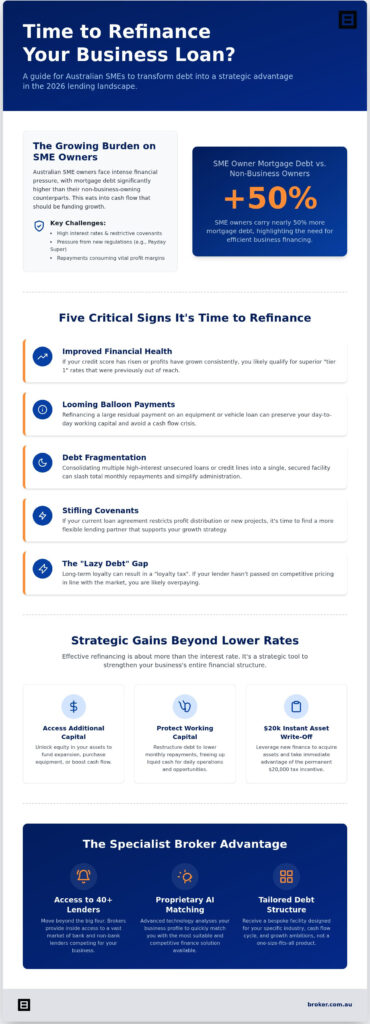
- Improved Financial Health: If your credit score has risen or your last two years of P&L statements show consistent growth, you likely qualify for “tier 1” rates that were previously out of reach.
- Balloon Payments Looming: Approaching the end of an equipment finance or vehicle loan term often triggers a large residual payment. Refinancing this into a new facility can preserve your working capital.
- Debt Fragmentation: Managing multiple high-interest unsecured loans or credit lines is inefficient. Consolidating these into a single, secured facility often slashes monthly repayment totals.
- Stifling Covenants: If your current lender’s “letter of facilities” restricts you from distributing profits or taking on new projects, it’s time to find a more flexible partner.
- The RBA Gap: With the cash rate at 4.35 per cent as of June 2026, some lenders are slower than others to pass on competitive pricing to existing customers.
However, refinancing isn’t always the right move. You should exercise caution if your current fixed-rate break costs are prohibitive, or if you plan to sell the business within the next six months. In these cases, the administrative friction and exit fees might outweigh the short-term interest savings.
Internal Triggers: Growth and Performance
Strong performance is your greatest bargaining chip. Two years of robust financial statements can unlock significantly lower interest margins and higher borrowing power. Many SMEs use this newfound leverage to transition from unsecured debt to Secured Business Loans, often using equity in commercial property to secure the lowest possible rates. This transition is a common way to fund a Business Acquisition or invest in large-scale Equipment Finance without draining your cash reserves. If you’re unsure if your current structure is holding you back, our team can provide inside access to the best rates currently available in the Australian market.
External Triggers: Market Movements
The Australian lending landscape in 2026 is defined by aggressive competition from new non-bank entrants. These lenders often offer introductory terms that undercut the big four banks to win market share. Monitoring the gap between your current rate and “best in class” market offers is essential. Whether you should switch from variable to fixed depends on your need for certainty versus your desire to benefit from potential future rate cuts. A specialist broker can help you navigate these 2026 predictions with tailored financial modelling.
Beyond Interest Rates: Strategic Reasons to Restructure Debt
Focusing solely on interest rates is a common mistake that overlooks the true power of a well-structured balance sheet. While a lower percentage is a win for your monthly budget, the strategic architecture of your debt often dictates your ability to scale. This is specifically when to consider refinancing business loans as a growth lever rather than a mere cost-cutting exercise. By realigning your debt with your current business maturity, you can significantly improve your debt-to-equity ratio, making your company far more attractive to lenders when you’re ready for your next major expansion or acquisition.
One of the most critical strategic moves for Australian directors is un-linking personal assets from business obligations. With SME owners currently carrying mortgage debt approximately 50 per cent higher than non-business owners, the family home is often unnecessarily at risk. Refinancing allows you to move toward standalone commercial facilities, protecting your private wealth from business volatility. Additionally, savvy owners use debt recycling strategies to transform non-deductible personal debt into tax-effective business debt, creating a more efficient wealth-building vehicle over the long term.
Unlocking Cash Flow with Working Capital Finance
Rigid term loans can often act as a handbrake on daily operations, especially for businesses with long payment cycles. Refinancing these facilities into a flexible Line of Credit or Invoice Finance arrangement provides the liquidity needed to bridge gaps between project milestones. A tailored debt structure outperforms a one-size-fits-all bank product because it matches your specific trading cycle rather than forcing you into a generic repayment schedule. This flexibility is essential for managing the increased cash flow pressure caused by the July 2026 payday superannuation requirements.
The Role of Asset and Equipment Finance
Your machinery and vehicle fleet shouldn’t just be tools for production; they should be tax-effective financial assets. Refinancing your existing Equipment Finance or Vehicle Finance allows you to take advantage of the permanent 20,000 dollar instant asset write-off that became a fixture in July 2026. Transitioning to a chattel mortgage can help you optimise GST and depreciation benefits, keeping more capital inside the business. If you’re planning a fleet upgrade, restructuring your current Asset Finance now ensures you have the borrowing capacity ready when the new models hit the market. This proactive approach ensures your equipment remains modern without straining your Working Capital Finance reserves.
The Refinancing Audit: Preparing Your Business for a New Facility
Success in restructuring your debt depends entirely on the quality of your preparation. Before you approach a new lender, you need a clear-eyed view of your current obligations and your future requirements. This audit is the definitive moment when to consider refinancing business loans with surgical precision. Moving too early without understanding your exit fees can erode your potential savings, while moving too late might mean missing a critical market window. A structured audit ensures you aren’t just swapping one problem for another; you’re building a foundation for sustainable growth.
Follow these five essential steps to prepare your business for a successful transition:
- Review your “letter of facilities”: Scrutinise your current contract for hidden clauses, restrictive covenants, and the specific terms of your security. Many directors discover their personal home is still cross-collateralised only after reading the fine print.
- Quantify exit costs: Calculate potential break costs and discharge fees. Fixed-rate loans often carry higher penalties that must be factored into your return on investment.
- Organise your financials: Ensure your Business Activity Statements (BAS) and tax returns are up to date. Lenders in 2026 value transparency and recent data over historical averages.
- Define your primary objective: Be clear about your goal. Are you chasing the lowest possible rate to boost margins, or do you need to unlock additional capital for a business acquisition?
- Leverage expert insight: Engage a specialist broker who uses proprietary AI technology to scan the market across 40 plus lenders instantly.
Calculating the “Real” Benefit
A lower interest rate is only one part of the equation. You must perform a rigorous break-even analysis that accounts for application fees, valuation costs, and legal charges. Don’t forget the “soft costs” involved; the time and administrative burden of a complex application can be significant if you don’t have a streamlined process. Sometimes, a slightly higher rate with more flexible terms or better service from a specialist lender is the more cost-effective long-term solution for your specific trading cycle. The goal is to move toward a state of streamlined confidence rather than just chasing a decimal point.
The Documentation Checklist for 2026
The lending environment has become more efficient, with “low doc” options now widely available for certain asset finance needs. However, if you’re seeking acquisition funding or complex restructuring, your financial modelling must be impeccable. You’ll need to demonstrate how the new facility supports your projected cash flow and meets the latest 2026 compliance standards. To get a head start on your figures, use our Business Loan Calculator to estimate your potential savings. Once you’ve seen the numbers, you can get started with our team to begin a seamless transition to a better facility.
How a Specialist Broker Simplifies the Refinancing Process
Navigating the Australian lending market alone is often an overwhelming task for time-poor directors. While a single bank can only offer you its own limited suite of products, a specialist broker provides inside access to over 40 different lenders. This breadth is vital when you’re deciding when to consider refinancing business loans, as the most competitive deal for your specific industry might sit with a niche non-bank lender rather than a major institution. By acting as your “High-Level Fixer”, we manage the entire transition, ensuring your move to a new facility is both seamless and professional.
The role of a broker goes far beyond simply finding a lower rate. We act as an expert guide through the complexities of the 2026 regulatory environment, including the latest anti-money laundering (AML) laws and SMSF loan requirements. Instead of you managing multiple applications and facing potential rejections that could damage your credit score, we provide a single point of contact. This person manages the administrative friction and communicates directly with lenders on your behalf, moving you from a state of uncertainty toward streamlined confidence.
The Advantage of AI-Driven Lending
Speed is a genuine competitive advantage in the current market. Broker.com.au uses proprietary AI technology to scan the lending landscape and match your financial profile with the right facility in minutes. This technology significantly reduces the time from the moment you say “I’m interested” to when the funds are settled in your account. The AI is incredibly accurate at identifying lenders with specific appetites for complex scenarios, such as Business Acquisition Funding or Development Finance, that traditional banks might overlook. This sophisticated technology is perfectly balanced by our human-led advisory, ensuring you receive the elite capability of a large firm with the boutique attention of a dedicated partner.
Taking the Next Step Without the Pressure
We understand that high-stakes financial decisions carry inherent anxiety, especially when your personal assets might be on the line. That’s why we’ve replaced aggressive sales tactics with a supportive, low-pressure approach. A no-obligation conversation is the most effective starting point for any SME owner looking to optimise their debt structure. Whether you’re navigating complex M&A regulations or simply want to reclaim your cash flow, our team is here to help you explore the possibilities without the stress. You can explore your refinancing options with Broker.com.au today to see how a tailored structure can fuel your next phase of growth.
Take Control of Your Financial Momentum
Refinancing in 2026 is no longer a reactive measure for struggling firms; it’s a sophisticated growth strategy for market leaders. By auditing your current facilities now, you can protect your personal assets and align your debt with the latest RBA movements. Identifying when to consider refinancing business loans is the first step toward reclaiming your operational freedom and lowering your monthly overheads. Whether you’re looking to consolidate high-interest debt or unlock capital for a major acquisition, the right structure provides the foundation your business deserves.
As an award-winning Australian brokerage, we provide inside access to over 40 specialist lenders through our proprietary AI-powered application technology. This blend of high-level tech and personal, human-led advisory ensures your transition is efficient and stress-free. Don’t let outdated loan terms stifle your 2026 growth plans. Reach out to Matt, Kylie, or the wider team to start a low-pressure conversation about your options.
I’m interested — let’s review my business loan
Your next phase of growth is closer than you think, and we’re here to help you unlock it with confidence.
Frequently Asked Questions
How much does it cost to refinance a business loan in Australia?
Refinancing costs vary based on your current facility’s structure and the complexity of the new loan. Common expenses include discharge fees from your old lender, valuation costs for commercial property, and legal fees for document preparation. If you have a fixed-rate loan, break costs can be significant. It’s essential to calculate these “real” costs before deciding when to consider refinancing business loans to ensure the long-term savings outweigh the initial outlay.
Can I refinance my business loan if I have ATO debt?
Yes, you can often refinance even with outstanding ATO debt, provided you have a clear strategy or a repayment plan in place. Specialist lenders are often more flexible than major banks and may allow you to use a portion of the new facility to clear your tax obligations. This approach can simplify your debt and improve your standing with the tax office, moving you toward a state of streamlined confidence.
Will refinancing my business debt affect my personal credit score?
Refinancing business debt can impact your personal credit score if you’ve provided a director’s guarantee. Each lender you apply with will likely perform a “hard” credit check on your personal file, which can temporarily lower your score. However, moving toward a more sustainable repayment structure often improves your long-term creditworthiness by ensuring you don’t miss future payments due to cash flow pressure.
How long does the business loan refinancing process typically take?
The timeline depends on the complexity of your business and the lender’s requirements. Streamlined, AI-powered applications for smaller facilities can take as little as 48 to 72 hours from submission to approval. More complex restructures or acquisition funding typically take between two and four weeks. This is because they require more detailed financial modelling and property valuations to ensure the new facility is tailored to your needs.
Is it possible to refinance an unsecured business loan into a secured one?
It’s absolutely possible to move from an unsecured loan to a secured one, and it’s a common strategy to lower interest rates. By offering commercial property or equipment as security, you reduce the lender’s risk. This often unlocks “tier 1” rates that were previously out of reach. This is a strategic moment when to consider refinancing business loans to significantly reduce your monthly interest burden and protect your margins.
What are the risks of cross-collateralisation when refinancing?
The primary risk of cross-collateralisation is that multiple assets are linked as security for a single loan. If your business faces financial stress, the lender may have the right to sell all linked properties, including your family home, to recover the debt. Refinancing is a brilliant opportunity to “un-link” these assets and move toward standalone commercial facilities, effectively separating your personal wealth from your business obligations.
Can I consolidate my business and home loans together?
You can consolidate business and home loans, often by using equity in your residential property to secure business funding at lower mortgage rates. While this can reduce your interest costs, it also places your home at direct risk if the business cannot meet repayments. Many savvy owners prefer to keep these facilities separate to protect their private wealth, a move that we can help you navigate as your expert guide.
What is the difference between a bank and a business loan broker?
A bank only offers its own suite of products, which may not be the most competitive for your specific trading cycle. A business loan broker acts as a high-level fixer with inside access to over 40 lenders, including niche non-bank specialists. We manage the entire application process and use proprietary technology to find the specific lender that matches your profile, saving you time and reducing the stress of high-stakes financial decisions.