
What if your family home wasn’t just a place to live, but the most efficient capital source for your next big expansion? With traditional business development rates sitting at 9.02% in mid-2026, many entrepreneurs are realising that using home equity to fund a business australia offers a far more sophisticated path to growth. You likely feel the pressure of tightening APRA debt-to-income caps and the frustration of rigid bank criteria that seem designed to say no. It is a stressful position to be in when you know your business is ready for the next level but the traditional lending numbers don’t seem to align.
We agree that your home should be your sanctuary, not a source of unnecessary risk. This guide will teach you how to safely unlock your property’s value to fuel business growth while protecting your most important assets through clever loan structuring. You will discover how to access lower interest rates than unsecured finance and how to organise your debt for maximum tax efficiency. We will walk you through the strategic steps to turn your residential equity into a streamlined, professional funding solution that keeps you in total control of your financial future.
Key Takeaways
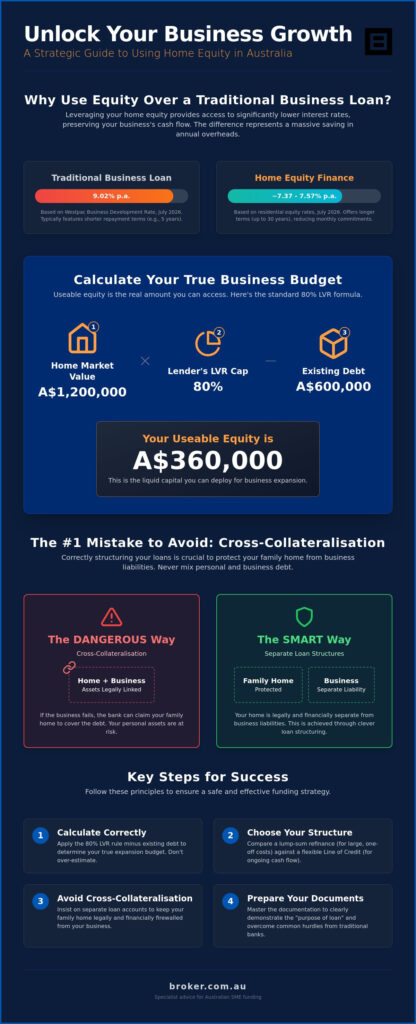
- Calculate your useable equity correctly by applying the 80% LVR rule minus existing debt to determine your true business expansion budget.
- Compare the benefits of a lump-sum refinance against a flexible Line of Credit to ensure your funding structure aligns with your specific cash flow needs.
- Learn how to avoid the trap of cross-collateralisation, keeping your family home legally and financially separate from your business liabilities.
- Master the documentation requirements for using home equity to fund a business australia to overcome common “purpose of loan” hurdles from traditional banks.
- Discover how specialist AI matching can provide inside access to non-bank lenders who offer more flexible equity policies for Australian SMEs.
Table of Contents
- Understanding Home Equity as a Business Growth Lever
- Loan Structures: Refinancing vs. Line of Credit
- The Danger of Cross-Collateralisation: Protecting Your Family Home
- Eligibility and Documentation: Making Your Application ‘Bankable’
- Why Partnering with a Specialist Broker is Your Best Move
Understanding Home Equity as a Business Growth Lever
Many Australian business owners view their mortgage as a monthly burden, but for a savvy entrepreneur, that bricks-and-mortar asset represents a dormant capital reserve. In the 2026 market, where property valuations remain a foundational pillar of wealth despite some softening sectors, your home is often the most efficient tool for scaling. It requires a psychological shift: you aren’t just living in a house; you’re sitting on a strategic financial engine. By using home equity to fund a business australia, you can bypass the restrictive lending criteria often found in the unsecured commercial market.
What is Useable Equity?
Before you can begin deploying capital, you must distinguish between total equity and useable equity. While What is home equity? can be defined broadly as the current market value of your property minus your remaining mortgage balance, lenders don’t allow you to withdraw every cent. Most Australian banks cap your borrowing at 80% of the property’s value to avoid Lenders Mortgage Insurance (LMI). Useable equity is the liquid portion of your property wealth that you can realistically access without incurring heavy fees or insurance costs.
To calculate this, take 80% of your home’s current market value and subtract your existing debt. For example, if your home is valued at A$1.2 million, your 80% threshold is A$960,000. If you owe A$600,000, your useable equity is A$360,000. Obtaining a fresh, formal valuation is a critical first step, as it often uncovers hidden capital that has built up through organic market growth.
Why Use Equity Instead of a Business Loan?
Traditional business loans often come with higher interest rates and shorter repayment windows that can choke a growing company’s cash flow. As of July 2026, the Westpac Business Development Rate is 9.02% p.a., whereas residential equity rates from lenders like HSBC are significantly lower, ranging between 7.37% p.a. and 7.57% p.a. for interest-only options. This interest rate spread represents a massive saving in annual overheads for your business.
The benefits extend beyond just the interest rate. Residential-backed funding offers several strategic advantages for SMEs:
- Repayment Terms: You can often extend terms up to 30 years, drastically reducing your monthly commitment compared to a standard 5-year commercial loan.
- Flexibility: The capital can be used for anything from business acquisition and fit-out finance to buying bulk inventory to hedge against inflation.
- Speed of Access: Once your equity is unlocked, accessing the funds is often faster than navigating the complex documentation required for a standalone business loan.
Lenders in 2026 are placing greater scrutiny on Debt-to-Income (DTI) ratios following APRA’s implementation of stricter caps in February. Working with a specialist who understands how to package your business income alongside your property assets is now more important than ever to ensure your application meets these modern standards.
Loan Structures: Refinancing vs. Line of Credit
Choosing the right architecture for your debt is just as critical as the interest rate you secure. When using home equity to fund a business australia, you must avoid the common mistake of “mixing” your personal mortgage with your professional capital in a single account. This creates an accounting nightmare and makes it difficult to claim interest as a tax deduction. Instead, we recommend a “sub-split” strategy. This involves dividing your home loan into two or more separate accounts under the same facility. One account remains for your private residence, while the other is dedicated solely to your business activities, ensuring your bookkeeping remains surgical and transparent.
You also need to decide between using an offset account or a redraw facility. For most business owners, an offset account is the superior choice. It provides immediate liquidity and keeps your funds accessible for rapid business opportunities without requiring bank approval for every withdrawal. If you ever feel that your debt levels are becoming complex or overwhelming, resources like free financial counselling can provide impartial guidance to keep your strategy on track.
The Lump Sum Refinance
A lump sum refinance is generally the most cost-effective path for one-off, high-value investments. This is ideal if you are looking at business acquisition funding or purchasing significant equipment. By refinancing your existing mortgage, you can “top up” the loan to release a specific amount of cash. In the current 2026 climate, where residential equity rates from lenders like HSBC sit between 7.37% p.a. and 7.57% p.a. for interest-only options, this structure allows you to lock in a lower rate for a portion of your debt compared to unsecured commercial finance. It provides the certainty of a fixed repayment schedule, helping you model your business’s long-term growth with precision.
Business Line of Credit (LOC)
If your capital needs are unpredictable, an equity-backed Line of Credit offers unparalleled flexibility. Think of it as a revolving credit facility secured by your home. You only pay interest on the funds you actually use, which makes it perfect for managing seasonal cash flow or unexpected working capital needs. However, be aware that many Australian lenders have tightened their LOC criteria throughout 2026. They now require more robust proof of the “business purpose” and may apply higher margins than a standard term loan. If your situation falls outside the standard bank appetite, we can help you explore professional loan restructuring options that provide the flexibility you need without the rigid constraints of traditional institutions.
The Danger of Cross-Collateralisation: Protecting Your Family Home
While using home equity to fund a business australia is a powerful growth strategy, the way you secure that debt determines your level of personal risk. Many traditional banks will encourage you to “cross-collateralise” your loans. This means the bank uses both your family home and your business assets as security for all your debts. To a lender, this is ideal because it creates a safety net where every asset you own covers every dollar you owe. For you, however, it is a dangerous entanglement that can lead to catastrophic consequences if the business faces a temporary downturn.
If your business loan is crossed with your mortgage, the bank holds the title to your home as leverage against your business performance. One bad quarter or a shift in market conditions could technically give the bank the right to call in the debt or even force the sale of your residence. Before committing to a structure, it is wise to consult the Australian government guide to business funding to understand how different debt instruments impact your liability. Our role is to ensure your expansion doesn’t come at the cost of your family’s security.
The ‘All-Monies’ Clause Explained
The “All-Monies” clause is the legal engine behind cross-collateralisation. It is a piece of fine print that allows a bank to use the equity in any of your properties to cover any debt you have with that same institution. This includes credit cards, business lines of credit, and equipment finance. Asset separation is the cornerstone of professional debt structuring. Without it, selling your home becomes incredibly complex. The bank may demand that a large portion of your sale proceeds go toward paying down your business debt before you can even think about buying a new house. It effectively gives the bank total control over your financial mobility.
How to Keep Business and Personal Debt Separate
The most effective way to protect your home is the “Two-Lender Strategy.” By using one bank for your residential mortgage and an entirely different lender for your business funding, you create a legal firewall between your assets. Lender A cannot seize your home for a default on a loan held by Lender B. This structure is particularly important in 2026 as APRA’s Debt-to-Income (DTI) caps make banks more sensitive to total exposure.
- Standalone Security: Ensure your business loan is secured only by the equity released, rather than a direct mortgage over the entire property.
- Director’s Guarantees: Use personal guarantees strategically instead of offering a property charge whenever possible.
- Expert Structuring: We find non-bank lenders who specialise in standalone business facilities, avoiding the “bank trap” of cross-collateralisation.
Our team at Broker.com.au focuses on “outside the norm” cases where asset protection is paramount. We provide inside access to flexible lenders who understand that your home and your business should never be legally married. This proactive approach ensures you are in good hands, moving you from uncertainty toward streamlined confidence.
Eligibility and Documentation: Making Your Application ‘Bankable’
Securing the capital is only half the battle. Presenting your case to a lender is where the strategy meets the reality of 2026 lending standards. The biggest hurdle many entrepreneurs face is the “Purpose of Loan” restriction. While major banks are comfortable with standard residential lending, they often become conservative when those funds are earmarked for business use. They aren’t just looking at your property value; they are assessing the risk of your venture. Using home equity to fund a business australia requires you to prove that the business can comfortably service the new debt without relying solely on your personal salary.
Proving servicing capacity as a self-employed individual has become more nuanced. Lenders now look for a holistic view of your financial health, combining your personal tax returns with your business’s Business Activity Statements (BAS). In the current environment, an Accountant’s Letter has become a vital piece of the puzzle. It provides a professional bridge between your raw numbers and the bank’s credit policy, explaining any anomalies or one-off expenses that might otherwise trigger a rejection. This level of preparation ensures you stay in good hands throughout the assessment process.
Proving the Business Case
A successful application highlights the Return on Investment (ROI). You must demonstrate how the released equity will generate enough cash flow to cover the interest and principal. If your latest tax returns aren’t ready, “Low Doc” options are still available through specialist non-bank lenders. These facilities allow you to use alternative income verification, such as six months of BAS or a self-declaration of income. However, a clean credit history for both you as a director and your company is non-negotiable. even a small default from years ago can stall a high-stakes application in the digital-first screening processes of 2026.
The 2026 Documentation Checklist
The days of paper-heavy applications are over. Most Australian lenders have transitioned to digital ATO verification, allowing them to pull your Notice of Assessments (NOAs) directly. This speed is efficient, but it leaves no room for error in your reporting. Lenders now use AI to scan BAS statements for cash flow consistency. They look for regular trading patterns rather than sporadic, high-value deposits that don’t reflect sustainable growth. You will also need to organise the following:
- Recent Profit and Loss (P&L) statements for the current financial year.
- Current balance sheets showing all existing business liabilities.
- Evidence of the specific “business purpose,” such as a quote for equipment or a signed heads of agreement for an acquisition.
If you’re unsure how to package your income to meet these strict new standards, get started with our expert team to find your perfect lender match through our proprietary AI technology.
Why Partnering with a Specialist Broker is Your Best Move
The Australian lending market in 2026 is a digital-first, data-heavy environment. While using home equity to fund a business australia is a brilliant move, trying to do it alone often leads to “computer says no” outcomes at the big four banks. We act as your expert guide, navigating the complex intersection of residential equity and commercial growth. Our team, including specialists like Matt and Kylie, manages the bank’s demands so you can focus on running your business. We take the weight of the application off your shoulders, ensuring you are in good hands from the first consultation to settlement.
We provide inside access to over 30+ lenders. This includes non-bank institutions that are often more flexible with their equity policies than traditional lenders. Our proprietary AI technology doesn’t just scan for the lowest rate; it matches your specific scenario with the lender most likely to approve your unique structure. Whether you are seeking fit-out finance or business acquisition funding, our AI-driven matching ensures your application is “bankable” before it even hits a credit officer’s desk. This proactive approach saves you time and protects your credit score from unnecessary rejections.
The Broker.com.au Advantage
Our approach is bespoke. We treat you as a partner, not a file number. We specialise in complex strategies like debt recycling and loan restructuring that most retail bank managers simply don’t have the authority or insight to execute. By working with us, you gain access to terms and rates that aren’t advertised to the general public. We understand the “outside the norm” cases, providing the local insights needed to navigate 2026’s strict APRA debt-to-income caps. This ensures your funding is not only approved but also optimised for your long-term wealth and asset protection.
Next Steps: Unlocking Your Growth Potential
The journey from uncertainty to streamlined confidence starts with a simple conversation. We begin with a no-obligation strategy session where we calculate your true useable equity and review your current loan structure for any hidden risks. We look for the traps mentioned earlier, such as cross-collateralisation, to ensure your family home remains a sanctuary. Our process is designed to be stress-free, moving at the speed your business requires. You deserve a partner who goes above and beyond to turn your business dreams into a financial reality.
I’m interested – let’s see how much equity I can unlock
Ready to Transform Your Home Equity into Business Growth?
Strategic expansion requires more than just capital; it demands a structure that respects the boundary between your professional ambitions and your family’s security. By using home equity to fund a business australia, you can access the most cost-efficient finance in the 2026 market without falling into the trap of cross-collateralisation. You now understand how to calculate your useable equity, the documentation required to satisfy modern digital verification, and the critical importance of keeping your debt facilities separate.
As award-winning Australian business loan experts, we provide the inside access you need to non-bank lenders and flexible terms. Our proprietary AI-powered lender matching ensures 100% accuracy in finding the right fit for your specific goals. We specialise in protecting your most important assets, ensuring your home remains a sanctuary while your business scales. You don’t have to navigate these high-stakes financial decisions alone. We are here to ensure the process is seamless and stress-free, giving you the streamlined confidence to move forward.
I’m interested in using my home equity for business
Your business is ready for the next level. Let’s work together to unlock its full potential while keeping your personal assets safe and secure.
Frequently Asked Questions
Can I use my home equity to start a brand-new business?
Yes, you can use your property’s value for a startup, provided you can demonstrate a clear path to repayment. Lenders will scrutinise your ability to service the debt without existing business revenue. Most traditional banks prefer established trading history, so startups often need to rely on their current PAYG income or a robust business plan to prove servicing capacity. We can help you find non-bank lenders who are more flexible with new ventures.
Is the interest on a home equity loan tax-deductible if used for business?
Interest is typically tax-deductible when the loan’s purpose is for an income-producing business activity. Using home equity to fund a business australia allows you to claim the interest portion of the loan as a deduction, but you must keep the business funds separate from your personal mortgage. We always recommend consulting a qualified accountant to ensure your loan is structured correctly for the Australian Taxation Office and to avoid “mixed-purpose” loan complications.
What is the maximum LVR for an equity-release business loan?
Most Australian lenders cap the Loan-to-Value Ratio (LVR) at 80% for business-related equity releases. While it is technically possible to go higher, you will likely incur Lenders Mortgage Insurance (LMI), which adds significant upfront costs. Staying at or below 80% ensures you access the most competitive residential interest rates while maintaining a healthy equity buffer for your personal security. This threshold is standard across most major and second-tier banks in 2026.
How long does it take to release equity for business purposes?
The process usually takes between 14 and 28 days depending on the lender’s current processing times and the complexity of your application. The most time-consuming steps are the formal property valuation and the verification of your business’s financial documents. Having your BAS and tax returns organised before you start will help us streamline the application and reach settlement faster. Digital verification tools have significantly reduced wait times compared to previous years.
Do I need a business plan to get an equity-based loan approved?
Established businesses often only need to provide their last two years of tax returns and current BAS statements. If you are a startup or seeking a significant “top-up” for a major acquisition, a professional business plan is essential. It helps the lender understand your projected cash flow and confirms that the debt is a sustainable move for your growth. A well-prepared plan increases your chances of approval with more conservative lenders.
What happens to my home if the business fails?
Your home is at risk if it is used as primary security for the loan. If the business fails and you cannot meet the repayments, the lender has the legal right to sell the property to recover their funds. This is why our “Expert Guide” approach focuses on avoiding cross-collateralisation. By structuring your debt correctly and keeping the facilities legally separate, you can mitigate the risk of a business downturn directly impacting your family’s residence.
Can I release equity if I have a low credit score?
A low credit score doesn’t automatically disqualify you, but it does mean traditional big banks may decline your application. We have inside access to specialist non-bank lenders who look beyond the credit score to assess the overall strength of your business and property equity. These “outside the norm” cases are our specialty. We focus on your current servicing capacity and the value of your assets rather than just your past credit history.
Is a line of credit better than a term loan for my business?
A line of credit is superior for managing seasonal fluctuations or ongoing working capital needs since you only pay interest on what you use. Conversely, a term loan is better for a one-off purchase, like buying a competitor or new machinery, because it offers a fixed repayment schedule. Using home equity to fund a business australia effectively often involves a mix of both structures tailored to your specific cash flow requirements and long-term growth goals.