
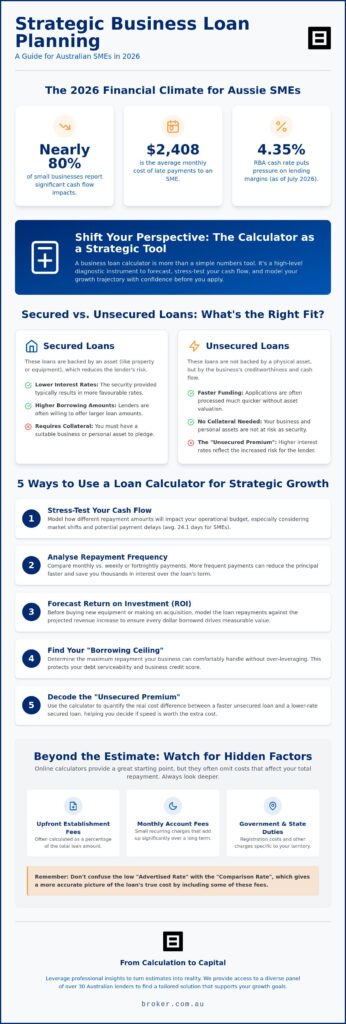
Nearly 80% of Australian small businesses reported a significant impact on their cash flow over the last year, often exacerbated by late payments that cost the average SME around $2,408 every month. With the RBA cash rate held at 4.35% as of July 2026, the decision to scale your operations requires more than just ambition; it demands absolute precision. You likely feel the weight of this responsibility, perhaps worrying if high interest rates or unexpected balloon payments might quietly erode your hard-earned margins.
It is a common concern for any savvy owner, but you don’t have to fly blind. Our guide shows you how to use a business loan calculator as a high-level diagnostic tool rather than just a simple arithmetic exercise. You will learn to master your finances by understanding how different loan structures, interest rates, and terms impact your bottom line long before you ever submit an application. We are going to break down the nuances of secured versus unsecured options and show you how to model a repayment plan that supports your 2026 growth goals with streamlined confidence.
Key Takeaways
- Transform your approach to debt by using a business loan calculator as a strategic forecasting tool to stress-test your cash flow against 2026 market shifts.
- Identify the impact of repayment frequency and loan terms on your bottom line to ensure your finance structure aligns with your long-term growth objectives.
- Decode the “Unsecured Premium” to decide if the speed of unsecured funding outweighs the lower interest rates typically found with secured business loans.
- Learn how to model the real-world ROI of new equipment or business acquisitions before you apply, ensuring every dollar borrowed drives measurable value.
- Move beyond generic estimates to a tailored solution by leveraging professional insights and access to a diverse panel of over 30 Australian lenders.
Table of Contents
- Beyond the Numbers: Why Every Aussie Biz Owner Needs a Strategic Loan Plan
- Decoding Your Repayment Estimate: Interest Rates, Terms, and Hidden Factors
- Secured vs Unsecured: How Your Choice Shifts the Calculator Results
- 5 Strategic Ways to Use a Business Loan Calculator for Growth Planning
- From Calculation to Capital: How Broker.com.au Turns Estimates into Reality
Beyond the Numbers: Why Every Aussie Biz Owner Needs a Strategic Loan Plan
Think of a business loan calculator as more than a digital abacus; it is your first line of defence in cash flow management. In 2026, with the official RBA cash rate holding at 4.35%, the margin for error in your financial modelling has narrowed. You aren’t just looking for a monthly figure. You are stress-testing your company’s resilience against market shifts and persistent inflation. Before you dive into the specifics of what is a business loan, you need to understand how these numbers interact with your unique operational cycle.
Savvy directors understand that borrowing isn’t a burden; it’s a strategic investment in growth. This psychological shift is vital. When you use a calculator, you’re not just calculating debt. You’re quantifying the fuel for your next acquisition or equipment upgrade. It’s the first step in the “I’m interested” journey, allowing you to approach a lender with the confidence of someone who already knows their limits.
The Role of Forecasting in Australian SME Success
Accurate repayment estimates are essential to prevent over-leveraging. With Australian SMEs waiting an average of 24.1 days to get paid in early 2026, your cash flow is already under pressure. If you don’t account for these delays, a loan that looks affordable on paper could quickly become a liability. A calculator helps you find your “borrowing ceiling” by showing how repayments fit into your existing revenue. This foresight protects your debt serviceability, which is a key driver of your business credit score. A strong score ensures that when you need to scale, the doors stay open.
Common Misconceptions When Using Online Calculators
Many owners fall into the trap of believing the “lowest rate” displayed on a generic tool is a guarantee. It’s a guide, not a contract. Lenders often advertise a headline rate that only applies to the most pristine risk profiles. You must also distinguish between advertised rates and comparison rates. In a business context, the comparison rate includes some of the costs associated with the loan, giving you a clearer picture of the true expense.
Calculators frequently omit certain details that can impact your bottom line, such as:
- Upfront establishment fees that are often a percentage of the total loan amount.
- Monthly account keeping charges that add up over a five-year term.
- Government duties or registration costs specific to your state or territory.
By identifying these gaps early, you can move from a rough estimate to a professional financial plan that actually works for your business.
Decoding Your Repayment Estimate: Interest Rates, Terms, and Hidden Factors
When you first engage with a business loan calculator, the output is only as reliable as the variables you input. The three pillars of any repayment estimate are the principal, the interest rate, and the loan term. With the RBA cash rate sitting at 4.35% as of July 2026, commercial lending margins are under a microscope. Lenders typically add a risk premium on top of this base rate, meaning your final figure will vary based on your business’s financial health and the security you provide. Understanding how these components interact allows you to move from a rough guess to a professional financial model.
Repayment frequency is an often overlooked lever in your strategy. Switching from monthly to weekly or fortnightly payments can shave thousands off your total interest bill over the life of the loan. This happens because most commercial facilities calculate interest on a daily reducing balance. By paying more frequently, you reduce the principal faster, giving interest less room to compound. If you’re unsure how these variables apply to your specific industry, you can explore tailored finance options with our expert team to find a structure that fits your cash flow cycle.
You might also consider the concept of loan restructuring. This involves adjusting your terms or repayment schedules mid-stream to reflect changes in your revenue or the broader economy. A calculator allows you to visualise these “what-if” scenarios before you commit, ensuring you remain in control of your debt rather than being managed by it.
The Impact of Loan Terms on Total Interest Paid
Choosing between a short-term and long-term facility is a balancing act between your monthly cash flow and the total cost of the debt. While a 5-year term for asset finance minimises your total interest expense, extending to a 7-year term can provide the crucial breathing room needed to maintain daily operational liquidity. You must also account for the “interest curve.” In the early stages of a loan, a larger portion of your repayment goes toward interest rather than the principal. Visualising this curve helps you time future refinances or early exits effectively without being stung by unexpected costs.
Balloon Payments and Residual Values Explained
A balloon payment, or residual value, is a lump sum owed to the lender at the very end of your term. By deferring a portion of the principal, you significantly lower your monthly repayments, which can be a lifesaver for businesses in a high-growth phase. However, this creates a “cliff” at the end of the term. You can use a business loan calculator to test whether a 20% or 30% balloon fits your exit strategy. Whether you plan to sell the asset, refinance the remaining balance, or pay it out from cash reserves, having a calculated plan prevents the stress of a sudden, unmanaged liability.
Secured vs Unsecured: How Your Choice Shifts the Calculator Results
When you adjust the settings on a business loan calculator from “secured” to “unsecured,” the change in the projected interest rate is often immediate and significant. This isn’t a glitch in the tool; it reflects the fundamental shift in risk the lender is assuming. Choosing between these two paths is a major strategic decision that defines your repayment schedule and your relationship with your assets. For a deeper dive into which path suits your current phase, you can read our guide on Unsecured vs Secured Business Loans to see how each impacts your long-term liability.
Lenders view security as a safety net. If you provide collateral, such as commercial property or heavy machinery, the lender’s risk of loss is mitigated. This lower risk profile translates directly into the lower interest rates you see on your calculation. Conversely, the “Unsecured Premium” is the higher rate you pay in exchange for speed and asset protection. You’re effectively paying more for the luxury of keeping your property titles unencumbered and for an approval process that can often be completed in a fraction of the time required for secured funding.
Secured Loans: Leveraging Assets for Lower Rates
Using residential or commercial property as security typically slashes your repayments because it provides the highest level of certainty for a bank. The business loan calculator logic often uses the Loan to Value Ratio (LVR) to determine your rate; the more equity you have in the asset compared to the loan amount, the more favourable your terms will be. Because the loan is backed by a physical asset, lenders are also more willing to offer longer repayment terms, sometimes extending to 15 or 25 years for commercial property. This spreads the principal over a longer period, significantly easing the pressure on your monthly cash flow.
Unsecured Loans: The Cost of Speed and Flexibility
Unsecured loan calculators usually show higher interest rates, but they also reflect lower upfront hurdles. You won’t need to provide property valuations or go through lengthy asset registrations. This makes unsecured funding ideal for rapid working capital needs or quick inventory pivots where the opportunity cost of waiting for a secured loan outweighs the higher interest expense. If your business demonstrates exceptionally strong cash flow and a history of consistent revenue, some specialist lenders may offer more competitive rates that partially offset the lack of physical collateral. It’s about trading a higher interest cost for the agility to move when the market demands it.
5 Strategic Ways to Use a Business Loan Calculator for Growth Planning
A business loan calculator is more than a tool for checking affordability; it is a strategic engine for your 2026 growth blueprint. Rather than accepting the first number you see, use the tool to stress-test your cash flow. Manually increase the interest rate by 2% in your calculations. This allows you to see exactly how your margins would hold up if the RBA cash rate, currently at 4.35%, were to shift or if lender margins widened. By preparing for the “worst-case” scenario, you move forward with the confidence that your business remains resilient.
You should also use the tool to weigh the opportunity cost of delay. With annual CPI inflation at 4.0% in May 2026, waiting for a minor dip in interest rates might actually be more expensive than borrowing now. If a new project promises a 15% return on investment, but you delay it by six months to save 0.5% on interest, you are effectively losing money. Calculating the cost of a Line of Credit for working capital against a standard term loan also reveals which structure keeps your interest expense lowest while maintaining the agility to pivot when a new opportunity arrives.
Scenario Planning for Asset Acquisition
When you are looking at Equipment Finance or Vehicle Finance, the calculator helps you determine if an asset pays for itself. If a new piece of machinery generates $5,000 in additional monthly revenue but the repayment is only $3,500, the ROI is clear. You can also use the tool to decide between a Chattel Mortgage and a Leasing structure. While a Chattel Mortgage allows for immediate ownership and potential depreciation benefits, a lease might offer lower monthly outgoings that better suit your current cash flow. If you are expanding your physical premises, modelling your Fit-out Finance repayments ensures your new location is profitable from day one. To see how these structures fit your specific goals, you can get started with a tailored finance assessment today.
Debt Consolidation and Restructuring
Many Australian business owners use a business loan calculator to explore debt recycling or consolidation. By refinancing existing high-interest debt into a single, lower-rate facility, you can often free up significant monthly cash flow to reinvest back into your operations. Consolidating multiple small loans into one facility simplifies your monthly management and often reduces the total fees you pay. This strategic restructuring transforms your balance sheet from a collection of liabilities into a streamlined foundation for future scaling.
From Calculation to Capital: How Broker.com.au Turns Estimates into Reality
A business loan calculator is an excellent starting point, but it remains a static tool in a dynamic market. When you use a calculator on a single bank’s website, you are only seeing a narrow slice of the Australian lending landscape. That bank’s primary goal is to fit your business into their rigid criteria. At Broker.com.au, we flip the script. Our proprietary AI technology takes your “calculated” requirements and cross-references them against a diverse panel of over 30 lenders. This ensures you aren’t just getting a loan; you are securing the specific capital structure that supports your 2026 growth objectives.
Moving from an estimate to a settlement requires more than just code. It requires the “Expert Guide” approach that our team members, like Matt, Kylie, and Flavio, provide every day. They offer inside access to the best rates and niche products that don’t appear on public comparison sites. While a web tool can give you a number, our specialists provide the context, helping you manage the complexity while you focus on your business’s core mission. We believe in high-level corporate competence delivered with a boutique level of personal attention.
Why a Broker Beats a Bank Calculator Every Time
The most competitive rates in the current market often come from non-bank lenders and private funds that don’t even host public calculators. These institutions offer incredible flexibility but are often only accessible through professional intermediaries. Instead of trying to force your business to fit a bank’s rigid box, we tailor a loan structure that fits your specific revenue patterns. Our stress-free promise means we handle the heavy lifting, from the initial analysis of your business loan calculator results to the final moment of settlement. We do the legwork so you can maintain your momentum without the administrative headache.
Next Steps: Moving Beyond the Estimate
Once you have a clear monthly repayment figure in mind, your next step should be a conversation rather than more clicking. A calculator cannot account for the local insights or industry-specific nuances that affect your approval chances. We provide high-level expertise and boutique personal attention without the need for you to visit a physical branch. This streamlined approach saves you time and reduces the anxiety often associated with high-stakes finance. We are here to move you from a state of uncertainty toward a feeling of streamlined confidence.
I’m interested—let’s discuss my strategy
Fuel Your Business Ambitions with Strategic Precision
Mastering your finances starts with a single, calculated step. By using a business loan calculator as a strategic forecasting tool, you’ve already shifted from a state of uncertainty to one of informed control. You now understand how to stress-test your cash flow against the current 4.35% RBA cash rate and how the choice between secured and unsecured funding defines your long-term liability. These insights are the foundation of a resilient growth plan for 2026.
However, numbers on a screen are only the beginning. To truly unlock the best rates and tailored structures, you need a partner who understands the nuances of the Australian lending landscape. At Broker.com.au, we provide award-winning finance solutions backed by proprietary AI for faster approvals. Our team offers inside access to over 30 Australian lenders, ensuring your strategy is supported by the most competitive products available.
I’m interested—get a tailored quote from an expert broker
Your vision for growth is within reach, and we’re here to ensure you have the capital to make it a reality. Let’s turn those estimates into a seamless, stress-free success story for your business.
Frequently Asked Questions
Is the business loan calculator result a guaranteed offer?
No, the results from a business loan calculator are indicative estimates rather than a formal, guaranteed offer. Lenders determine your final rate and approval based on a comprehensive assessment of your credit history, business financial health, and the specific security provided. These digital tools provide a vital baseline for your planning, but a formal quote requires a full application and credit review by an expert guide.
Does using a business loan calculator affect my credit score?
Using an online calculator has absolutely no impact on your business or personal credit score. Since you aren’t submitting a formal application or authorising a credit file check, these calculations remain private. This allows you to model multiple growth scenarios and repayment structures without leaving any footprints on your credit report, giving you the freedom to explore your options with streamlined confidence.
What is the difference between a fixed and variable rate in the calculator?
A fixed rate remains constant throughout the specified term, providing absolute certainty for your monthly cash flow budgeting. In contrast, a variable rate can fluctuate based on changes to the RBA cash rate or lender margins. While variable rates often start lower, they introduce the risk of higher repayments if rates rise. It’s essential to use the tool to stress-test both scenarios before committing to a facility.
Can I include a balloon payment in my calculation?
Yes, including a balloon payment allows you to defer a portion of the principal until the end of the loan term, which significantly lowers your ongoing monthly repayments. This is a common strategy for asset and vehicle finance. When using a business loan calculator, you can often input a percentage, such as 20% or 30%, to see how this residual value affects your immediate cash flow and final payout requirement.
Why is my bank’s calculator showing a different rate than a broker’s estimate?
A bank’s calculator only reflects their specific, often rigid, lending criteria and headline rates. A broker’s estimate is typically more accurate because it draws on inside access to a panel of over 30 Australian lenders, including non-bank and private funds. This broader view allows for a more tailored assessment that accounts for specialist products and current market competition that a single bank’s tool simply cannot see.
Do these estimates include GST or tax-deductible interest components?
Most calculators focus purely on the principal and interest repayments and do not automatically account for GST or specific tax deductions. While the interest component of a business loan is generally tax-deductible in Australia, the way GST applies depends on whether you are using a Chattel Mortgage, lease, or standard loan. We always recommend discussing the specific tax implications of your calculated estimate with your accountant to ensure total clarity.
How do I calculate the repayments for a business acquisition loan?
To estimate repayments for Business Acquisition Funding, input the total purchase price minus your cash deposit or equity contribution. You should also factor in a buffer for working capital and professional fees. Because acquisition loans often involve complex variables like goodwill and future revenue projections, the calculator serves as a preliminary guide before our team performs more detailed financial modelling to ensure the debt is serviceable.
What is a ‘comparison rate’ and why is it higher than the interest rate?
The comparison rate is a tool designed to show you the true cost of a loan by including both the interest rate and most mandatory fees and charges. It is higher than the base interest rate because it accounts for upfront establishment fees and ongoing account keeping costs. Reviewing the comparison rate ensures you aren’t caught out by hidden expenses that a simple interest-only calculation might omit, giving you a professional and transparent view of your liability.