
What if you could drive a new commercial vehicle off the lot today, claim the full GST back in your next BAS, and keep your business’s cash reserves completely untouched? For many Australian business owners, the pressure to upgrade equipment often clashes with the need to maintain a healthy safety net. It’s a common frustration to feel like you’re choosing between growth and stability, especially when navigating shifting interest rates and complex tax thresholds.
In this 2026 guide, you’ll discover how a chattel mortgage serves as a strategic tool to help you acquire essential assets while maximising your tax position. Whether you’re looking to leverage the $20,000 instant asset write-off or manage the 2026-27 car depreciation limit of $69,883, we’ll show you how to structure your finance to protect your working capital. We will break down the latest ATO regulations, explain how to navigate balloon payment risks, and provide the expert clarity you need to own your assets from day one with total confidence.
Key Takeaways
- Understand why immediate ownership of business assets is a game-changer for your balance sheet and provides greater operational control from day one.
- Learn how to navigate the 2026 lending landscape by matching your unique business profile with the most competitive rates from over 40 Australian lenders.
- Discover how a chattel mortgage allows you to claim the full GST amount upfront in your next BAS, providing a significant and immediate boost to your cash flow.
- Compare the long-term financial impacts of various asset finance structures to ensure you choose the option that best aligns with your specific debt-to-equity goals.
- Streamline your acquisition process using AI-powered insights to secure faster approvals for essential vehicles, machinery, and specialized equipment.
Table of Contents
- What is a Chattel Mortgage? Defining Asset Finance for Australian SMEs
- How a Chattel Mortgage Works: The Step-by-Step Process
- Tax Benefits and Financial Advantages for Your Business
- Comparing Finance Options: Chattel Mortgage vs. Hire Purchase vs. Leasing
- Securing Your Asset Finance with Broker.com.au
What is a Chattel Mortgage? Defining Asset Finance for Australian SMEs
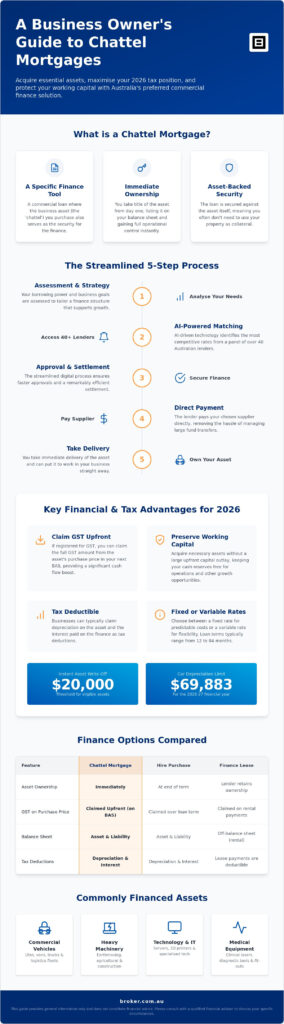
A chattel mortgage is a specialised commercial finance product designed for businesses that want the benefits of ownership without the upfront capital hit. Unlike a traditional mortgage used for land or buildings, this arrangement allows a lender to provide the funds for an asset while you take immediate title. To understand the legal foundations, you can explore the technical background of What is a Chattel Mortgage? which outlines how these agreements operate within the Australian legal framework. It’s a popular choice for ABN holders because it bridges the gap between needing new equipment and maintaining a healthy bank balance.
The term ‘chattel’ might sound like legal jargon, but it simply refers to movable property. This includes anything from a delivery van to a 3D printer. Because the asset isn’t fixed to the ground, it’s treated differently than real estate. In a chattel mortgage, the asset itself serves as the primary security. This is a massive win for many Aussie SMEs because it means you often don’t need to put your family home or other property on the line to upgrade your fleet or workshop. The lender takes a mortgage over the ‘chattel,’ which is then registered with the Personal Property Securities Register (PPSR).
This finance structure is particularly attractive for Australian businesses operating on a cash or accruals basis. If you’re registered for GST, the immediate ownership status allows you to claim the GST paid on the purchase price in your next Business Activity Statement. It’s a proactive way to manage your tax obligations while ensuring your team has the tools they need to perform. Most Australian lenders will require you to use the asset for more than 50% business purposes to qualify for this specific commercial product.
The Core Components of the Agreement
Taking immediate ownership is a strategic move. It puts the asset on your balance sheet from day one, which can improve your business’s perceived value. You’ll find that most Australian lenders offer terms ranging from 12 to 84 months, allowing you to align your repayments with the asset’s expected lifespan. With the RBA cash rate sitting at 4.35% as of May 2026, choosing between a fixed or variable rate requires careful thought. A fixed rate offers the comfort of predictable monthly costs, while a variable rate might suit those looking for flexibility if economic conditions shift later in the year.
Common Assets Financed via Chattel Mortgage
This finance structure isn’t just for trucks. While commercial vehicles like utes and logistics fleets are the most common, heavy machinery is a close second. Think earthmoving gear for civil contractors or harvesters for primary producers. We also see high-value technology and medical equipment, such as clinical lasers or server stacks, financed this way. If it’s essential for your business and it moves, it’s likely a candidate for this type of funding. This flexibility allows businesses to stay at the cutting edge of their industry without draining their working capital.
How a Chattel Mortgage Works: The Step-by-Step Process
Securing a chattel mortgage has evolved into a streamlined experience that prioritises your time and business momentum. The journey begins with a comprehensive assessment of your borrowing power and the specific equipment your business needs. We look at your current financial position and future goals to ensure the finance structure supports your growth rather than hindering it. If you’re ready to see how these steps apply to your unique situation, you can explore our tailored asset finance options and get a clearer picture of your potential savings.
Unlike traditional banking models that might leave you waiting weeks for an answer, modern lender matching uses AI technology to identify the most competitive rates across a panel of more than 40 Australian lenders. This digital precision means your application is directed toward the institutions most likely to approve your specific profile, whether you’re a long-standing enterprise or a growing trade business. Once approved, the settlement process is remarkably efficient. The lender pays your supplier directly, allowing you to take delivery of the asset without the stress of managing large fund transfers yourself.
Flexibility is at the heart of the repayment structure. You can organise your payments to occur monthly or quarterly, which is particularly beneficial for businesses with seasonal cash flow, such as those in the agricultural or tourism sectors. This ensures your obligations remain manageable even during quieter periods of the year.
Understanding the Balloon Payment
A balloon payment is a strategic lump sum owed at the end of your loan term. By deferring a portion of the principal to the final payment, you can significantly reduce your monthly commitments and keep more cash in your business for daily operations. The key is to set a balloon amount that aligns with the asset’s expected resale value. For example, if you plan to upgrade a van after four years, the balloon should ideally match the projected trade-in price. If paying the lump sum isn’t feasible when the term ends, refinancing the remaining amount is a common and stress-free way to maintain your cash flow.
The Role of the Mortgage Memorandum
The legal security of this arrangement is anchored by the mortgage memorandum. This document allows the lender to register their interest in the asset on the Personal Property Securities Register (PPSR). This registration acts as a formal notice of the lender’s security interest while you maintain full operational use of the equipment. Once you’ve made your final payment, the mortgage is discharged, and the encumbrance is removed from the PPSR. While some lenders may require a director’s guarantee for certain loan amounts, this is a standard part of the process designed to secure the most professional and competitive terms for your business.
Tax Benefits and Financial Advantages for Your Business
Choosing a chattel mortgage is as much a tax strategy as it is a financing decision. Because you take ownership of the asset immediately, the financial structure behaves differently to a lease. You aren’t just paying for the use of a vehicle or machine; you’re building equity while accessing significant tax levers that can improve your bottom line from the very first month. In a high-interest environment where the RBA cash rate sits at 4.35%, every deduction counts toward maintaining your business’s resilience.
The most immediate advantage is the preservation of your working capital. Instead of sinking a massive lump sum into a depreciating asset like a delivery truck or a CNC machine, you keep that cash in your offset account or use it for daily operations. This liquidity provides a vital safety net. You can then use the interest component of your repayments as a valid business expense, effectively reducing your taxable income throughout the life of the loan.
GST Treatment and the BAS Advantage
For businesses registered for GST, the chattel mortgage offers a powerful cash flow injection. Unlike other finance products where GST is claimed over time, this structure allows you to claim the full GST amount paid on the purchase price in your next Business Activity Statement (BAS). This is particularly beneficial for businesses on a cash basis. If you’re purchasing a vehicle for the 2026-27 financial year, remember that the maximum GST credit you can claim for a car is capped at $6,353. You have the choice to finance the full purchase price including GST, or pay the GST component upfront to reduce your total loan amount. Your bookkeeper will need to separate the principal from the interest in your records, as only the interest and the depreciation are deductible against your income.
Depreciation and the 2026 Tax Rules
Navigating the 2026 tax landscape requires precision. For the 2025-2026 income year, the Australian government has confirmed an instant asset write-off threshold of $20,000 for eligible small businesses with an aggregated turnover of less than $10 million. If your asset falls under this amount, you may be able to deduct the full cost immediately. For larger investments, you’ll need to use traditional depreciation methods. The car depreciation limit for the 2026-27 year is set at $69,883, which is the maximum value you can use to calculate your claim on a business vehicle.
You can typically choose between the diminishing value method, which front-loads your deductions, or the prime cost method, which spreads the deduction evenly over the asset’s life. Choosing the right path depends on your projected profit. If you expect a bumper year, front-loading depreciation can provide a massive shield against a high tax bill. We recommend speaking with your accountant to see which method aligns best with your 2026 financial modelling.
Comparing Finance Options: Chattel Mortgage vs. Hire Purchase vs. Leasing
Selecting the right asset finance isn’t a one-size-fits-all process. It requires a clear understanding of how each product interacts with your business’s balance sheet and tax obligations. While a chattel mortgage has become the go-to for many Australian SMEs, it’s essential to weigh it against alternatives like finance leases and commercial hire purchases to ensure your choice aligns with your long-term goals.
The primary differentiator is ownership. With a chattel mortgage, you hold the legal title from the moment of purchase. In contrast, a lease or hire purchase typically keeps the title with the lender until the agreement concludes. This distinction affects your debt-to-equity ratio and how your business appears to future investors or lenders. If you’re unsure which path fits your specific growth strategy, you can get started with an expert consultation to compare these options side-by-side.
Chattel Mortgage vs Finance Lease
The fundamental divide here is between ownership and rental. A finance lease is essentially a long-term rental agreement where the lender buys the asset and leases it back to you for a set period. Because the lender retains ownership, they also bear the residual value risk, though you are often responsible for a final payment at the end of the term. This makes leasing attractive for assets with high obsolescence, like office IT equipment or rapidly evolving tech. However, for “long-life” assets such as heavy machinery or prime movers, the chattel mortgage is usually superior. It allows you to build equity in an asset that will likely outlast its loan term, providing your business with a tangible piece of capital once the debt is cleared.
Chattel Mortgage vs Commercial Hire Purchase (CHP)
Commercial Hire Purchase is increasingly rare in the Australian market, largely due to how GST is handled. Under a CHP, the lender owns the asset and you “hire” it, with an option to purchase at the end of the contract. Historically, this meant GST was paid on each individual instalment. In a chattel mortgage, the GST treatment is much cleaner, allowing for that upfront claim we discussed in the previous section. Legal title also remains with the lender in a CHP until the very last payment is made, whereas the chattel mortgage gives you that control from day one. Most modern Australian businesses have shifted away from CHP in favour of the more tax-efficient and streamlined chattel structure.
Quick Comparison Guide:
- Ownership: Chattel Mortgage (Day 1) vs. Lease (Lender holds title)
- GST Claim: Chattel Mortgage (Full Upfront) vs. Lease (Claimed per payment)
- Balance Sheet: Chattel Mortgage (Asset and Liability) vs. Lease (Typically viewed as an operating expense)
- End of Term: Chattel Mortgage (Mortgage discharged) vs. Lease (Option to buy, return, or upgrade)
Securing Your Asset Finance with Broker.com.au
Securing a chattel mortgage shouldn’t feel like a second job. When you walk into a traditional bank, you’re limited by a single credit policy. If your business doesn’t fit their specific ‘box,’ the conversation often ends there. At Broker.com.au, we turn that model on its head. By providing inside access to a panel of over 40 Australian lenders, including the Big Four and specialised boutique firms, we ensure your application finds the right home. We act as your expert guide, navigating the complexities of the lending landscape so you don’t have to.
Our approach combines high-level financial modelling with AI-powered precision. This technology doesn’t just crunch numbers; it identifies which lenders are currently ‘hungry’ for specific asset classes. Whether you’re financing a single ute or a fleet of heavy machinery, we match your business profile to the institution most likely to offer a seamless approval. This proactive matching saves you from the credit-score damage that can occur when businesses apply blindly to multiple lenders. We also specialise in bespoke structuring, ensuring that your balloon payments and loan terms are tailored to your specific industry cycle and cash flow needs.
Why a Specialised Broker Beats a Big Bank
We see the bigger picture. Our experts don’t just look at a single chattel mortgage in isolation. We consider your entire portfolio, from business acquisition funding to commercial property goals. If your financials are complex or you require a low-doc solution, we have the market insight to navigate those ‘outside of the norm’ situations. Unlike a bank employee who is bound by a single set of rules, we have the flexibility to go above and beyond. We know which lenders prioritise current cash flow over historical data, ensuring you get the best rates without the typical bank hurdles. This award-winning service is designed to move the stress of paperwork from your desk to ours.
Our Seamless Application Process
Efficiency is our signature. We’ve refined our process to be as professional and stress-free as possible, moving you from the initial inquiry to settlement in record time. You’ll receive personalised guidance from dedicated team members like Matt and Kylie, who stay with you every step of the way. It’s a human-led advisory service backed by best-in-class technology. We believe in building long-term partnerships, helping you grow your business one asset at a time. If you’re ready to see what’s possible for your workshop, fleet, or clinic, the next step is simple.
I’m interested — Get a tailored quote today
Empower Your Business Growth with Strategic Asset Finance
Navigating the Australian lending landscape doesn’t have to be a source of stress. By choosing a chattel mortgage, you’ve seen how your business can secure immediate ownership of vital equipment while leveraging powerful tax advantages like upfront GST claims. Whether you’re upgrading a single vehicle or an entire industrial fleet, the right structure keeps your working capital where it belongs; in your business. We’ve explored how this path offers more control and better balance sheet outcomes than traditional leasing models.
As an award-winning business loan broker, Broker.com.au provides the inside access you need to more than 40 Australian lenders. Our proprietary AI technology streamlines the approval process, matching your unique profile to the most competitive rates available in 2026. You don’t have to manage the paperwork or the complexity alone. Our team is here to ensure your next acquisition is seamless and professional, giving you the confidence to focus on your long-term goals.
I’m interested — Let our experts find your best chattel mortgage rate
Your business deserves a finance partner that goes above and beyond. We look forward to helping you turn your next big project into a reality.
Frequently Asked Questions
What is the difference between a chattel mortgage and a car loan?
A chattel mortgage is a commercial finance product specifically for business use, whereas a standard car loan is typically a consumer product for personal use. To qualify for this commercial structure, you must use the vehicle for more than 50% business purposes. This allows you to claim specific tax deductions like interest and depreciation, which are generally not available under a personal car loan agreement.
Can I get a chattel mortgage for a used truck or piece of equipment?
Yes, you can certainly finance both new and used assets through this structure. Most Australian lenders have age limits for the asset at the end of the loan term, often requiring the equipment to be no older than 12 to 15 years. Financing used machinery is a popular strategy for growing businesses to acquire high-quality tools without the premium price of a brand-new model.
Do I need to be GST registered to get a chattel mortgage?
No, you don’t strictly need to be GST registered to obtain this type of finance, but you must have a valid ABN. However, being GST registered is what allows you to claim the full GST on the purchase price as an Input Tax Credit in your next BAS. If you aren’t registered, you’ll still own the asset and can claim depreciation, but you won’t get that immediate GST cash flow boost.
What is a balloon payment and is it mandatory?
A balloon payment is a lump sum owed at the end of your loan term, and it’s an optional feature rather than a mandatory one. It’s a strategic choice used to lower your monthly repayments by deferring a portion of the principal. You can choose a $0 balloon if you’d prefer to pay off the entire debt through regular instalments, ensuring you own the asset outright with no final bill.
How much deposit do I need for a chattel mortgage in 2026?
You often don’t need any deposit at all, as many Australian lenders offer 100% financing for eligible ABN holders. This flexibility allows you to keep your working capital in the business for daily operations. If you have extra cash and want to reduce your monthly interest costs, you can choose to provide a deposit, but it isn’t a requirement for most well-established businesses.
Can I pay off my chattel mortgage early?
Yes, you can settle your loan before the term ends, though most lenders will apply an early termination fee. These fees vary between institutions and are often calculated based on the remaining interest and term. While paying early can save you on total interest costs, it’s important to have your broker check the specific payout figures to ensure it makes financial sense for your situation.
Is a chattel mortgage better than a lease for tax purposes?
It depends on your business’s accounting method and long-term goals. A chattel mortgage is frequently preferred because it allows for an upfront GST claim and the ability to claim both depreciation and interest. A lease might be more suitable if you prefer to treat the entire monthly payment as a tax-deductible rental expense. We always recommend a quick chat with your accountant to see which fits your 2026 tax strategy.
What happens if my business can no longer afford the repayments?
If you encounter financial difficulty, the most important step is to contact your broker or lender immediately to discuss hardship options. Because the asset serves as the primary security, the lender has the right to repossess and sell it to recover the outstanding debt if you default. Proactive communication often allows for a restructure or a temporary repayment pause, helping you avoid more serious legal consequences.