
What if the difference between a profitable quarter and a cash flow crunch was hidden in a single decimal point? With the RBA cash rate at 4.35% and the average truck loan in Australia now sitting around A$115,000, the financial stakes for expanding your fleet are significant. You’ve likely felt the weight of choosing between a chattel mortgage and a lease while keeping an eye on interest rate fluctuations. It’s a common stress point for Australian operators who want to scale but fear the impact of a large balloon payment on their future stability.
This guide helps you master the maths of heavy vehicle finance by using a truck loan calculator to protect your business cash flow. We’ll explore how to structure your repayments to lower immediate costs and provide the clarity you need to apply for finance with confidence. By the end, you’ll have a clear roadmap to navigate the upcoming HVNL reforms on 1 August 2026 and understand how to leverage the A$20,000 instant asset write-off before the window closes.
Key Takeaways
- Learn how to use a truck loan calculator as a sophisticated financial modelling tool to forecast monthly commitments and protect your business cash flow.
- Discover how to customise your finance estimates by balancing loan terms, deposits, and trade-ins to find the ideal repayment structure for your fleet expansion.
- Compare the strategic advantages of a chattel mortgage versus an operating lease to identify which structure offers the best ownership and tax benefits for your SME.
- Identify the “effective cost” of your vehicle by factoring in depreciation and potential tax incentives like the instant asset write-off for eligible assets.
- Transition from a simple estimate to a professional approval by leveraging AI technology and expert insights to access a network of over 40 leading lenders.
Table of Contents
- Understanding the Power of a Truck Loan Calculator for Your Business
- Key Inputs: How to Customise Your Truck Finance Estimates
- Strategic Comparison: Using the Calculator to Choose the Right Finance Structure
- Beyond the Repayment: Factoring in Tax Benefits and Total Cost of Ownership
- Moving from Estimate to Approval with Broker.com.au
Understanding the Power of a Truck Loan Calculator for Your Business
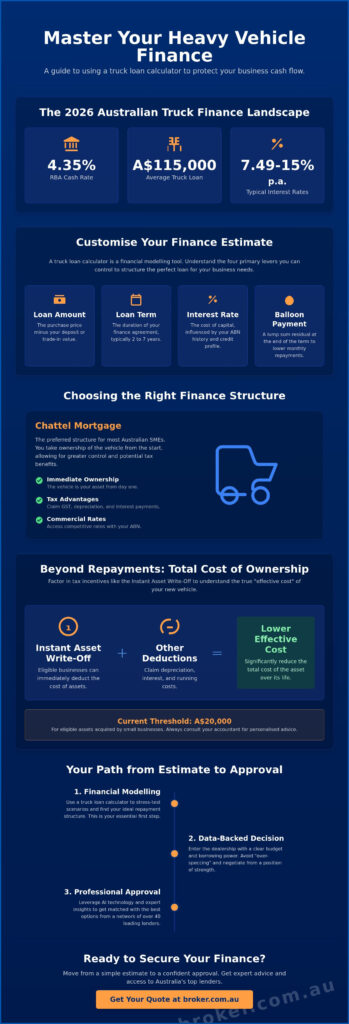
A truck loan calculator isn’t just a simple repayment estimator; it’s a sophisticated financial modelling tool that allows Australian business owners to stress-test their fleet expansion plans before committing to a contract. With the RBA cash rate currently at 4.35%, the cost of capital has become a primary consideration for logistics and construction firms. By inputting current 2026 interest rate benchmarks, which typically range from 7.49% to 15.00% p.a. depending on your credit profile, you can forecast monthly commitments with high precision. This foresight helps you organise cash flow around existing obligations, ensuring that a new asset remains a driver of growth rather than a drain on liquidity. While these figures are “rough estimates,” they serve as the essential first step in a professional procurement strategy. They move you from guesswork toward a data-backed decision that respects your bottom line.
Why Estimates Matter Before You Visit the Dealership
Walking onto a dealership floor without a clear budget is a recipe for “over-speccing.” With new full-size truck prices reaching up to A$163,950 for high-end models like the Ford F-150 Platinum, understanding your borrowing power is vital. A calculator lets you compare used vs. new truck finance costs in real-time. This is particularly relevant given that 64% of businesses applying for finance in 2026 are opting for used vehicles to maximise their ROI. By running the numbers first, you establish a realistic ceiling that keeps your fleet expansion sustainable. It also gives you the leverage to walk away from deals that don’t fit your pre-calculated financial framework.
The Math Behind Australian Heavy Vehicle Finance
The interaction between principal, interest, and term length determines your daily operational cost. Most Australian SMEs prefer a Chattel Mortgage structure because it allows for immediate ownership and potential tax advantages under current Australian tax law. Your ABN plays a critical role here. It grants you access to commercial-grade rates that are often more competitive than consumer finance options. Additionally, the percentage of business use you claim will influence your final calculation and tax deductibility. When you understand how these variables interact, you can structure a loan that balances lower monthly costs against the total interest paid over the life of the asset. This level of preparation is what separates a standard purchase from a strategic investment.
Key Inputs: How to Customise Your Truck Finance Estimates
Getting the most out of a truck loan calculator requires more than just moving sliders until the numbers look right. It’s about understanding the four primary levers that dictate your financial future. The loan amount is your starting point, representing the purchase price minus any deposit or trade-in value. The loan term is the duration of your commitment, while the interest rate is the cost of the capital itself. Finally, the balloon payment, or residual, is a lump sum left at the end of the term. Each of these inputs interacts to create a profile that lenders will use to assess your risk and suitability.
When you input your loan amount, remember that a larger deposit doesn’t just lower your monthly bill; it often unlocks more competitive interest rates. In the current 2026 market, where the average truck loan is approximately A$115,000, even a 10% deposit can significantly reduce the total interest paid over five years. You should also distinguish between “advertised” rates and “personalised” rates. Advertised rates are marketing tools for prime borrowers, but your actual rate will be tailored to your ABN history, credit score, and whether you’re purchasing a new model or a used vehicle from the 64% of buyers currently looking at the second-hand market.
The Strategic Use of Balloon Payments
A balloon payment is a powerful tool for managing immediate cash flow. By setting a 30% or 40% residual, you effectively defer a portion of the principal until the end of the loan, which can significantly lower your weekly or monthly overheads. This keeps more working capital in your business for fuel, wages, and maintenance. However, you must have an “end game” strategy. When the term concludes, you’ll need to refinance the balloon, pay it out from savings, or trade the truck in to cover the debt. While Australian regulations differ from the SBA 7(a) loan program found in the United States, the core principle of using structured debt to scale a small business remains a universal strategy for growth.
Choosing the Right Term Length for Your Asset
Matching your loan term to the operational life of the truck is essential for long-term fleet health. Heavy-duty trucks often suit a 5 to 7-year term, whereas light-duty delivery vehicles might be better suited to a 3-year cycle. The “sweet spot” for many Australian operators is a 5-year term. This duration usually offers a balance between manageable repayments and avoiding the point where maintenance costs start to outpace the value of the asset. If you’re ready to see how these variables look for your business, you can explore tailored finance structures that fit your specific fleet goals.
Strategic Comparison: Using the Calculator to Choose the Right Finance Structure
Selecting the right finance structure is just as critical as securing a competitive interest rate. A truck loan calculator allows you to toggle between different setups to see how they impact your cash flow and balance sheet in real-time. While most Australian SMEs gravitate toward a Chattel Mortgage for its ownership benefits, others find value in the flexibility of an operating lease. Understanding these differences before you sign helps you avoid costly restructuring down the track. It’s about finding a rhythm that suits your specific business cycle and long-term fleet goals.
GST plays a pivotal role in your initial calculation and subsequent tax filings. For instance, with a Chattel Mortgage, you can typically claim the entire GST amount on the truck’s purchase price in your next Business Activity Statement (BAS). This upfront cash injection can be used to reduce the loan principal or bolster your working capital for other operational needs. In contrast, Commercial Hire Purchase (CHP) has become less common in the current market. This is because the tax treatments for SMEs have shifted to favour the more direct ownership and depreciation benefits provided by the Chattel Mortgage model.
Chattel Mortgage: The Go-To for Australian Trucking
Most operators choose this structure because you own the asset from day one. The truck itself acts as the primary security; this usually means you won’t need to put up other business assets or personal property as collateral. Using your truck loan calculator, you can model how a GST refund might be applied as a “mid-term” lump sum payment. This strategy can significantly shorten your loan life and reduce the total interest paid. It’s a transparent path to full equity in your vehicle while keeping your balance sheet clean and professional.
Leasing and Rental Options for Fleet Flexibility
If your priority is maintaining a fresh fleet with the latest safety features without the hassle of asset disposal, an operating lease might be the answer. These are often considered “off-balance sheet” finance, which can improve your business’s debt-to-equity ratio when applying for other types of credit. You can use a calculator to compare these monthly lease costs against traditional loan repayments to see which one leaves more room in your budget. While you won’t own the truck at the end of the term, you gain the freedom to upgrade to a newer, more fuel-efficient model as soon as the lease expires. This keeps your fleet at the cutting edge of industry standards without the long-term debt commitment.
Beyond the Repayment: Factoring in Tax Benefits and Total Cost of Ownership
The monthly figure generated by a truck loan calculator is only the starting point for a savvy fleet manager. To see the true impact on your bottom line, you need to calculate the “effective cost” of the asset. This involves looking past the raw repayment and factoring in the significant tax offsets available to Australian businesses. For the 2025 to 2026 income year, eligible businesses with a turnover under A$10 million can immediately deduct the business portion of an asset costing less than A$20,000. For larger assets like heavy trucks, general depreciation and interest deductibility become your primary levers for reducing taxable income. By the time these deductions are applied, the actual cost to your business is often lower than the sticker price suggests.
Taking these numbers to your accountant is a vital step. They can use your calculator data to model how different depreciation schedules align with your loan term, ensuring you aren’t paying more tax than necessary in the first few years of ownership. Don’t forget that your total cost of ownership also includes “on-road” expenses. Insurance, registration, and the mandatory Safety Management System (SMS) required by the August 2026 HVNL reforms must be budgeted alongside your finance. If you want to see how these tax benefits apply to your specific situation, you can get started with a tailored quote today.
Maximising Your Tax Deductions
Claiming interest charges as a business expense is a standard move, but the real strategy lies in aligning your loan term with your depreciation schedule. If your truck loses value faster than you’re paying off the principal, you could find yourself in a negative equity position. Conversely, structuring the loan correctly can save your business thousands in the first financial year. This proactive approach turns a simple vehicle purchase into a strategic tax-management tool. It ensures that your cash flow remains healthy even as you grow your fleet.
Calculating ROI: Is the New Truck Paying for Itself?
ROI isn’t just about revenue; it’s about cost avoidance. A new truck might have a higher monthly repayment than a used one, but it often brings lower maintenance costs and better fuel efficiency. Use your truck loan calculator results to find the “break-even” point where the truck’s daily earnings exceed its daily operational cost. When the new vehicle allows you to take on a high-value route or replace a hire truck that was costing your business hundreds of dollars a day, the finance practically pays for itself. This clarity gives you the confidence to expand without overextending.
Moving from Estimate to Approval with Broker.com.au
Once you have used our truck loan calculator to narrow down your budget, the next step is moving from a digital estimate to a professional approval. While a calculator provides a vital baseline, the Australian lending landscape is nuanced. We use advanced AI technology to match your unique “calculator profile” against a panel of over 40 leading lenders. This ensures that the figures you see on your screen translate into a real-world finance offer that respects your business’s specific cash flow requirements. We don’t just provide a portal; we provide a pathway to growth.
Choosing an expert guide over a traditional bank gives you a distinct advantage. A bank is restricted to its own limited suite of products, which may not account for the complexities of heavy vehicle finance or the upcoming HVNL reforms. In contrast, we act as a high-level fixer. Our team provides inside access to competitive rates and flexible terms that aren’t advertised to the general public. This insider advantage is often the difference between a standard loan and a tailored finance structure that maximises your first-year tax position. Transitioning from a web estimate to a formal, no-obligation quote is a seamless process designed to leave you feeling confident and in good hands.
Our Seamless Application Process
We’ve designed our procurement journey to be as efficient as possible, allowing you to focus on running your business while we handle the heavy lifting. The process follows three simple steps:
- Step 1: Use our truck loan calculator to find your ideal repayment range and test different balloon payment scenarios.
- Step 2: Submit a low-pressure “I’m interested” enquiry through our website to start a conversation.
- Step 3: Our specialists, such as Matt or Kylie, will reach out to understand your goals and negotiate the best possible deal on your behalf.
Why We Are Best in Class for Asset Finance
Our award-winning service prioritises your business growth over bank profits. We understand that whether you’re adding a single delivery van or a fleet of prime movers, the finance must be sustainable. We pride ourselves on a can-do attitude, often securing approvals for complex situations that fall outside the norm of traditional lending. If you’re ready to move beyond the numbers and secure your fleet’s future, I’m interested in a tailored truck finance quote. We are here to ensure your next asset acquisition is professional, efficient, and perfectly aligned with your long-term vision.
Drive Your Business Forward with Confidence
Mastering the financial modelling of your fleet expansion starts with a truck loan calculator, but it doesn’t end there. You’ve seen how balancing loan terms and balloon payments can protect your cash flow while positioning your business to take advantage of tax incentives like depreciation. By moving beyond simple estimates, you can structure your debt to align with the upcoming August 2026 HVNL reforms and ensure every new asset is a profitable addition to your balance sheet.
As an award-winning AI-driven brokerage, Broker.com.au provides inside access to 40+ leading Australian lenders. We specialise in complex asset finance and fleet scaling, moving you from a state of uncertainty to streamlined confidence. Our expert guides are ready to help you navigate the Australian lending landscape with tailored solutions that a standard bank simply can’t match. If you’re ready to secure the best possible rates for your next heavy vehicle, I’m interested in a tailored truck finance quote. Your growth is our priority, and we’re here to ensure you’re in good hands every step of the way.
Frequently Asked Questions
How much can I borrow for a commercial truck loan?
You can typically borrow up to 100% of the truck’s purchase price, including GST, depending on your business’s financial strength and the asset’s value. While the average truck loan in 2026 sits around A$115,000, lenders can provide much higher amounts for prime movers or large fleets. Your borrowing capacity is determined by your serviceability; this is your ability to meet repayments while maintaining healthy working capital for your daily operations.
What is a balloon payment and how does it work in truck finance?
A balloon payment is a predetermined lump sum you pay at the end of your loan term to settle the remaining debt. By deferring a portion of the principal, usually between 20% and 40%, you can significantly lower your monthly repayments during the loan’s life. This structure helps you maintain better cash flow for immediate business needs. Once the term ends, you can choose to pay the amount, refinance it, or trade the vehicle in.
Does using a truck loan calculator affect my credit score?
Using a truck loan calculator on our website has no impact on your credit score whatsoever. It’s a risk-free financial modelling tool designed to help you explore different repayment scenarios before you make a formal enquiry. A “hard” credit check only occurs when you submit a formal application to a lender. We recommend using the calculator to establish a realistic budget first, ensuring you apply for a loan that fits your business’s capacity.
Can I get a truck loan with a new ABN or as a start-up?
Yes, you can secure finance with a new ABN, though options like “Low Doc” loans are often the most efficient path for start-ups. Lenders typically look for a minimum of 12 months of ABN registration and property ownership, but specialist lenders can assist newer businesses. While rates might be slightly higher than for established firms, these loans provide the essential capital needed to get your first vehicle on the road and start generating revenue.
What is the current average interest rate for truck loans in 2026?
As of June 2026, fixed interest rates for truck finance generally range from 7.49% to 15.00% p.a. Your specific rate depends on your credit history, the age of the truck, and whether you’re a prime borrower. For comparison, the RBA cash rate is currently 4.35%. We use our inside access to 40+ lenders to find the most competitive rate for your specific “calculator profile,” ensuring you don’t pay more than necessary for your fleet expansion.
What documents do I need for a formal truck loan application?
For a standard application, you’ll need your ABN details, recent bank statements, and identification like a driver’s licence. If you’re applying for a “Full Doc” loan to secure the lowest possible rates, you may also need to provide your latest tax returns and a Profit and Loss statement. Having these documents ready makes the process seamless and efficient, allowing our specialists to negotiate with lenders on your behalf without any unnecessary delays.
Can I include the cost of a trailer in my truck loan calculation?
You can certainly include the cost of a trailer in your total finance amount. Whether you’re purchasing a refrigerated van or a flatbed, asset finance covers the entire combination as a single package or separate components. Using a truck loan calculator to factor in the combined price helps you understand the total monthly commitment for your complete rig. This ensures your revenue projections are based on the full cost of the equipment required for the job.
Is it better to lease or buy a truck for my business?
The choice depends on whether you value long-term ownership or fleet flexibility. Buying via a Chattel Mortgage offers immediate ownership and potential tax benefits like depreciation; it’s the go-to choice for many Australian SMEs. Leasing provides an “off-balance sheet” solution that makes it easier to upgrade to newer, more fuel-efficient models every few years. We suggest comparing both structures to see which one best supports your business’s growth strategy and cash flow.